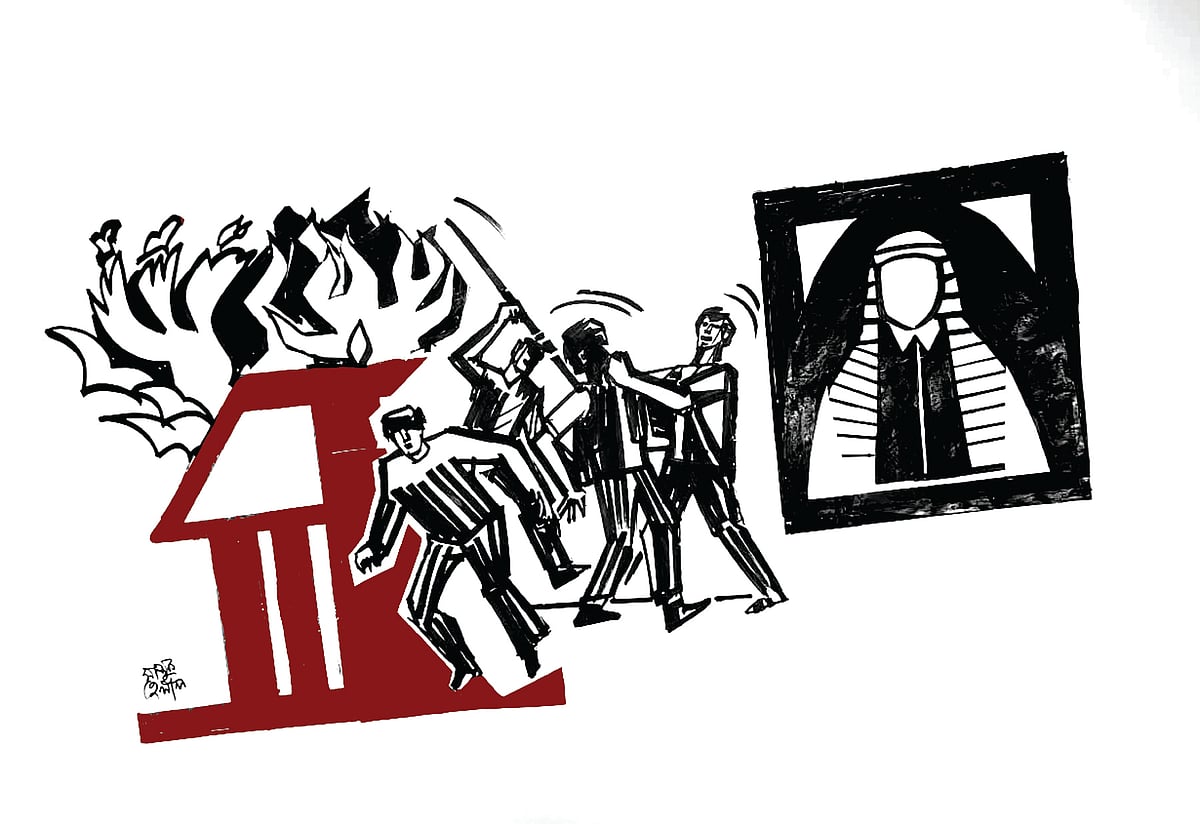
In Bangladesh's public life, the culture of 'mob' or the sudden organisation of the masses is a peculiar social reality. Sometimes it is the strength of protest, and at other times, a tool of blind revenge. This behaviour of the people reflects the inherent fear, anger, lack of justice, and vindictiveness in our society.
The power of the masses has always been significant in Bangladesh's history. During the Liberation War, the unity of the people was the strength for liberation. From rural farmers to urban workers, everyone came together for independence. At that time, the power of the people was positive. After independence, political instability, the weakness of the judicial system, and social inequality have manifested the anger of the people in the form of 'mob'. In the famine of 1974, the hungry masses attacked food warehouses.
Within the masses operates a kind of collective emotion that detaches an individual from their reasoning. The French physician, sociologist, and psychologist Gustave Le Bon, in his book 'The Crowd: A Study of the Popular Mind', stated that an individual's logic is lost within the crowd, where emotion prevails. Le Bon's concept has been used in both fascist and democratic movements. There is a psychological theory about this known as 'Deindividuation Theory'.
According to this theory, an individual loses their identity within the crowd. It is an important concept in social psychology, describing how an individual's personal identity, logic, and morality can weaken when they become part of a crowd. As a result, they may behave in a way that they would never do alone.
The components of this loss of individuality are: (a) Loss of identity: Within the crowd, an individual loses their distinct identity; (b) Dominance of emotion: Behaviour is controlled by emotion rather than logic; (c) Decreased sense of responsibility: In a crowd, individuals feel they are not solely responsible for their actions. In such a state, people become involved in vandalism, attacks, or violence. There are numerous examples like mobs hearing rumours that someone is a thief or snatcher and beating them to death; emotions getting carried away in political rallies leading to the destruction of cars or shops; spectators suddenly becoming violent at a sports venue.
One of the major reasons for the mob culture in Bangladesh is the lack of justice. The absence of justice and corruption forces the masses to take the law into their own hands. Rumours spread through social media or mass media organise mobs more rapidly. This culture exists similarly in both urban and rural settings. In Sarat Chandra Chattopadhyay's novel 'Palli Samaj', it's shown how village society's emotions can destroy an individual's life.
Sometimes Bangladesh's mob culture illuminates the path of protest, such as the power of the masses in mass movements. At other times, it burns innocent lives, as seen in murders based on rumours. Mob culture is like fire — it provides light but can also cause destruction.
The sudden organisation of the masses, taking the law into their own hands under the sway of emotion, or engaging in violence based on rumours have deep roots in our history. There are many examples of murders stemming from rumours. In 2019, many people were killed due to the 'child abductor' rumour. Mass hysteria is a common occurrence in political gatherings. In many cases, political rallies turn into riots. However, sudden public protest against social injustice is also notable. In the event of rape or murder, people take revenge outside the court. These incidents prove that if the power of the masses is not regulated, it can become terrifying.
To control mob culture, a strong judicial system, increased public awareness, media responsibility, and the creation of a rational society through education are necessary. The mob culture in Bangladesh exposes the internal wounds of our society. It is both terrifying and educational. If the power of the masses can be directed correctly, it can serve as a safeguard for democracy. But if it turns into blind revenge, it drives society towards destruction. The signs of this are already evident.
In Bangladesh's rural society, the tendency of the masses to organise based on rumours is very old. There have been several incidents where innocent people suspected of theft have been killed by villagers. The weakness of the justice system in society has compelled people to take the law into their own hands. This tendency is actually the initial form of mob culture. In Bangladesh, mob culture is like a river. During mass movements, it was a life-giving stream. But in times of lack of justice, it has become a flood that sweeps everything away.
When two groups or factions confront each other in an organised manner, resulting in a brawl, it is generally identified as political violence or conflict. It is part of party rivalry, the struggle for power, or exerting political influence. Mob violence occurs when the masses suddenly organise out of emotion, take the law into their own hands due to some rumour, anger, or instant excitement. Here, there is usually no organised political structure, rather the emotions of the people are the main driving force. On the other hand, conflicts with political opponents can be called 'organised violence' — where there are party flags, slogans, leadership. Mob violence, however, is the frenzy of the masses, where logic is lost, and emotion reigns. But in many instances, it is seen that political groups provoke the mob against their rivals.
There have been discussions for some time about 'pressure groups' versus mob violence. The pressure group theory emerged during the interim government period. In many cases, this theory was used to grant political legitimacy to mob culture. Those in favour of this theory are also a political faction. They believe their actions have social and political legitimacy. Can mob culture indeed be considered the work of pressure groups? Pressure groups apply organised pressure, while mob culture is uncontrollable violence. If a pressure group's movement loses control and is swept away by public emotion, it becomes mob violence. This kind of incident is happening frequently.
The manifestation of mob culture occurs in various ways. The arguments behind it are quite intriguing. For instance, the allegation of hurting religious sentiments. It is seen that the masses attack someone or a religious site over a Facebook post.
Recently, we have seen several examples of mob culture forming. A few individuals attacked an outlet of the publisher of the book 'The Unfinished Memoirs' by Sheikh Mujibur Rahman. This event stirred reactions in society. For some, the book is a historical document, while for others, it is a source of controversy. The mob took it beyond logic. Those seen in the pictures don’t seem like they've ever read a serious book. They couldn't even pronounce the book's name correctly. It’s understood that some vested or political interest fueled this incident.
A few days ago, journalists were attacked at Rajshahi University. Activists of a student organisation beat journalists. This is essentially a political conflict. The student organisation is a political faction. They felt their fellow journalists were writing against them. So, they decided to beat them up. When members of the student organisation become violent, its political character disappears, turning into mob violence.
#Mohiuddin Ahmad is writer and researcher
* Opinions expressed here are the author's own.
#The article, originally published in Prothom Alo print and online editions, has been rewritten in English by Rabiul Islam