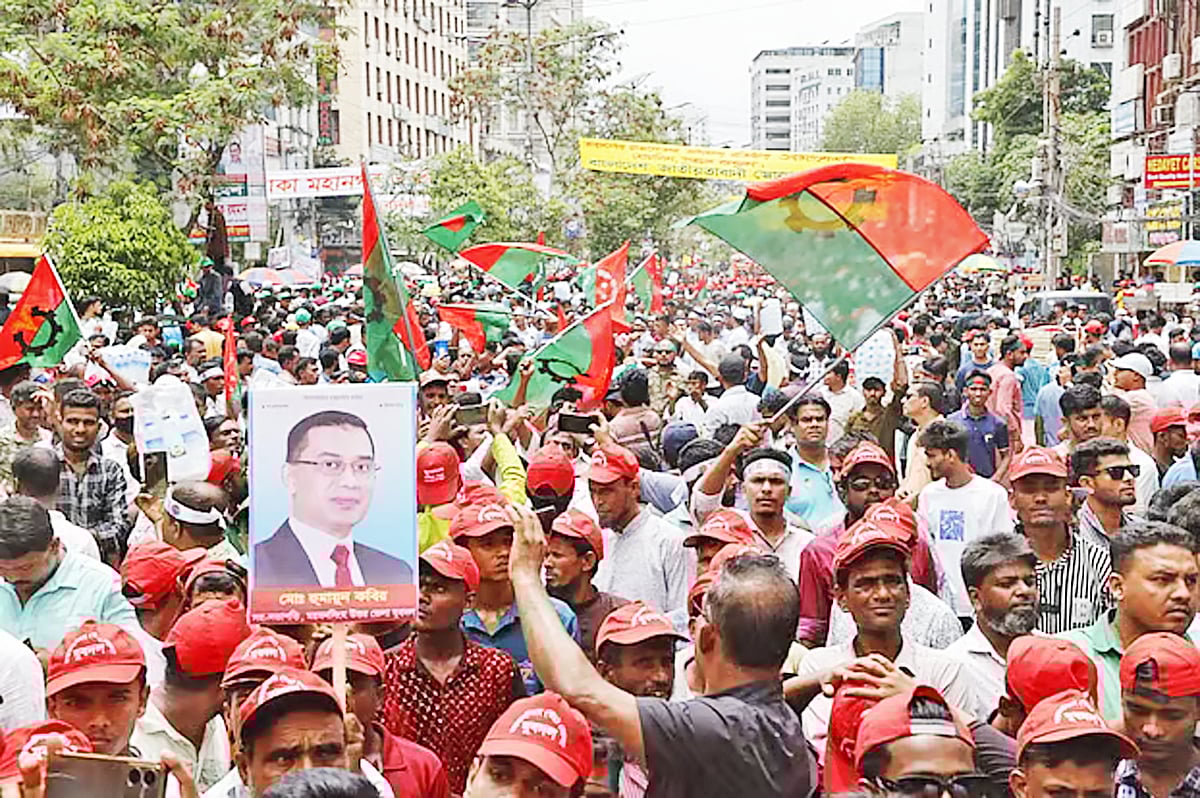
The postmortem—or detailed analysis—of the Dhaka University Central Students' Union (DUCSU) election is still ongoing. Political analysts have offered various interpretations of victory and defeat. For quite some time, DUCSU—and to some extent Rajshahi University Central Students' Union (RUCSU)—dominated newspaper headlines. Political parties have responded differently to the DUCSU results: some are embarrassed, while others are elated. Those on the losing side have been busy coming up with conspiracy theories to explain the defeat of their junior wings. Meanwhile, those who won are quietly smiling, refraining from overt celebration.
Journalists and observers have identified several reasons behind the Shibir victory in DUCSU. These include well-organised coaching programmes, polite and respectful behaviour of their candidates, long-term preparation, and engagement with students’ everyday problems. All of these may be true and are important for any educational institution. Yet, no one seems to be openly saying that they voted for Shibir because of its ideological alignment with Jamaat-e-Islami. That’s because this time, Shibir campaigned by downplaying or concealing its connection to Jamaat.
BNP: Right after the DUCSU election, I clearly wrote in a column: It wasn’t Jamaat-Shibir that won — it was BNP and Chhatra Dal that lost. This was a result of negative voting. That’s why the outcome varied so widely. I have already explained the reasons why students voted against BNP — no need to repeat them here. But those who claim that the DUCSU election was not about politics have likely not examined the history of DUCSU closely. The winners in DUCSU this time engaged in politics while hiding their political identities, often under different names. Some might call it underground politics — doing politics while denying it.
On the other hand, those who made their political affiliations known proudly imposed hall committees, often against the will of general students. The students, in turn, voted against these 'known' political forces. That’s why others won. This shows that DUCSU elections have always involved politics, but both sides have played it in different ways.
In short, Dhaka University students rejected BNP’s conventional political approach. However, that does not mean they endorsed Jamaat’s religion-based politics either. Perhaps this small conclusion from the DUCSU election carries significance for both major parties at the national level. BNP lost the DUCSU election not just because of Jamaat-Shibir’s strategy but also due to its own internal decline.
The fact that BNP’s weaknesses were exposed in the DUCSU election could, in one way, be positive — it gives them a chance to identify new paths for reform. But many will rightly ask: Does BNP have the willpower and organisational capacity to reform itself?
One thing might work in BNP’s favour: while students can change their political preferences quickly, the general public tends to take more time. So, it's unrealistic to assume that BNP’s support base will vanish overnight just because they lost DUCSU. Still, the warning signs are clear. The BNP leadership must now consider: When will the storm come, if at all? What precautions should be taken? When is it safe to lower the warning flag?
Jamaat: Meanwhile, a disciplined and energized Jamaat-e-Islami is now dreaming big. After the victory at Dhaka University, Jamaat is re-entering national politics with renewed confidence, trying to build a larger alliance. Historically, except for one election, Jamaat has never secured more than 5 per cent of the vote, even during BNP’s time in power. In Pakistan, Jamaat’s vote share also hovers around 5 per cent.
However, in the next national election—especially if the Awami League does not participate—Jamaat is expected to perform better than before. The party believes it would do even better if Bangladesh adopted a proportional representation (PR) electoral system. Still, many observers believe that if the Jatiya Party is allowed to contest freely, it may outperform Jamaat by attracting pro-Awami League votes.
That said, it’s also true that Jamaat has never had a better moment in the 55 years since Bangladesh’s independence than it has right now.
NCP: Since its inception, the Nationalist Citizen Party (NCP) has suffered from an identity crisis. The party itself seemed unsure — of its ideological stance, its political alignment, or whose politics it was actually following. There are also criticisms about the inexperience and carelessness of its young leaders. They tried to shape their political identity solely around the July Movement, but their failure to secure more than fourth place in the student elections at Dhaka University — the birthplace of that movement — signaled their derailment. As a result, the party’s relevance in national politics is expected to diminish, if it hasn't already.
NCP is now widely perceived as operating within the orbit of religion-based politics, having aligned repeatedly with Jamaat-e-Islami. For now, they seem to have taken a step back. It’s assumed that as electoral politics intensifies, NCP will begin searching for larger allies.
Another report suggests that National Citizen Party (NCP) and Gono Odhikar Parishad are in talks for a potential merger. Both parties are organisationally weak, and many are watching with interest to see which name will survive and who will lose the position of president in the merger.
Centrist politics is shrinking
Just before his death, political scientist and veteran politician Badruddin Umar remarked at a public gathering: “It is unfortunate that, given the current state of politics in Bangladesh, the BNP now appears to be the most progressive force.”
In Bangladesh today, progressive politics is nearly extinct, and centrist forces are shrinking by the day. It can now be said that BNP stands as the last hope for centrist and progressive politics — what in English would be called the “last line of defense.”
However, BNP is a hybrid party, ideologically muddled. Within it, one finds traces of Jamaat, Awami League, Muslim League, freedom fighters, and leftists — all coexisting. Though nationalism is BNP’s core slogan, today that term has lost much of its former glory. Nationalist parties have repeatedly used the idea of nationalism for narrow partisan ends, failing to build an inclusive, “big-tent” political platform.
BNP’s recent attempts to court Hefazat-e-Islam, a hardline religious group, could further undermine its claim to centrist politics. In the past, when BNP allied with parties like Jamaat, it didn’t have to compromise much ideologically. But political analysts believe that in the current climate, gaining Hefazat's support will likely come at a significant ideological cost.
If centrist politics continues to weaken, who will fill that space? The answer is simple: the right will. With the left virtually absent, religion-based parties have already begun signaling their intent to take over the vacuum.
BNP’s Secretary General Mirza Fakhrul Islam Alamgir himself acknowledged this trend, saying: “We are witnessing the rise of the far right in Bangladesh.”
Even acknowledging the centrist bloc’s internal weaknesses, it is still safe to say that a large majority of Bangladeshis continue to support centrist politics. The true test of this will come in the next national election.
Whoever is elected through democratic means should govern the country — whether it’s a centrist party, a right-wing group, a religion-based party, or a secular one. If Jamaat or Zaker Party were to win a majority and form a government, that outcome must be accepted by all. Without this mindset of acceptance, a democratic framework cannot be built — and if built, it will collapse.
What cannot be accepted is any party trying to impose its will or ideology on the entire population. The increasing, unnecessary controversy surrounding issues like Baul music, ghazals, shrines, music education, and women’s clothing is creating unrest in our society. These are matters of personal freedom, not subjects for any party's political platform.
Religious discord leading to unrest is not a new phenomenon. In Pakistan, anti-Ahmadiyya campaigns frequently result in deaths. Beautiful and resource-rich countries like Afghanistan, Libya, Syria, and Lebanon are being crippled by the internal strife caused by religion-based politics. The people of Bangladesh have every right to demand that such a fate does not befall them.
The peace-loving citizens of this country do not — and will not — support religious division and unrest. However, there is a valid fear: in a world of conflict, the voices and hopes of those who seek peace are often ignored.
*Saleh Uddin Ahmed is a writer, political analyst, and former member of DUCSU. salehpublic711@gmail.com
#The views expressed are the author's own.