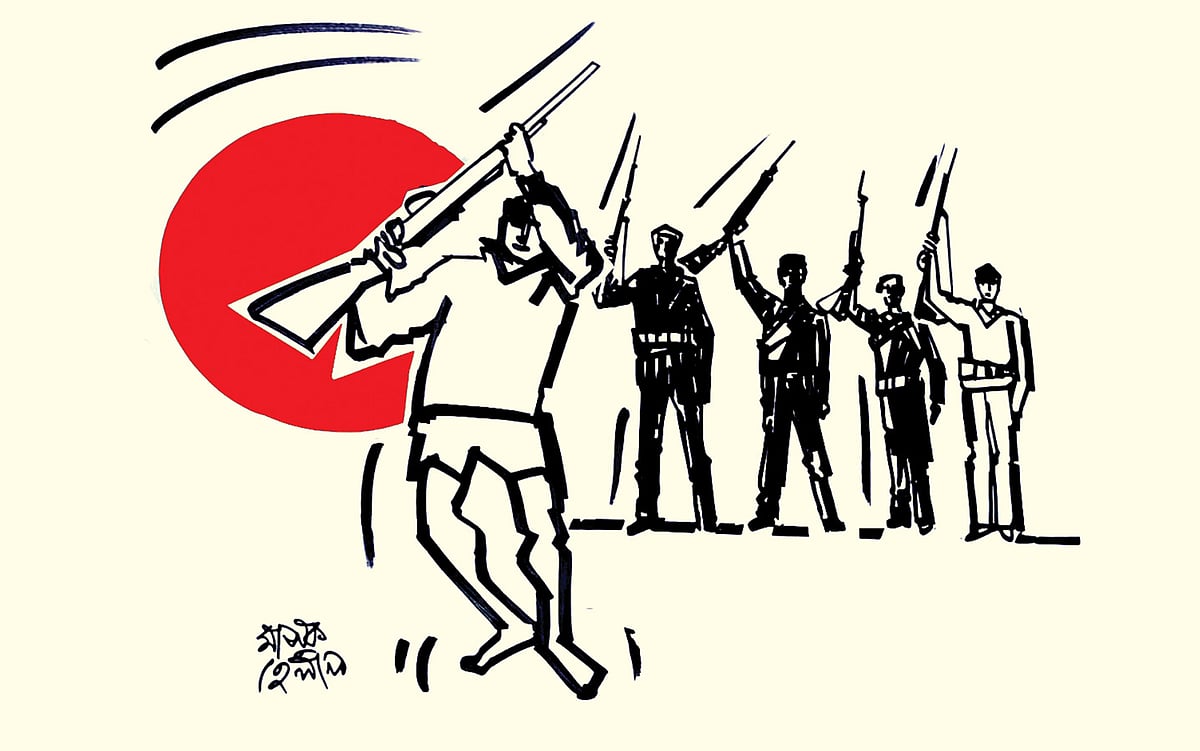
This year, the month of Victory has begun amid political uncertainty. The likelihood is that this uncertainty will increase rather than decrease, raising concerns and anxieties among the people about the future. Under such circumstances, there is little visible enthusiasm for Victory Day celebrations. The deterioration of Khaleda Zia’s health and the uncertainty surrounding Tarique Rahman’s return to the country have further complicated the situation. In this context, discussions during the month of Victory may also focus on the rise and consolidation of right-wing forces following the country’s regime change.
The difficult times for left-progressive forces are not new; they began after the July 24 uprising. In the early 1990s, the collapse of the Soviet Union further intensified the challenges faced by the major leftist parties. However, since the language movement, influential segments of the country’s artists, writers, intellectuals, professionals, and organised student, worker, and peasant groups have maintained a strong progressive-leftist consciousness. Their active involvement ensured that left-progressive trends were never absent from society; on the contrary, their influence in movements was significant.
Those who are pioneers of social change and social progress, though attempting to push and probe here and there, are not finding the companions and supporters they need. Even the architects of the revolutionary upheaval are unable to clearly define their future path or to inspire a forceful awakening and achieve unity. Yet people do not tolerate uncertainty and instability for long, and the state too cannot bear such weight indefinitely. Thus, elections have now become everyone’s primary focus. But what outcome can be expected from an election if the buds of new possibilities that emerged from the uprising fail to bloom?
During the 1960s, leftist movements were surging globally, and socialism was celebrated as an ideal in student movements and anti-colonial liberation struggles. In the global and historical context, Bangladesh’s Liberation War became a practical manifestation of this trend, although the ruling political party at the time, the Awami League, did not fully embrace or practice socialist ideals either during the war or after independence.
At that time, right-wing parties were struggling; the Muslim League could not remain in central government without military backing. While they had some influence in West Pakistan, the nationalist awakening in East Pakistan gradually led to a decisive conflict with the central government and unprecedented unity for the goal of independence. This movement aligned with left-progressive trends.
During the nine-month Liberation War, pro-Pakistan parties such as Jamaat-e-Islami, Nezam-e-Islam, and PDP opposed the war, supporting the occupying Pakistani government and armed forces. Although they were numerically small, they held positions of influence. Their support ultimately failed, and they were held accountable for treason in the newly independent country. Over the nine months, the Pakistani army and its collaborators carried out widespread massacres, and organisations like Al-Badr and Al-Shams systematically killed the country’s best sons, committing crimes against humanity. This marked the beginning of difficult times for these parties in independent Bangladesh.
2.
Although the people of Bangladesh have accepted and supported left-progressive politics, religious devotion has always been deep-rooted. Rather than pursuing in-depth study and understanding of scriptures, devout people have generally followed religious leaders and have also been drawn to informal spiritual guides such as pirs and dervishes. This is a long-standing cultural trait.
On the other hand, although secular education began in Bengal under the British, its adoption by the Muslim community took time due to various social realities. Moreover, because advanced, enlightened religious scholarship did not develop strongly, the overall expansion of reasoning and critical thought through knowledge was delayed or uneven. Society has not yet fully freed itself from superstition, blind faith, emotional impulses, and mass hysteria. Unfortunately, the weakness in rational inquiry and critical thinking persists.
Overall, the idealistic consciousness fostered during the Liberation War and the rational mindset expected to develop through left-progressive politics could not fully materialise. Consequently, the foundations of progress and achievements in Bangladesh’s socio-political and cultural spheres have remained weak, and in many cases, fragile.
Given this reality, preventing the strong rise of right-wing forces against the decline of the left-progressive movement has become visibly difficult. Furthermore, the fallen Awami League is now increasingly regarded as a major force within this right-leaning trend, and the inclusion of certain left or pseudo-left groups within its alliances has made the revival of genuine left-progressive politics even harder.
Another concern is the position of the BNP, currently seen by many as the largest party on the ground and the likely winner in the upcoming election. It is difficult to say with certainty how much room the BNP’s centrist politics will leave for left-progressive ideology. Although the party includes some centre-left groups and individuals, the strong presence of right-leaning elements and the uncertainty surrounding how its old relationship with Jamaat-e-Islami might reshape itself create an overall atmosphere of ambiguity.
Since independence, amid persistent political instability, the strength of right-wing—particularly religion-based—political parties has steadily grown at least since the 1980s. In response to this rise and in attempts to counterbalance it, both the BNP and the Awami League have increasingly used religion in politics, fostering and maintaining close ties with various religious groups and parties. Additionally, they have developed deep relationships with wealthy classes created through corrupt bureaucracy and plunder.
In such a reality, politics has shifted away from ideals and principles toward compromise with prevailing conditions to consolidate power. As a result, during their periods of governance, both parties failed to cultivate a society inclined toward intellectual reflection or to build an educational and political environment capable of nurturing critical thinking and new ideas. It must be acknowledged that both politics and socio-cultural values have experienced degradation during this time.
Against this backdrop, the revolutionary uprising of July 2024 took place, but the student-youth leadership at its centre could not assume a firm and clear political role. They were also unable to take any effective initiative toward organisational reconstruction or reform.
3
It is evident that although the anti-discrimination movement played a central role in bringing down the government, one of the key reasons for its fall was the public’s growing disinterest in this degraded, coercion-based politics. As the ruling Awami League clung to power, its political role and influence in society gradually diminished. Its strength became increasingly confined to state power—supported by sections of the bureaucracy, various forces, business groups, and elite classes of the wealthy. Such practices of power lose public support and inevitably rely on coercion and force, which in turn increase involvement in various forms of crime. Right-wing groups that used religion for political activism gained substantial influence over society.
Even within the student community, and among teachers, artists, writers, and intellectuals—who had long energised the left-leaning progressive tradition—the influence of the broader society has grown stronger. A significant portion of the educated population, nurtured by rote-learning, has become part of a society strengthened by conventional, accumulated ways of thinking. Though defiant youth can be found, the presence of inquisitive, science-minded young people is weak. As a result, protests have often ridden the tide of emotion—producing immediate impact—but it has become difficult to achieve lasting outcomes. Everyone understands that implementing the reforms proposed by the interim government will not be easy.
The uprising of ’24 has brought society to the threshold of a new possibility. Many viewpoints are being expressed, and from universities too, epistemic discussions are emerging on relevant issues and topics. But the society to which these ideas are being presented has long lacked enthusiasm for intellectual pursuit. For generations, people have grown up with their eyes closed to knowledge, relying on rote learning without reasoning. They lack the intellectual capacity and courage to question or challenge what is conventional, traditional, or prescribed.
Those who are pioneers of social change and social progress, though attempting to push and probe here and there, are not finding the companions and supporters they need. Even the architects of the revolutionary upheaval are unable to clearly define their future path or to inspire a forceful awakening and achieve unity. Yet people do not tolerate uncertainty and instability for long, and the state too cannot bear such weight indefinitely. Thus, elections have now become everyone’s primary focus. But what outcome can be expected from an election if the buds of new possibilities that emerged from the uprising fail to bloom?
*Abul Momen is poet, columnist and journalist
*The views expressed are the writer’s own.