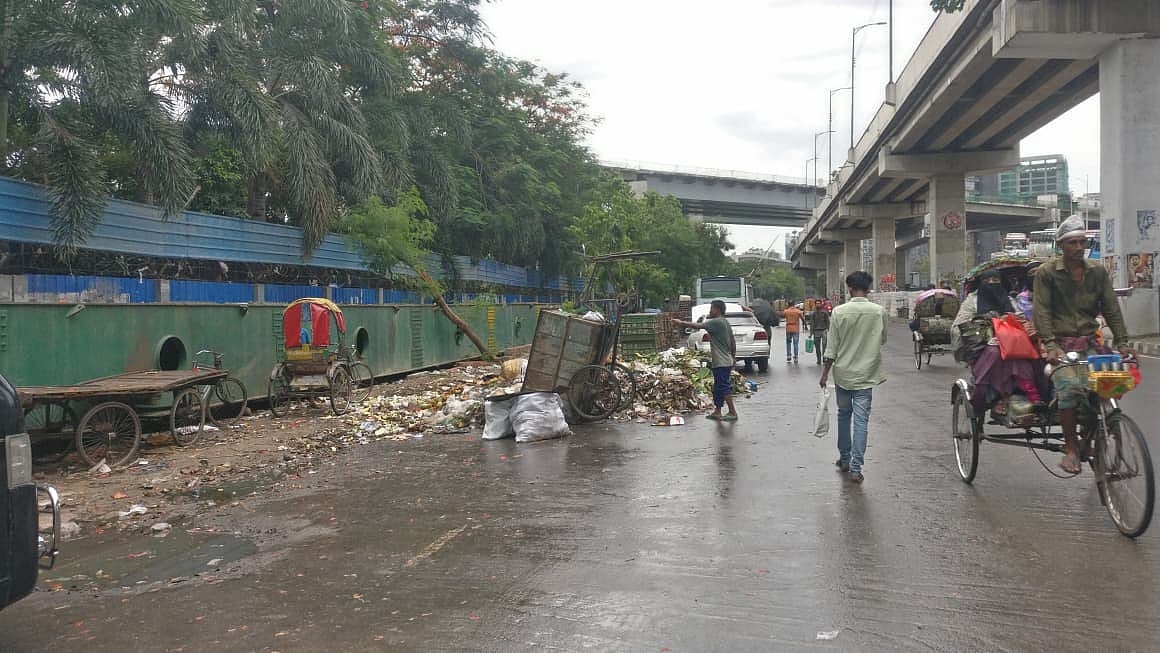
Everyday nearly 7000 tonnes of waste is generated in Dhaka city. But only a little of the waste is being recycled or reused. The rest ends up in drains, burning in open air or piling up in landfills.
In 2019–2020, the per capita waste generation in Dhaka was estimated at 0.72 kilograms per day, as reported in the Waste Management Report 2019–2020 by Dhaka South City Corporation. This figure reflects a rising trend over recent years—up from 0.65 kg per day in 2018–2019 and 0.575 kg per day in 2017–2018. Dhaka continues to significant challenges in managing its rapidly increasing waste generation. A key challenge is the limited access to proper waste disposal services, with only about 37 per cent of waste being collected in Dhaka.
Also, the city struggles with the inadequate collection and disposal infrastructure, limited landfill space, and a lack of effective recycling and composting systems. As a result, the mismanagement of these wastes is leading to environmental pollution and public health risks. However, this substantial volume of waste holds immense potential to drive Dhaka’s next economic transformation.
By adopting a circular economy model, the city not only can have the chance to solve its waste crisis but also can unlock new industries, green jobs, and inclusive economic growth.
Generally, a circular economy means an economic system focused on minimising waste and maximising resource efficiency by keeping materials in use for as long as possible through practices like reuse, repair, and recycling. Key pillars of a circular economy include waste prevention, resource efficiency, reuse and recycling, and innovation. In contrast, Dhaka currently operates under a linear economy model of "take-make-dispose," where resources are extracted, used once, and then discarded.
Transitioning to a circular economy, Dhaka city could unlock significant economic benefits, including creating new industries, reducing waste, and improving resource efficiency. This shift could also lead to job creation in informal sectors and enhance the city's sustainability. For example, textile waste from Bangladesh's garment industry could be recycled into new yarns and used in garment manufacturing, potentially creating a business opportunity. Also, high electricity demand presents an opportunity to generate energy from waste, reducing reliance on fossil fuels and creating a sustainable energy source.
Composting and biogas production can also be a promising solution. Organic waste can play a crucial role in enhancing urban agriculture and clean energy access in Dhaka city. By converting organic waste into nutrient-rich compost, urban farmers can improve soil health and crop yields. Meanwhile, biogas systems can transform waste into renewable energy, reducing reliance on fossil fuels and lowering greenhouse gas emissions.
An inspiring example of a successful circular economy approach to waste management can be found in Ljubljana, the capital of Slovenia. Once reliant on traditional waste disposal methods, Ljubljana became the first European capital to commit to a Zero Waste strategy in 2014.
Over the years, the city implemented a series of bold reforms through its public waste company, Snaga, focusing on door-to-door waste collection, composting, and strong public engagement. As a result, 68 per cent of municipal waste is now separately collected, and residual waste has dropped to just 115 kg per capita annually. The city also reduced the amount of waste sent to landfills by 95 per cent while maintaining some of the lowest household waste management costs in Europe.
By committing to Zero Waste Strategy in 2014 rejected incineration plans and instead embraced a model based on the 9R circular economy framework: Refuse, Rethink, Reduce, Reuse, Repair, Refurbish, Remanufacture, Repurpose, Recycle, and Recover. Its RCERO Ljubljana facility—one of the most advanced in the region—processes organic waste into biogas and compost, further reducing reliance on landfills and fossil fuels.
This integrated, circular approach has made Ljubljana a model city for urban waste innovation, offering valuable lessons for cities like Dhaka seeking sustainable, inclusive, and low-cost solutions to growing waste problems.
Dhaka's circular economy transition is hampered by weak enforcement of waste segregation, a lack of a coordinated roadmap, limited public-private partnerships in innovation, and low public awareness coupled with insufficient business incentives for sustainable practices.
Dhaka should adopt integrated policies—including strategic planning, innovation support, informal sector integration, infrastructure development, business incentives, public awareness campaigns, and stronger regulations—to transition to a circular economy, fostering sustainable resource management and economic growth.
Dhaka’s waste is not a burden—it’s a resource waiting for vision. By embracing circularity, we can create cleaner neighborhoods, better livelihoods, and a more resilient economy.
Let Dhaka lead South Asia’s urban transformation—where circular systems create not just less waste, but more opportunity.
Tanjila Marjahan is a Research Associate at Business Initiative Leading Development (BUILD).