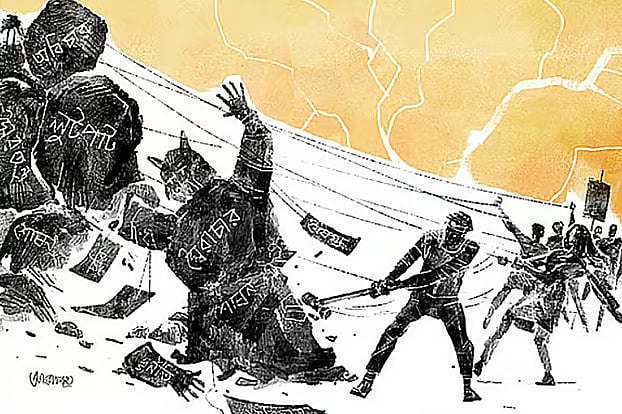
For the past 15 years, many people, political parties and organisations had been striving together to restore democracy and stand up against autocracy. As a result, in July and August 2024, students and the masses took to the streets against Sheikh Hasina’s rule.
This led to the fall of the Hasina government, forcing her and her party activists to flee the country. The change was not merely a shift in government -- it was a major victory for the courage, hope and democratic spirit of the people against a long period of fear and repression.
Over time, it became evident that certain groups and political parties began claiming the movement’s success solely in their own name. Some insisted that it was because of them that the government had fallen, and therefore they alone should be the sole stakeholders in power in the future.
At the same time, some religious or ideological groups, which had not been openly active before, sought to use the movement to strengthen their position. In addition, a few new parties, previously little known in politics, suddenly emerged on the scene. Presenting themselves as a “new force” or a “different kind of party,” they have displayed the very tactics of the old politics.
During the movement, various groups stood together, but after it ended, they became divided while trying to determine their own positions. Some even began engaging in power equations among themselves. As a result, the core spirit of the movement, that is, people’s rights, democracy, and freedom of expression, seems to have gradually receded into the background.
This reality raises the question of will those who once took to the streets against fascism, upon coming to power in the future, give birth to a new form of autocracy?
World history and Bangladesh's experience
It has been seen time and again in history that those who lead a mass uprising and come to power with people's hopes and expectations, often themselves become fascists. They initially emerge as saviours, but later use that popularity to destroy democracy and suppress freedom of expression.
For example, Robert Mugabe of Zimbabwe was a hero of the country’s liberation war. In the early years of his rule, there was progress in education, but later he suppressed opposition parties, seized farmers’ land, and plunged the country into a severe economic crisis.
Hugo Chavez of Venezuela came to power with overwhelming support by speaking on behalf of the poor. However, he later began to control the media and political opposition. After his death, his successor Nicolas Maduro imposed an even harsher rule, using the military to suppress opponents and facing international criticism for human rights violations.
In Uganda, Yoweri Museveni was once a leader of the country’s liberation struggle who came to power promising to restore democracy for the people. But he has now remained in power for nearly four decades, suppressing the opposition and undermining the credibility of the electoral system.
Meles Zenawi of Ethiopia was likewise a leader of the national liberation movement. But once in power, he established one-party rule, initiated wars with various countries, and restricted freedom of expression.
This reality is evident not only abroad but also in the history of Bangladesh. In the 1960s, Sheikh Mujibur Rahman emerged as a leader of a powerful mass movement of students and youth against Pakistan’s repressive policies. The education movement of 1962, the Six-Point Programme of 1966 and the mass uprising of 1969 all saw massive participation from the student community. When he was imprisoned in the Agartala Conspiracy Case, students and general people organised protests demanding his release. In this struggle, Maulana Bhasani’s significant role remains memorable in history.
His unprecedented victory in the 1970 elections and his leadership in the 1971 Liberation War established him as “Bangabandhu.” Yet after independence, his rule began to show propensities towards absolute power. He came to believe only his leadership was beyond question in this country.
In 1975, he formed BAKSAL and abolished all political parties, shut down newspapers and shut down all space for dissent. Thus, despite rising to power through a mass movement, he chose the path of authoritarian rule.
Another important point is that the participation of students and youth during the Liberation War was marked by extraordinary courage.
However, in the post-war period, a section of those student leaders (especially those connected with the Mujib Bahini) began to think that since they had fought in the Liberation War, they alone had the legitimate right to build the new state. Some among them, in the name of socialism, put pressure on Sheikh Mujibur Rahman and, claiming themselves to be the “vanguard of the revolution,” became involved in violent and extremist politics.
JSD activists and supporters tried to press their political demands through armed movements. As a result, the combination of Sheikh Mujib’s misrule on the one hand, and the violent face of student extremism in the name of JSD on the other, plunged the country into disorder, despair and the breakdown of state stability.
These examples and experiences show that no matter how noble the ideals of a mass movement may be, once in power, its leaders can turn authoritarian due to their own state of mind, the sycophantic environment around them and a sense of “moral superiority.”
Why leaders’ mindsets change
According to researchers and political thinkers, some leaders who come to power through mass movements undergo a significant mental shift. They start to see themselves as the “liberators of the people.”
Hannah Arendt, in her book 'The Origins of Totalitarianism', showed how Nazi Germany and Stalin’s Soviet Union, though based on different ideologies, both transformed into equally repressive regimes.
These two examples illustrate that after a revolution, many of those who come to power gradually begin to see all dissent as a threat. They then surround themselves only with people who agree with them, suppress their opponents and create a system in which people no longer have the space to speak or ask questions. Eventually, instead of democracy, they establish a form of rule in which one person or one group controls everything.
Many writers and analysts have shown that when a party leading a movement comes to power, or remains active in politics for a long time, it often begins to see itself as being beyond all question. They start believing that they alone are right, and that they are the only moral representatives of the nation.
Indian writer and human rights activist Arundhati Roy has said that parties close to power gradually lose tolerance and seek to impose their own beliefs on everyone else. From such thinking, leaders transform from “ordinary people” into “sacred rulers”, a point from which fascism begins.
In 1971, American psychologist Philip Zimbardo conducted a famous study known as the 'Stanford Prison Experiment'. In it, some students were assigned the role of “prisoners” and others of “guards.” Within just a few days, those who were “guards” began behaving cruelly and without empathy, simply because they held power. Zimbardo showed that when ordinary individuals are suddenly placed in positions of authority, they psychologically start seeing themselves as superior and gradually lose empathy for others.
The background of Bangladesh’s politics shows that it is not only old parties or ruling groups but also anyone who claims to be the ‘voice of the people’-- invoking moral superiority, righteous governance, or a vision of an egalitarian society -- who can bring back authoritarianism.
Movies and literature have also repeatedly depicted how individuals or groups that start out with constructive intentions can slowly turn authoritarian. One example is the German film 'The Wave' (2008). It shows how a teacher, in a classroom experiment, forms a group with his students bound by strict rules. At first everything seems fine, but soon the group’s members begin to act as though they are better than everyone else, suppressing those who hold different views.
A similar scenario is depicted in George Orwell’s 'Animal Farm' (1945), where the animals drive out the humans and establish their own rule. But after some time, it becomes clear that they themselves have turned into oppressors like the humans. The story says, “All animals are equal, but some are more equal than others.” This illustrates how, once in power, some begin to see themselves as above everyone else.
Explaining this mindset, psychologist Erich Fromm writes in his book 'Escape from Freedom' (1941) that even when people gain freedom, they often conceal within themselves a desire for control. In search of security and leadership, people rely on someone who seeks to keep everything under forceful control. In this way, a dictatorial attitude can one day grow from within ordinary people themselves.
Who will be the future dictator?
Answering this question is difficult right now. Because the background of Bangladesh’s politics shows that it is not only old parties or ruling groups but also anyone who claims to be the ‘voice of the people’-- invoking moral superiority, righteous governance, or a vision of an egalitarian society -- who can bring back authoritarianism.
Take BNP as an example. Even though it came to power through a mass movement in 1991, the party has made many political mistakes. It is not free from accusations of vote-rigging and repression. However, from the perspective of political structure, BNP’s ideological framework shows a comparatively weaker tendency toward “absolute authoritarian rule.” From the start, the party has built its image around economic and social development, which is reflected in the 19-point program formulated by Ziaur Rahman.
Besides, BNP secretary general Mirza Fakhrul Islam Alamgir has admitted several times that many injustices and mistakes occurred during BNP’s rule. Compared to many other political parties, many BNP supporters also do not hesitate to criticise their own leadership on social media. Though this cannot be called perfect democracy, it does represent a somewhat different example compared to personality-driven politics.
We still cannot say for sure who the next ruler will be. However, it can be said that to preserve democratic ideals, whichever party comes to power must maintain tolerance, transparency and accountability to the people, otherwise, whether new or old, any party can turn authoritarian.
* Mohammad Jalal Uddin Sikder is teacher and researcher, Department of Political Science and Sociology, North South University
* The opinions are the author’s own