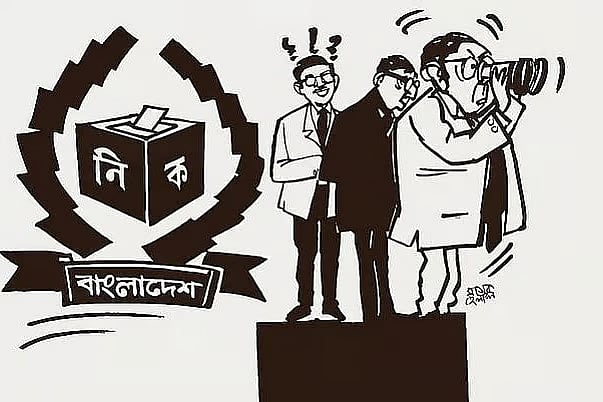
We are moving towards a national election after a long time. There is endless interest and enthusiasm among the general public regarding this matter, and there are also various speculations and discussions on what the nature of the post-election government will be. The idea of a national government is one such topic.
It is to be noted here that the Jamaat-e-Islami is talking about forming a national government after the election. Meanwhile, the BNP is discussing forming a government with their allies, with whom they are contesting the election through seat arrangements. The resolution of these issues, I believe, will be determined after the election. However, it is crucial to have an in-depth discussion on how logical the concept of a national government is in the context of Bangladesh. Engaging in this conversation without thoroughly analysing this concept could be harmful to our democracy.
A national government is a consensus-based government in which opposition parties generally become part of the government. As a result, there is no opposition, and everyone pledges to work towards a political goal. Although the idea of a national government sounds appealing from this standpoint, its implementation after the election could be contradictory to the democratic system.
The renowned political scientist Robert Dahl in his book "Polyarchy: Participation and Opposition" states that an ideal democratic practice requires a multi-party system where citizens can participate in the political space through a free and inclusive process. However, the concept of a national government functions differently, where multi-party participation effectively merges into a single government system, which in no way represents an ideal democratic system.
If we examine the experiences of national governments on an international scale, we find that during periods of civil war, when the fundamental structure of the state is at risk, and under violent circumstances, a national government can establish a stable environment temporarily. Still, in a normal democratic context, it overlooks public opinion and opposition politics, and there is also a risk of increased religious and social divisions. Therefore, a national government is not seen as part of normal democratic practice but rather as an exception.
Recently, discussions have arisen about the national government in Bangladesh's politics. First and foremost, we need to understand what kind of impact the idea of a national government might have on us.
The first important issue here is that even though political parties become part of the national government, when the desire arises among them to implement their own political commitments or party interests, the implementation of national interest-inclusive priorities becomes problematic and can become entangled in delays. As a result, the policy-making process becomes more protracted and problematic, effectively becoming a significant obstacle to national decision-making, leading to divisive politics among political parties.
The greater concern here is if this division spreads into society. Then, political party-centric divisions might increase among people. The vested interests associated with political party supporters can divide the political parties nationally and their supporters, potentially culminating in political violence. In this way, we may become more socially divided.
We also need to be particularly cautious regarding the risk of religious-based divisions, as efforts to use religion politically have intensified so much that some groups are promoting voting as a means to attain paradise. Therefore, there is no room for doubt that efforts to use religion for political purposes may increase further.
Additionally, if a national government is used merely as a strategic process for political power-sharing and improving interrelations among political parties, then fundamental democratic features such as freedom of expression and media independence, the rule of law—which, without these, democracy can turn into a tyrannical rule of the majority—accountability and transparency, the rights of opposition politics, civic participation, free elections, an independent election commission, and judiciary, etc., will become even more compromised.
Since a national government is formed based on consensus among political parties, there is no concept of an opposition party. Hence, all political parties become part of the government, and in the absence of an opposition party, the development of a one-sided government can occur, through which the concentrated circle of power of a national government may undermine the fundamental conditions of modern democracy.
Thus, such an opposition-less government establishes itself as a risky system for the development of democracy. When the opposition party no longer remains an opposition, counter-narratives or alternative discourses in the street, parliament, and public sphere weaken, and the alternative space for power gradually diminishes, creating significant opportunities for the emergence of an authoritarian government.
Due to the absence of opposition politics, there is no alternative political platform available to the public. Consequently, people have to experience political isolation, limiting their participation in the state system and gradually distancing them from the government.
In these processes, when electoral fairness is undermined, a gap of trust, reliance, and belief forms between the government and the people. In this way, public participation in the state space diminishes. At a time when we see a desire for a democratic revival among people, where people are looking toward the moral path of democracy with the determination to build a new Bangladesh, if the concept of a national government leads us to more division at such a time, it will be a matter of disappointment for us. This could transform public enthusiasm around elections and democracy into resentment once again.
In conclusion, it can be said that forming a national government in a country like Bangladesh, with weak institutions and a desire for centralised power, is not a democratic solution but rather could push democracy to a more precarious position. What we need now is an effective parliament, where there will be a strong opposition party, and political parties will transform our country's organisational form through debate and discussion.
What we need is a parliamentary system that advances the institutional transformation and reform of fundamental democratic matters. In this way, state institutions will become stronger, and the politics of centralized power will cease permanently. Through this, we will gradually expedite the desired reform process and move forward in building a stable, inclusive, and humane country. Therefore, it can be said that rather than a national government, what Bangladesh needs more is free elections, a strong opposition party, accountable institutions, and effective reforms.
#Bulbul Siddiqui is Professor, Department of Political Science and Sociology, North South University
*The opinions are solely those of the author.
#This article, originally published in Prothom Alo online edition, has been rewritten in English by Rabiul Islam