AKM Zakaria's column
How should we view the cabinet reshuffle and new appointments?
At the first Cabinet meeting, Prime Minister Tarique Rahman had instructed each ministry to submit a 180-day action plan. We can assume that he regarded six months as a period for assessing the ministries’ performance and efficiency.
The BNP government has completed six months. We do not know the outcome of any assessment of the performance of the ministries or ministers, nor do we know how the Prime Minister conducted such an assessment, or whether he conducted one at all. However, at the six-month mark, we saw changes in the Cabinet.
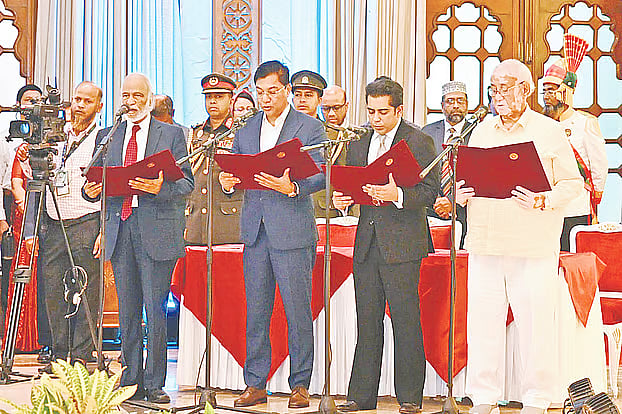
In reality, this is less a more or an expansion rather than reshuffle of the Cabinet. The Prime Minister has appointed four new ministers and two state ministers. The responsibilities of one ministry have been changed. One minister has been removed from his post and made an adviser to the Prime Minister.
As a result, the size of the Cabinet has increased. The number of Cabinet members now stands at 51. In addition, there are 13 advisers and special assistants holding the rank of minister or state minister. Altogether, that makes 64. This is the second-largest Cabinet in Bangladesh’s history. During the Awami League government after 2008, the Cabinet at one point grew to 70 members.
The question is, how should we view the Cabinet reshuffle and the appointment of new ministers and state ministers six months into the government’s tenure? Since the Prime Minister had asked the ministries to prepare 180-day action plans, many of us assumed that once this period had elapsed, there would be a performance-based evaluation followed by a reshuffle. But what has actually happened is the appointment of new ministers. Even in the two cases where changes were made, it remains a major question whether they were based on any particular consideration or on performance.
We have seen the minister in charge of the Ministry of Civil Aviation and Tourism removed from that portfolio and given responsibility for the Ministry of Food. At the same time, the state minister who had been serving under her has been elevated to a full minister. Does this change reflect an assessment that the minister failed in discharging his responsibilities or that the state minister performed successfully? Or was the redistribution of responsibilities made for some other reason? If it was based on performance, on which indicators was the former minister’s performance deemed inadequate? And how was his suitability for the new portfolio assessed?
The same questions arise in the case of the Ministry of Information. The minister was removed from the Cabinet and appointed as an adviser to the Prime Minister with ministerial rank. Should this be considered a promotion, or was he effectively removed from the ministry? If his performance was good, why was he not retained in charge of the ministry? And if his performance was not good, why was he appointed as the Prime Minister’s political adviser with the same rank?
Who remains in the Cabinet and who does not, or who is assigned responsibility for which ministry, falls within the Prime Minister’s constitutional and political prerogative. Nor is the Prime Minister obliged to explain why he has made changes or reshuffled the Cabinet. However, when the government itself has indicated that performance would be evaluated after six months, the public will naturally want to connect that evaluation with the changes in the Cabinet. Here, we have not seen any clear message or position from the government. As a result, we have to regard the changes simply as an expansion or reconfiguration of the Cabinet.
However, assessing how individual ministers have performed is not an easy task. A minister’s success cannot be measured simply by how many projects they approved, how many meetings they held, where they went, or what they said. Research in government and political science discusses various approaches and methods for evaluating ministerial performance. In general, the assessment takes several factors into account.
These include how successfully the ministry has achieved its objectives; how quickly decisions were made and the quality of those decisions; the ministry’s level of administrative efficiency; how effectively public funds were used and whether there were any allegations of irregularities; whether citizens are satisfied with the services provided by the ministry; and whether the minister is properly able to answer for the ministry’s work and remain accountable to Parliament.
Beyond these, another important consideration is whether a minister’s actions, conduct, or statements are damaging the government’s image. This is because a minister’s mistake or inappropriate remarks are not viewed merely as an individual’s error; the responsibility ultimately falls on the government. In fact, evaluating a minister’s performance is not limited simply to whether the work gets done. Leadership qualities, the ability to build public trust, and the capacity to manage controversies are also part of the equation.
We have seen controversies emerge over the actions and statements of several ministers over the past six months. Some decisions and statements had to be withdrawn. In some cases, the Prime Minister himself had to intervene. There have also been allegations of irregularities, corruption, and nepotism in certain instances.
At the first Cabinet meeting, the new government identified three priorities: controlling the prices of essential commodities, improving the law-and-order situation, and restoring a normal supply of electricity and fuel. It is clear that the government has not succeeded in these three areas. However, six months is not a very long time. A new government has to start many things from scratch. It has to organise and streamline the administration. It also has to address problems inherited from the previous government. Therefore, it is only natural that not all promises will be fulfilled within six months.
However, six months is enough time to understand the government’s style of functioning and overall direction. During this period, it was important to take stock of where the government had performed well, where it had fallen short, and which ministries had failed to meet expectations. If this assessment had been reflected in the Cabinet reshuffle, the public would have seen it as evidence of the government’s sincerity and proactiveness. Of course, newspaper reports suggest that these Cabinet changes may not be the final word, and that further reshuffles could be on the way.
Questions have also been raised about the size of the Cabinet. Having a minister, a state minister, and an adviser overseeing the same ministry can sometimes delay decision-making. It can also lead to a lack of coordination. For this reason, experts in government and political science advocate a smaller, more effective, and more efficient Cabinet. The Public Administration Reform Commission formed during the interim government had also proposed a Cabinet of 35 members, including ministers and state ministers.
It appears that not all ministers are able or willing to properly follow the political culture that the Prime Minister himself is trying to promote
We know that a political government has various considerations to take into account. The BNP had been out of power for a long time. During the Awami League’s rule, many of the party’s leaders were subjected to repression and persecution. Many played active roles in anti-government movements and made significant sacrifices. The Cabinet has perhaps become so large in an effort to ensure recognition, rewards, or compensation for those contributions. But the government’s foremost consideration should be effective governance and efficiency.
Another challenge posed by a large Cabinet is the difficulty of effectively managing such a large number of ministers, supervising their work, and ensuring accountability. Moreover, it appears that not all ministers are able or willing to properly follow the political culture that the Prime Minister himself is trying to promote.
The gap in this regard is clear. In a parliamentary system of government, the Prime Minister’s image is not the only thing that matters. He runs the government through the Cabinet, and he must also bear responsibility for the performance of its members.
* AKM Zakaria is Deputy Editor, Prothom Alo
* The views expressed here are the author’s own.
* This article appeared in Prothom Alo online and print and has been translated by Ayesha Kabir for Prothom Alo English Online