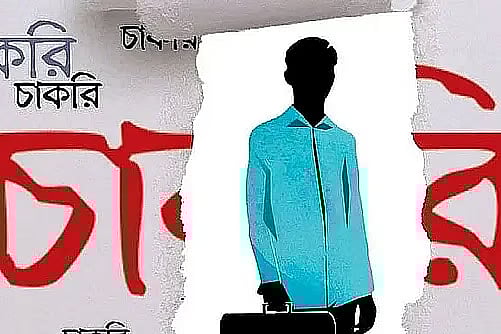
When a child is born, their fate seems to be written by society immediately. The first blessing or expectation placed on them is to "get a big job." The definition of this big job has changed over time. Sometimes it is a doctor, sometimes an engineer, or a lucrative post in a multinational company. Recently, government jobs or the BCS have become the centre of this dream. But surprisingly, very few parents say, "My child will create something new, provide jobs for ten people, will be an innovator."
We live in a strange socio-economic reality. Here, the only measure of a successful life is a secure job. And the only ticket to that dream job is a shiny certificate. An endless rat race starts from childhood just to get this piece of paper. It is natural to ask, in this relentless competition, are we just producing loyal servants and employees? Are we forever losing the courage to think differently, create something new, and take risks outside the box?
What should have been the main purpose of education? It should have been developing the mind, building a deep desire to know the unknown, and finding new solutions to the problems around us. But our education system has slowly turned into a mechanical factory. Millions of graduates are coming out of this factory every year. They hold precious paper certificates, but they have almost no practical knowledge or depth of thought.
From primary school to university, the entire academic life revolves around the terrible rat race of GPA-5 and CGPA. Memorising everything to get the highest marks is the only standard of merit here. A student quickly realises something. They see that memorising guidebooks or teachers' notes gets them more marks than independent and creative thinking. Naturally, they withdraw from the world of imagination.
Through this process, we are constantly killing our students' courage to ask questions. Curiosity is a natural human instinct. But instead of satisfying that curiosity, our classrooms strangle it. This certificate-centric education system programs the brains of our youth. They become afraid to think beyond a specific syllabus. They learn how to pass exams, but they do not learn how to solve real-life or social problems.
The Bengali word 'chakri' (job) comes from 'chakor' (servant). If we look at history, the British did not want to create a scientific or innovative nation. They needed a group of loyal clerks. These clerks would understand English, keep accounts, and obey the British masters without question. We live in an independent country now. But we still carry the colonial burden of the education system planted by Lord Macaulay. Our education system is still producing those same loyal employees.
If we look at today’s universities, a deeply frustrating picture emerges. Youth is the time for the madness of doing something new. This is the age to stay in laboratories and research new technologies. Instead, they sit in libraries memorising general knowledge books. From the very first or second year, students put aside their academic studies. They start swallowing guidebooks for BCS or government jobs.
A young person was supposed to research artificial intelligence, bring a technological revolution in agriculture, or build a startup. Instead, they spend days memorising which ancient king sat on the throne or where a river originates. This brain drain is not just happening abroad. A massive waste of talent is happening right here inside the country.
Why is everyone running blindly in this competition? The main reason is the illusion of security and social status. Economic uncertainty is very high in our country. A government job means a guaranteed life, a fixed monthly salary, the power of the chair, and the security of a pension. In the eyes of society, a government employee is the ultimate symbol of success. They have the highest demand in the marriage market. Their respect among relatives is sky-high.
The youth sacrifice all their creativity, dreams, and courage to take risks just for this secure life and social pressure. Innovation never comes without risks. Those who brought groundbreaking changes to the world did not succeed on their first try. They failed repeatedly, walked off the beaten path, and endured people's taunts. But our social structure treats failure as a severe crime.
When a young person finishes their studies and tries to do something different, the biggest obstacle is their own family and society. A large part of our society still views the word "entrepreneur" as a fancy name for unemployment. If someone wants to start a small business, a farm, or a tech startup, sarcastic comments fly from all sides. They say, "After studying for so many years and spending so much money, you are doing this? You could have just taken a small job!"
The state and policymakers must step forward to create an entrepreneur-friendly ecosystem. We must ensure easy access to venture capital or investments for the youth. Licensing and legal processes for starting new businesses must be simplified
Fearing this social harassment or "what people will say," many destroy their brilliant ideas right at the beginning. Our society has given birth to a mindset where even a successful thief or a corrupt person gets respect if they hold a high position. But an honest, struggling young entrepreneur faces insults at every step.
Alongside this, there are structural weaknesses in the state. Starting something new means facing bureaucratic hurdles at every step. Banks do not want to give loans to new ideas or young entrepreneurs. They want real estate or guarantees. Lack of capital, zero sponsorship, and corruption frustrate the youth at every turn.
As a result, the boy or girl who could have been Bangladesh's next big innovator or the founder of a global company eventually gives up under social pressure. They pack their dreams in a box. They lose themselves under piles of files at a corporate desk or a government bureaucrat's chair. We are only creating followers, not innovators or leaders.
There is no magic spell to overcome this suffocating, talent-destroying situation overnight. It requires a massive mental and structural change. First, the change must start with the family. Parents must understand that not all children are made from the same mold. Everyone's talent, interest, and ability are different.
The definition of success cannot just be a fat salary and job security. If a child wants to work in art, literature, agriculture, freelancing, technology, or their own business, they should be supported, not stopped. We must learn to celebrate failure. We need to teach our children that stumbling once does not mean life is over. Rather, it is an opportunity to learn anew.
Second, the education system must be completely overhauled. We must stop the blind race for GPA-5. We need to focus on practical and skill-based education. Educational institutions must increase students' analytical and problem-solving skills instead of rote learning. Universities should become laboratories and idea-generation hubs, not just printing presses for certificates. Here, students will get the chance to turn their ideas into reality.
Third, the state and policymakers must step forward to create an entrepreneur-friendly ecosystem. We must ensure easy access to venture capital or investments for the youth. Licensing and legal processes for starting new businesses must be simplified. If a startup fails, the social and state safety net must ensure the young person gets a chance to stand up again.
Above all, we need to change the definition of heroes or idols in our society. We should not only praise those who stand first in exams or get big government jobs. The boy who set up a small factory through his own efforts, the girl who created jobs for ten women—they must be highlighted in the media and in society.
If we want to face the challenges of the 21st century and stand tall in the world, we must get out of this certificate rat race immediately. We must gain the courage to dream of creating something new and becoming owners, rather than competing to be servants.
There is no shortage of talent or potential among the youth of Bangladesh. The only shortage is courage, inspiration, and a proper environment. A society that does not know how to take risks, a society that does not teach its youth to think differently, can never make its place in history.
We must decide right now. Will we keep producing millions of obedient, spineless, stereotyped clerks? Or will we build an independent generation that will surprise the whole world with its innovative power? Looking at ourselves in the mirror and bringing structural changes is essential for our survival before time runs out.
* The author is a free researcher and a student of Folklore and Social Development Studies at the University of Rajshahi. He may be contacted at shihab.fsds@gmail.com.
* The views expressed here are strictly the author's own.