Analysis
Referendum: Why the interim govt seeks a ‘Yes’ vote to win
The manner in which the interim government has been operating suggests that it harbours deep misgivings about the positions and commitments of political parties on reform.
As the election draws nearer, the government’s weak performance on issues such as law and order has generated a sense of public frustration and discontent.
Those who are not members of any political party, yet are currently in government and making far-reaching decisions, raise a critical question: will they remain beyond the scope of accountability?
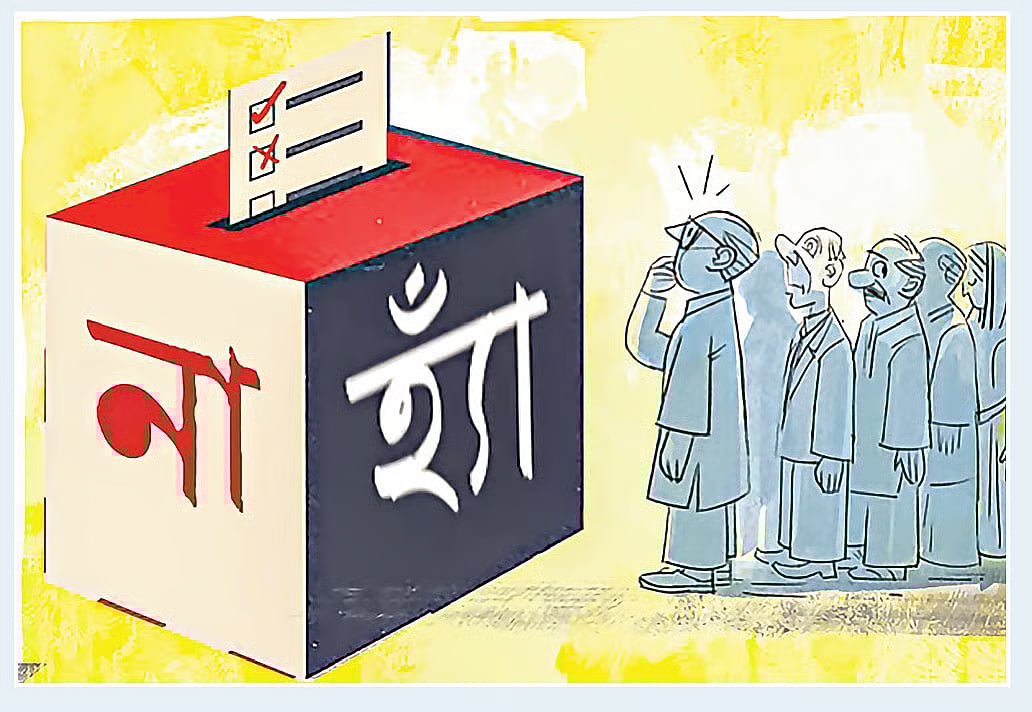
As the interim government is not a political party, it is inherently inappropriate for it to take sides in a referendum. Imran Azad examines why the interim government is seeking the victory of a ‘Yes’ vote.
In the run-up to the forthcoming referendum, the interim government has already begun campaigning at every level, from local to national, urging the public to cast a ‘Yes’ vote. Where the government’s role should have been limited to raising public awareness about the referendum process itself, it has instead entered the electoral arena by taking a clear position in favour of one side. This has naturally raised questions about the government’s neutrality.
It may reasonably be assumed that the government has adopted a pro-‘Yes’ stance for two principal reasons. First, a lack of confidence in political parties’ commitments to reform; and second, an attempt by the interim government to preserve its own image as the custodian of reform.
From the outset, the manner in which the interim government has handled the reform agenda suggests that it harbours deep misgivings about the positions and pledges of political parties on reform. In December 2024, the interim government’s adviser for environment, forest and climate change, Syeda Rizwana Hasan, openly expressed doubts about whether politicians would be capable of carrying out the necessary reforms (Jugantor, 14 December 2024). She asked pointedly, “If politicians were to carry out reforms, why have those not been implemented over the past 53 years?” (The Daily Star Bangla, 13 December 2024).
According to Syeda Rizwana Hasan, political parties have failed to implement essential reforms because of their preoccupation with retaining power, safeguarding their own interests, and resisting changes in mindset. This, she argued, ultimately necessitated the assumption of responsibility by an interim government, compelling the people, particularly the younger generation, to step forward to bring about change (Bangla Tribune, 12 December 2024).
Judged against Bangladesh’s political trajectory, these arguments are not without merit. However, a review of history shows that it is not entirely true to say that no reform initiatives whatsoever were undertaken over the past five decades. Bangladesh has, in fact, seen a number of positive initiatives in the past, many of which were subsequently repealed or altered.
Can anyone guarantee that, even if a ‘Yes’ vote prevails in the referendum, no one will ever attempt to roll back fundamental positive reforms in the future? In other words, can it be assured that fascism or authoritarian rule will never return?
2.
Reforms can only be sustainable if the people themselves gradually learn to internalise them and become aware of their impact on everyday life. Encouraging people merely to vote ‘Yes’ will not, by itself, prevent the return of authoritarianism.
It is not appropriate for the government to publicly express distrust of political parties. After all, these very parties have, from the outset, participated seriously and intensively in the government-organised reform-focused discussions. In addition to taking part in the National Consensus Commission dialogues, the parties have debated reform issues within their own forums and various civic platforms, and have even attempted, where necessary, to make concessions.
It must not be forgotten that some political parties had been working on agendas for state reform long before this uprising. Alongside this, the interim government may believe that if a ‘No’ vote were to prevail in the referendum, all its reform-related initiatives, arrangements and efforts would end in failure.
Moreover, as elections draw nearer, the government’s weak performance on issues such as law and order has generated a degree of public frustration and dissatisfaction. Within Bangladesh’s political reality, the interim government may wish to exit “with dignity”, at least by securing the success of a ‘Yes’ vote.
This approach resembles the adage, “all’s well that ends well”. Put differently, the victory of the ‘Yes’ vote has now become critically important for the government as a means of obscuring its other failures. This has been made somewhat explicit in a recent statement by Syed Muhammad Rezaul Karim, ameer of Islami Andolan Bangladesh, who warned that if the ‘Yes’ vote did not win by a large margin, the formation of the interim government, the parliamentary elections and everything else would come under question (Prothom Alo, 11 January 2026).
3.
Various senior figures within the interim government have repeatedly argued that the government could take a position in favour of the referendum and that there is no legal impediment in doing so. This claim is misleading and not entirely accurate, as it relies on a narrow interpretation of the law.
Law is not confined to written rules alone; unwritten ethical principles may also form part of it. One widely recognised principle of liberal constitutionalism, for example, is that in governing the state, a government must never take sides with anyone other than the people themselves.
For a government to work for the people, it must work for everyone, not for a specific faction or group. The very concept of democracy is encapsulated in the phrase: “government of the people, by the people, and for the people”. In this context, why does the interim government assume that all the people of Bangladesh desire reforms exactly as the government envisions them?
Is it not possible that some individuals or groups may hold wholly or partially different views on reform? If so, does the government not, by supporting a ‘Yes’ vote, effectively take a position against those segments of the population?
The government argues that every political party that supported the July uprising participated in the deliberations of the National Consensus Commission and expressed its views, leading to the adoption and signing of the July National Charter.
It is important to note that while these political parties undoubtedly represent a large section of the population, they do not represent all the people of the country. This means that one or more segments of the population were not represented in the commission’s discussions, and their perspectives, statements and participation on reform were absent.
Does this mean that the Bangladesh we seek to build will be a Bangladesh for only one side? Will we, as in Sheikh Hasina’s authoritarian era, witness the creation of a new category, labelled “anti-July”, much like the earlier branding of “anti-liberation forces”, to marginalise a section of the population? It must not be forgotten that this very politics of exclusion has brought Bangladesh to its present crisis.
4.
The claim that the government may take sides because there is no legal prohibition is problematic for another reason. Since 5 August 2024, with parliament non-functional, the interim government has been running the country by promulgating ordinances in the name of the president. In effect, the government alone decides which matters will or will not be turned into law.
Now, if someone were to argue that a government vested with the authority to legislate in the absence of parliament would naturally be disinclined to enact laws that might constrain its own actions, would that really be an unreasonable assertion?
Notably, while Section 18 of the Referendum Ordinance stipulates that the election commission shall organise the referendum with honesty, integrity and neutrality, the law is entirely silent on the conduct of the interim government itself and of government officials, including advisers and civil servants, during the referendum.
Section 18 of the ordinance is itself questionable. This is because field-level government officials within the public administration are simultaneously carrying out election duties on behalf of the election commission, both for parliamentary elections and for the referendum, while also being engaged, at the direction of the interim government, in campaigning for a ‘Yes’ vote.
Such a situation is not only rare but also constitutes a violation of the fundamental principle of neutrality from a legal standpoint. Some may argue that the duty of civil servants is to serve the “government of the day” in a politically neutral manner by assisting in the implementation of its policies. Even if this argument is accepted for the sake of debate, the inherent contradiction described above raises serious questions.
This is because assisting in the implementation of government policy is one thing, while performing election-related duties and simultaneously campaigning for a ‘Yes’ vote in a referendum is quite another.
5.
Even in Britain, the involvement of civil servants in campaigning during the Brexit referendum gave rise to political controversy. As with our interim government, the justification offered by Jeremy Heywood, then cabinet secretary under David Cameron’s government, was that the civil service code contained no provision prohibiting the government from using the civil service in referendum campaigning.
However, the House of Commons Public Administration and Constitutional Affairs Committee, in its post-referendum inquiry report titled “Lessons Learned from the EU Referendum (2017)”, observed that the participation of the civil service in referendum campaigning had created an atmosphere of public distrust.
The public came to assume that the civil service—and, by extension, state institutions—were biased on the Brexit question. The report also criticised the government’s expenditure of £9.3 million on distributing leaflets door to door.
Citing a survey by the Electoral Reform Society, the report noted that public trust in the government as a credible source of information fell from 10 per cent to 8 per cent as a result of such actions. In Bangladesh, it remains unclear from which budgetary heads, and at what cost, the government’s campaigning in favour of a ‘Yes’ vote in the referendum is being financed.
6.
In conclusion, the interim government’s decision to take a position in favour of a ‘Yes’ vote in the referendum has far-reaching implications. As the government is not a political party, taking sides is inherently inappropriate. Some responsible figures within the government have asked where the problem is in supporting a ‘Yes’ vote for their own ‘product’—that is, the reform proposals they have formulated.
The question is this: if authoritarian rule were to return in the future even after a ‘Yes’ vote endorsing these reform proposals, would those within the interim government accept any responsibility as the architects of that ‘product’?
It is generally assumed that members of the interim government will not, in future, join partisan governments. None of them are, in the conventional sense, members of political parties. Political parties can be held accountable in various ways. But those who are not party members, yet are currently in government making far-reaching decisions—will they remain beyond the reach of accountability?
*Imran Azad is a writer and legal researcher
*The views expressed are the author’s own