David Bergman's column
July violence: Flawed detentions and precarious trials
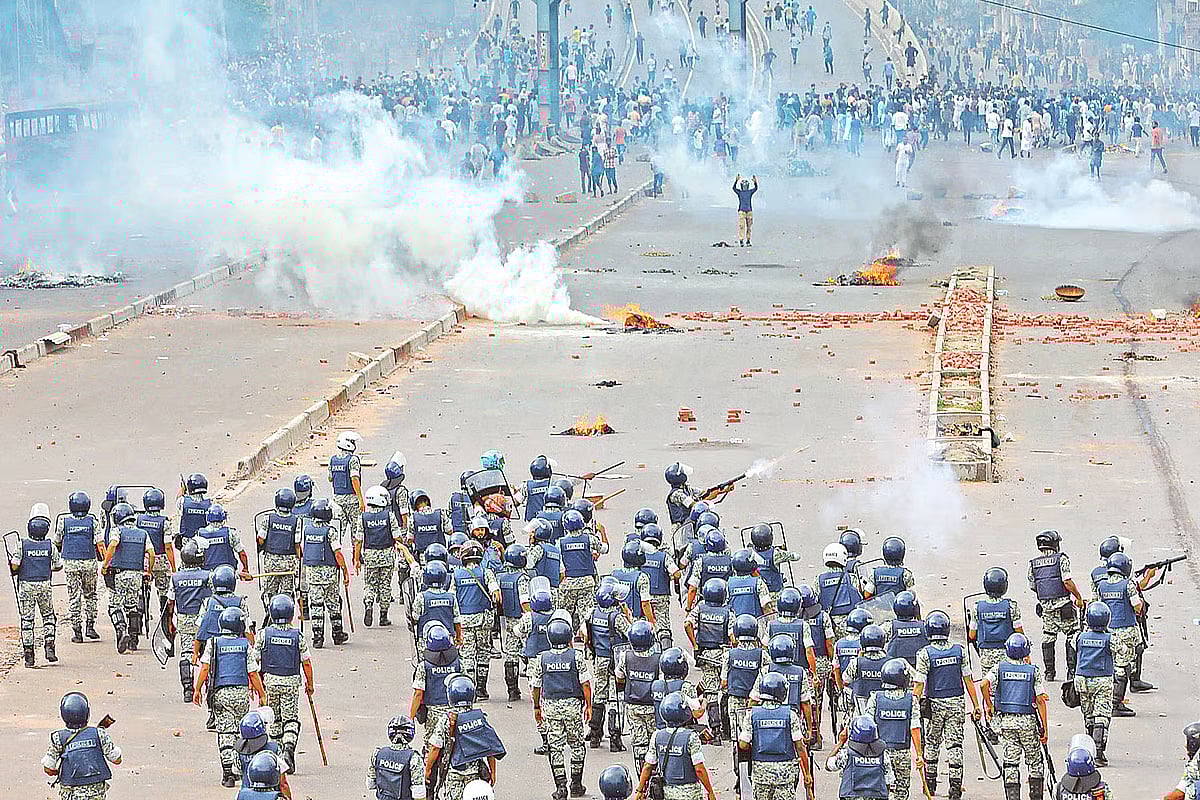
Following the hundreds of killings and thousands of injuries resulting from shootings by law enforcement personnel and Awami League activists between 16 July and 5 August 2024, as well as the smaller number of deaths caused by protestors, the question of how to hold to account those responsible was amongst the most difficult questions facing the new interim government when it took power on 8 August 2024.
Almost a year on, there needs to be a reckoning of how successful the government has been so far in this process. “Process” is the right word to use here, because if the investigations are done properly and the court procedures are fair, achieving accountability does not happen quickly. So the fact that no case has yet concluded should not in itself be seen as a sign of failure.
From a prosecutor’s perspective, unlike in relation to the trials a decade ago that took place relating to the 1971 war of independence, this is an evidence-rich environment, with the availability of videos and records of telephone communications. In addition, since the events of July and August 2024 took place so recently, copious and reliable first hand witness testimony is present. There should be no need to resort to any inappropriate method to “strengthen” the cases that could bring the judicial process into question -- a flaw that tainted the International Crimes Tribunal's proceedings ten years ago.
In Bangladesh there are two parallel systems of criminal accountability dealing with the July protests crimes. The first involves the criminal cases filed by victims or their families at police stations in First Information Reports. These allege that hundreds of people, mostly local or national Awami League politicians along with the party’s well-known supporters, are guilty of murder or attempted murder involving a particular death or injury.
The second tracks involve cases filed before the International Crimes Tribunal and deal with the offence of Crimes against Humanity.
Ordinary courts
Of the 1,601 cases filed till 17 July regarding the July uprising, 637 were murder cases. While the number of arrests may not have reached up till thousands in these cases, several hundreds have been arrested. No doubt amongst those named in the FIRs, there are people who have actually committed crimes during the July protests and so may be rightfully detained. But right from the moment a person is listed in an FIR to the present day when many have spent months or nearly a year in detention, the system now operating does not seek to distinguish between those who are complicit in the murders or attempted murders and those who are innocent of any involvement. Both categories have been as likely to get arrested as each other, and both remained detained for a very long time. The key criteria for detention of a person has nothing to do with evidence, but everything to do with their relationship with the Awami League.
Right now in Bangladesh, in relation to most of these cases, what we have is not just “detention before trial” or “detention before charge” (potentially concerning in themselves) but something far more worthy of criticism: “detention before investigation”. In some cases the police may conduct some investigation; however, where that is the case, the police fail to inform the courts when it has not identified any evidence connecting the accused to the crime alleged against them.
It took the government/police 9 months – and hundreds or thousands of arrests - before they took some kind of action to try and stop these arbitrary detentions. On 9 April 2025, Dhaka police authorities issued an order which stated that to arrest someone in relation to July/August case, there must be “appropriate evidence” as in “eye-witness”, “video”, “photographic” along with permission from the “higher authorities”.
This is of course an initiative that should have been implemented in August or September 2024. Following a petition that claimed the order was unconstitutional, the High Court subsequently stayed it. Since then, however the government has neither sought to appeal the stay, nor pass an ordinance changing the law.
On 10 July 2025, the government did amend the Criminal Procedure Code that allowed a senior officer to remove a person’s name from an FIR if a “preliminary investigation” showed that there was “insufficient evidence” against an accused. Whilst welcome, the law does nothing to stop the continuing arrests of people¬ or do anything to assist those now detained without evidence.
Equally concerning is the failure of the system to provide bail, particularly when the accused has national prominence. The Magistrates and District courts never give bail (at least for any high profile detainee). High Court benches are more willing to provide it, but a combination of factors prevent the release of the accused: the intent of the Attorney General’s office to stay any interim bail orders given; the appellate division acceding to applications to block interim bail; and the police “showing” an accused arrested in a new case.
This could all have been very different. The government should very soon after coming to power have changed the law to allow a centralised system of investigations, with an elite groups of investigators, not relying on local police officers, and only arresting those where there was sufficient evidence. This is not being said in hindsight. It was suggested to government advisers just weeks after 5 August.
A further matter of concern is an order, reportedly issued by the government, giving immunity to protestors and others in relation to violence, including killings, that they committed during the protests and afterwards. Such immunity, if it was given, is against all norms of due process and is entirely unjustified.
It is important that the ICT prosecution team focuses narrowly on the proving the charges against the men and women accused, with substantive and reliable evidence and ensure that political considerations play no part in the future trials. Otherwise the ICT will become subject to similar criticisms of the past.
The International Crimes Tribunal
Compared to the ordinary courts, the ICT is doing a better job. The International Crimes (Tribunal) Act 1973 has been significantly updated and brought closer to international law standards. It has its own investigation body and only X people have so far been detained. It has also started prosecutions for the offence of Crimes against Humanity. In three separate cases, prosecutors have charged a total of X people, including the former prime minister and home minister, though both are absconding. The prosecutions appear to be based on substantive evidence, though the details will only become clear when the trial starts.
Nonetheless there are significant concerns and criticisms. The law needs further updating. It allows people to be arrested without any evidential threshold – and, as a result, there are a number of people arrested by the ICT whose detention appear unjustified. The law does not allow appeals against any trial court decisions, other than the final judgement. Some of the wording of the offences, for example in relation to “superior responsibility”, does not follow accepted international definitions. Legal protections for those accused in in absentia trials is inadequate. And there is no clear definition of what will be considered a “fact of common knowledge” and there is concern about how the concept of Judicial Notice will be used. The existence of the death penalty is of course also a matter of criticism.
Some have raised concerns about the appointment of Tajul Islam, a former defence lawyer to the Jamaat-e-Islami at the previous ICT Trials, as Chief Prosecutor. Whilst the optics of his appointment may certainly be of concern for many, his new role does not in itself create conflicts of interests and his ability to the do the job fairly will be on open display for all to see as the trials start. He is also one of few practicing lawyers in Bangladesh with significant understanding of international criminal law.
However, the three charge sheets so far produced by the ICT prosecution team deal with much more than the factual basis of the allegations against the accused men, and read like a wider political indictment of the Awami League, matters that are not, and should not be, before the court. It is important that the ICT prosecution team focuses narrowly on the proving the charges against the men and women accused, with substantive and reliable evidence and ensure that political considerations play no part in the future trials. Otherwise the ICT will become subject to similar criticisms of the past.
* David Bergman is journalist and a long-time observer of the situation in Bangladesh and the activities of the ICT