Opinion
Govt and the Army: Democratic transition and justice must not be obstructed
Formal charges in three cases were submitted at the International Crimes Tribunal on 8 October. The tribunal accepted those and issued arrest warrants against 32 individuals. Two of these lawsuits were filed on charges of crimes against humanity, including enforced disappearances and torture, committed during the rule of the previous Awami League government. The third one concerns alleged crimes against humanity committed in Rampura and Banasree in Dhaka during the July Uprising. Among those named in the warrants, 25 are current or former senior officers of the Bangladesh Army.
At a press conference on 11 October, Major General Md. Hakimuzzaman, the Adjutant General of the Bangladesh Army, stated that of the 25 officers facing warrants, 15 are still serving in the army, while one is on Leave Preparatory to Retirement (LPR). Among these 16 officers, all are currently in army custody except for Major General Kabir Ahmed, former military secretary to ousted Prime Minister Sheikh Hasina, who remains in hiding.
Given that the accused belong to a disciplined force, the process of bringing them to justice is a highly sensitive matter. Questions have arisen as to whether the proceedings should fall under the Army Act (1952) or the International Crimes (Tribunals) Act (1973). The army, however, has reaffirmed its commitment to justice.
At the same briefing, Major General Hakimuzzaman said, “The Bangladesh Army unequivocally stands for justice. There will be no compromise with fairness. We believe that the law will take its own course and that the truth will prevail through judicial proceedings. The Bangladesh Army extends its deepest sympathy to the families of the victims of enforced disappearances.” (Army headquarters’ media conference: 15 army officers in custody, one absconding, Prothom Alo Online, 12 October 2025)
2.
During Sheikh Hasina’s autocratic rule, negative tendencies and practices took hold across the judiciary, bureaucracy, police, military, and intelligence agencies. Naturally, some of these patterns influenced the armed forces as well. Consequently, a number of senior army officers have been accused of involvement in extrajudicial killings, enforced disappearances, and the establishment of ‘Aynaghar’ (Mirror House), secret detention centres.
This raises an important question: to what extent are the individual officers responsible, and to what extent is the institution itself accountable?
Addressing this issue, the army’s Adjutant General in the media conference clarified, “At the time when the alleged incidents occurred, none of the accused officers were directly under the command of the Bangladesh Army. They were all serving on deputation to other organisations such as the Rapid Action Battalion (RAB) or the Directorate General of Forces Intelligence (DGFI).”
He further explained, “RAB operates directly under the Ministry of Home Affairs, and its reporting structure does not fall under the jurisdiction of army headquarters. The DGFI, meanwhile, is an agency functioning directly under the Prime Minister’s Office, and therefore not part of the army’s chain of command. Consequently, the army headquarters neither had oversight nor operational control over the activities of these officers.” (Prothom Alo Online, 12 October 2025)
It cannot be denied that under autocratic rule, the state operated at the command of a single individual — the Prime Minister. However, it is now time for constructive reflection on those issues. Even if the culpability lies primarily with individual officers, it seems that the army also has a responsibility to engage in institutional introspection.
There are several issues that merit consideration. During the previous regime, attempts were made to politicise the military, like various other state institutions — the judiciary, bureaucracy, and the police. The army must remain vigilant against any such influence. Supporting unlawful government actions, showing partisan bias, or attempting to influence politics are serious threats to military professionalism.
Another issue concerns retired military personnel. Many join the civil administration, business, corporate, or political sectors after retirement. While this is their civic right, albeit subtly, it sometimes could affect the image of the army. There have been tendencies to blur the line between personal opinion and the army’s institutional position due to the public statements or actions of retired personnels. The army has to draw a clear boundary between official policy and individual expression to prevent such confusion. Institutional guidelines on this should be made explicit.
3.
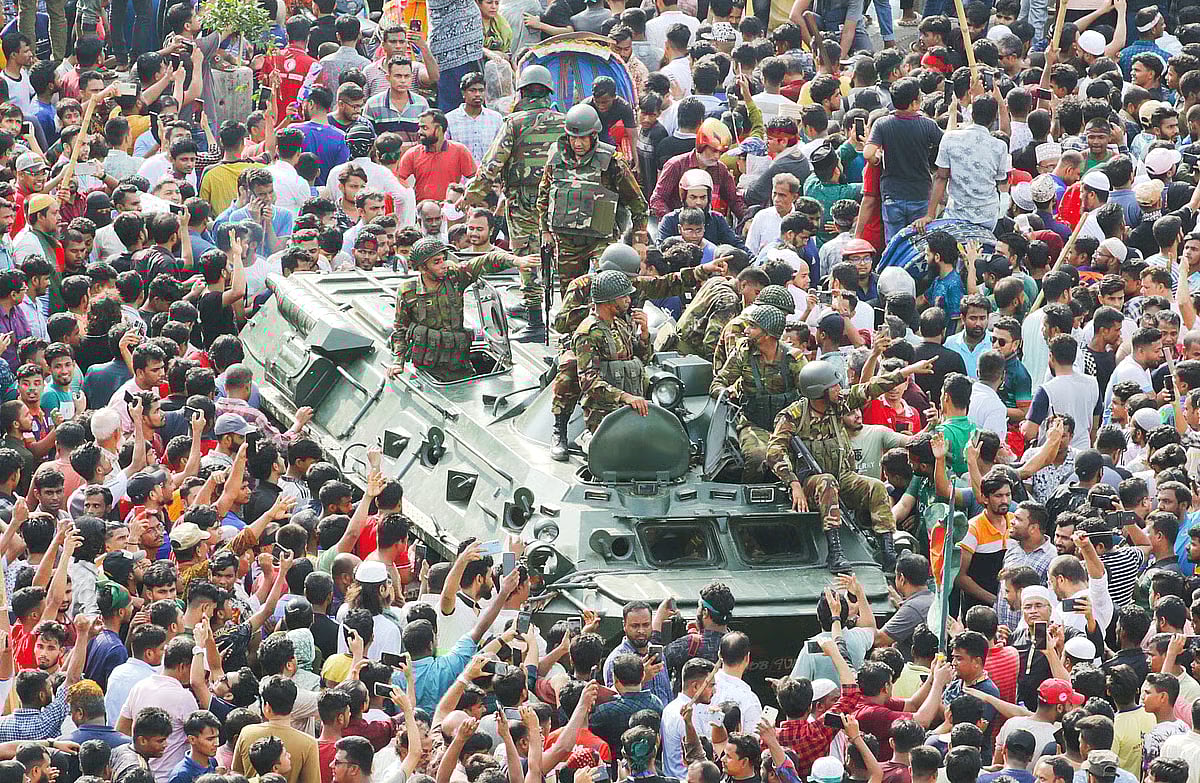
At the decisive stage of the 2024 Mass Uprising, the army effectively withdrew its support from the Hasina government. People came to know about the resignation of Sheikh Hasina through the announcement of the army chief. The military also played a role in facilitating several meetings between political leaders and student representatives to form the interim government. Subsequently, the army was deployed with magisterial authority to stabilise law and order, a deployment that continues, and is expected to remain in place until the general elections scheduled for February 2026.
Discussing the army’s potential role in the upcoming elections, Ridwanul Hoque, former professor of Law at Dhaka University, said in a recent interview, “One major aspect of the forthcoming election is maintaining law and order. The army will have to play a crucial role in ensuring a fair and peaceful election. This means that the military now holds a stake in Bangladesh’s democratic transition. Moreover, given current geopolitical realities, the army has a responsibility to help preserve national stability.” (‘July Charter cannot be placed above the Constitution’ – special interview with Ridwanul Haque, Prothom Alo, 21 September 2025)
Earlier, in another interview, economist Hossain Zillur Rahman had observed, “The army is one of the pillars of our state capacity. Weakening or discrediting this institution through immature or short-sighted political discourse is tantamount to self-harm. We must remain alert to ensure that narrow political or personal interests do not create larger crises.” (‘People are absent from discussions on political settlements’ – Interview with Hossain Zillur Rahman, Prothom Alo, 6 April 2025)
4.
At the National Consensus Commission meeting on 15 October, BNP standing committee member Salahuddin Ahmed addressed chief adviser professor Muhammad Yunus, saying, “We don’t want any imbalance among the defence forces. At this moment, we cannot afford that. We want you to have good relations with the defence forces. The state must remain in a balanced position. As we approach the election, we cannot afford to take any risks.” (‘Salahuddin to chief adviser: We want you to have good relations with the defence forces’, Prothom Alo Online, 16 October 2025)
Over the past year, there have been some public and social media discussions about misalignment or distance between the interim government and the military. Such speculation only breeds uncertainty among citizens. From that perspective, Salahuddin Ahmed’s remarks carry significance. All sides must take seriously the “risk” he referred to.
It is not warranted at all that the issue of prosecuting accused army officers trigger any new tensions between the interim government and the military. While justice for all perpetrators must be ensured, efforts to destabilise the country through defaming the army or spreading rumours of a military coup must be firmly curbed. The opportunity that has emerged for democratic transition through the February election must not be jeopardised by recklessness.
The Bangladesh Army was born out of the Liberation War, grounded in the people’s struggle for freedom. Therefore, the nation rightfully expects that the army will always stand with the people, with democracy, and with justice.
* Monzurul Islam is a senior subeditor at Prothom Alo.
* The views expressed are the author’s own.