Analysis
Why is Padma Barrage necessary, and what are the main challenges
After more than six decades of surveys and planning, the Padma Barrage has now reached the implementation stage. Previous surveys have established the crucial scientific and engineering foundation for this project. Md Ataur Rahman has written about why this barrage is necessary and its main challenges.
The Padma Barrage is a much-discussed and long-planned project for water management in the southwestern region of Bangladesh. Its potential benefits are numerous: water conservation during the dry season, river revival, irrigation expansion, navigability enhancement, salinity control, increased freshwater flow in the Sundarbans, fish production, and hydroelectricity generation are some of those.
However, constructing a barrage on a major river is not just about building an engineering structure. Its success will depend on how the potential challenges and adversities after the barrage's construction are addressed.
Recently, some researchers have raised questions about the challenges, sediment management, and negative impacts of the Padma Barrage. Following more than six decades of various surveys, 13 domestic and international technical organisations conducted a nearly four-year-long survey, mathematical modeling studies, physical model studies, environmental impacts, social impacts, and other considerations to prepare a feasibility study report for the proposed barrage, which answers many of the raised questions.
Outline of Padma Barrage Project
The current Padma Barrage project was long known as the "Ganga Barrage Project." Its main objective is to conservatively store the Ganges water entering Bangladesh within the river to provide the necessary freshwater to the southwestern rivers, especially during the dry season.
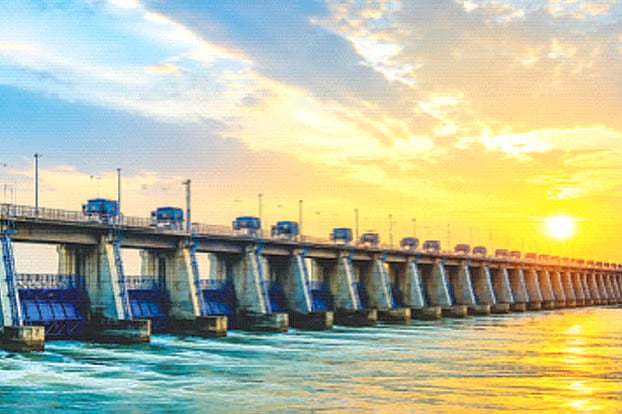
According to the current plan, a barrage about 2.1 kilometers long will be constructed on the Ganges in Rajbari’s Pangsa, about 37 kilometers upstream from the confluence of the Ganges and Jamuna at Goalanda.
It will have 78 main water discharge paths, 18 lower discharge paths, two fish passages, a navigation lock, four-lane roads, and necessary river management infrastructure.
The expenditure for the first phase, approved by ECNEC (Executive Committee of the National Economic Council) on 13 May 2026, is approximately Tk 344.97 billion with an implementation period from July 2026 to June 2033. The project also plans to conserve around 2,900 million cubic meters of water and 113 MW of hydroelectricity production at the Padma Barrage and the Garai source.
Furthermore, the project aims to rejuvenate five significant river systems reliant on the Ganges: Hisna-Mathabhanga, Garai-Madhumati, Chandana-Barasia, Baral, and Ichhamati.
The Ganges River
The Ganges is one of South Asia's largest transboundary rivers. Its main stream originates from the Gomukh within the Gangotri Glacier in Uttarakhand, India, flowing through Uttar Pradesh, Bihar, Jharkhand, and West Bengal, entering Bangladesh through the Ganges Chapainawabganj border. Flowing approximately 240 kilometers past Chapainawabganj, Rajshahi, Kushtia, Pabna, and Rajbari in Bangladesh, it meets the Jamuna near Goalanda.
This combined flow continues as the Padma before merging with the Meghna near Chandpur. Though from Chapainawabganj border to Goalanda, the river is traditionally called the Padma in Bangladesh, scientifically, it is still part of the lower Ganges.
India has constructed six barrages on the main Ganges upstream, including Farakka, and numerous dams, barrages, and water withdrawal structures on its tributaries. However, with the commissioning of the Farakka Barrage in 1975, the availability and distribution of the Ganges water during the dry season became a significant issue in Bangladesh-India water relations.
Survey and planning: Over 6 decades of history
The Padma Barrage is not a recent concept; it has been in the works for over six decades. In 1963, the American consulting firm TAMS examined the potential for building a barrage to raise the water level of the Ganges to increase dry season flow in the Garai and other southwestern branches. Later, in 1964, ICECO and in 1969, ACE Pakistan conducted surveys on this issue. These surveys occurred before the commissioning of the Farakka Barrage, indicating that the idea for a Ganges Barrage wasn't just a reaction to Farakka.
After the Farakka Barrage's commissioning in 1975, dry season water flow, freshwater supply, and salinity control became even more critical. Subsequently, expert surveys in 1984 and a French engineering consortium survey in 1989 supported the proposal to build a barrage at Pangsa.
Following the Ganges Water Sharing Treaty of 1996, efficient use of Bangladesh's water share became a priority, leading to a pre-feasibility study in 2002. In 2009, the Bangladesh Water Development Board initiated a detailed feasibility study and engineering design.
In the feasibility study, specialised firms like DDC, BETS, BCL, ACE Bangladesh, ACE of Pakistan, NESPAK, international consulting firms SMEC, IWM, CEGIS, the River Research Institute, BUET, and DataEx collectively proposed building a barrage on the Ganges at Pangsa, Rajbari through data collection, mathematical modeling, physical model testing, environmental assessment, social impact assessment, and other technical surveys. After subsequent technical review, the design was finalised by 2016.
Why Padma Barrage necessary
Rejuvenation of Five River Systems: When Ganges water flow decreases in the dry season, its impact doesn't just remain confined to the main river. Reduced flow in the tributaries leads to sediment deposition, reduced navigability, and weakened effective connections between many rivers and the main river. Currently, adequate flow during the dry season through rivers like Garai, Mathabhanga, or Hisna is challenging, resulting in irrigation difficulties and ecological stress for the Sundarbans.
An engineering solution to this challenge is building a water control structure or barrage on the Ganges to manage the water storage in reservoirs, channel water to tributaries, and release some water downstream over nine months of the year.
By conserving Ganges water through the barrage and altering water flow, the river systems of Hisna-Mathabhanga, Garai-Madhumati, Chandana-Barasia, Ichhamati, and Baral could be rejuvenated.
Agriculture and Fisheries Production: The project's pre-estimation highlights the potential for expanding irrigation facilities to nearly 2.9 million hectares of net arable land. Water availability for surface-water-dependent irrigation systems like Ganges-Kobadak and north Rajshahi may increase.
The Ganges river basin is a significant source of freshwater fish for Bangladesh. The reservoir created upstream of the barrage could also aid fish resources besides conserving water in the dry season.
Salinity Control and Sundarbans: Providing ample freshwater during the dry season in rivers like Garai-Madhumati may help control the advancement of saline sea water into Khulna, Bagerhat, Satkhira, and the Sundarbans.
This could benefit agriculture, fisheries, drinking water sources, and the Sundarbans ecosystem. Plans are in place to use mathematical model results for defining necessary water flow in barrage operations.
Navigability Enhancement: Dry season flow decreases significantly in many rivers of the southwest, such as Garai-Madhumati. In the past, Garai has sometimes nearly ceased to flow during certain dry seasons. Planned water release from the barrage could enhance the flow and sediment transport capacity of the river. Necessary dredging and source management coupled with this could create opportunities for restoring navigability.
Waterlogging Reduction: Waterlogging in the southwestern region is a complex issue of river and sediment management. Enhancing the navigability and drainage capacity of associated rivers through the Padma Barrage could aid in reducing waterlogging. However, it would require harmony with local drainage management, tideborne sediment, and polder and sluice management.
Supporting Facilities—Hydroelectricity: The project plans to produce a total of 113 MW of hydroelectric power. However, in the limited water context of the dry season, priority must be given to rivers, the environment, agriculture, and southwestern water demands. Thus, it is logical to view hydroelectricity not as the core goal but as a supportive benefit of the project.
Potential challenges
Experts have raised several important questions about the proposed Padma Barrage's effectiveness and possible negative impacts, including sediment management, upstream water availability in the dry season, necessary downstream flow, river erosion, and environmental impact. These challenges are expected when constructing a barrage on a large and dynamic river like the Ganges.
However, these aspects have been considered in the feasibility study through data collection, mathematical and physical modeling tests, environmental and social impact assessment, and various technical analyses.
Among the 20 chapters of the main report, there is analysis on water and sediment flow, barrage operations, hydroelectricity, and engineering design, as well as upstream water conservation, tributary and irrigation project water supplies, downstream flow, and potential sediment accumulation analysis up to 2172.
Environmental assessment discusses 22 potential impacts and remedies, including sediment flow, river erosion, flooding, agriculture, fisheries, and salinity. Hence, evaluating the project's potential benefits and risks requires a proper analysis of the main feasibility study and updated data to identify any inconsistencies. The Bangladesh Water Development Board can make this report publicly available and present its contents to the nation through a press conference.
Sediment Management: One of the main technical challenges for the long-term success of the Padma Barrage is sediment management. Increasing the water level and reducing flow velocity upstream of the barrage could lead to sediment accumulation, riverbed elevation, shoal formation, main flow path shifts, and reduced water holding capacity. That’s why the design includes 18 lower water discharge paths or under sluice, which are approximately 1. 5 meters below other gates, facilitating the downstream passage of high sediment load water.
However, under sluice alone is not sufficient; scientifically based sediment management through gate operation, sediment-laden water discharge, and necessary dredging is essential. According to the plan, all barrage gates will remain open for three months (10 July to 10 October). During this period, a portion of the accumulated sediment could be transported downstream with the strong monsoon flows.
How much water will be released downstream: Holding all water reaching the barrage and sending it to the southwest is neither feasible nor environmentally desirable. Downstream flow is crucial for maintaining river depth, sediment transport, fish habitats, navigation, bank stability, and freshwater and sediment supplies to the lower Padma-Megha. According to the feasibility study, even during the most critical months of March and April, a minimum of about 9, 000 cusecs of water is planned to be released downstream; during other dry months, a higher flow rate will be maintained.
Can the barrage increase river erosion: Like any significant river infrastructure project, there is no absolute guarantee against riverbank erosion with a barrage, nor is it scientifically definitive to conclude that significant modifications will inevitably occur.
Upstream sedimentation, flow path changes, and local riverbed erosion and sediment deficit downstream might increase erosion risk in some areas. Therefore, river regulation and necessary bank protection measures are included in the study. Regular monitoring of flow path, riverbank, and bank changes before and after construction is essential.
Ganges Water Sharing Treaty: The most important reality is that a barrage cannot create water; it can only conserve and redistribute the water that comes to the river. The 30-year-long Ganges Water Sharing Treaty of 1996 is expected to end in 2026. For the Padma Barrage's full functionality in the future, adequate and reliable upstream flow in the dry season is highly crucial.
Otherwise, fulfilling all goals such as ensuring water supply to southwestern rivers, irrigation, freshwater to the Sundarbans, necessary downstream environmental flow, and hydroelectric power will be challenging. Therefore, future water-sharing arrangements should consider guaranteed dry season flow, environmental flow, and the effects of climate change.
Need for an integrated and adaptive management policy
The success of the Padma Barrage ultimately depends not just on the concrete structure but significantly on how it will be managed. An effective management policy should simultaneously consider water conservation, sediment flow, water supply to southwestern rivers, downstream environmental flow, navigability, salinity, flood, and riverbank erosion risk.
A modern monitoring system should be established for regularly observing river flow, water levels, sediment concentration, riverbed changes, shoreline changes, and the salinity of southwestern rivers. Management processes must be regularly updated based on new information, river changes, drought-flood patterns, and the impacts of climate change.
Final Words
Dams or barrages in rivers are not forbidden structures. They are sometimes necessary to properly utilise river flow. However, during the planning and design phase, it is essential to ensure ways to tackle adverse environmental impacts of such structures and their long-term effective use.
Notably, India has constructed six barrages on the main Ganges and, overall, 73 barrages within the Ganges basin, including the tributaries of the Ganges. Pakistan has built six barrages over the Sindh River flowing through India and Pakistan, which are primarily used for irrigation, flood control, and the supply of potable water. These barrages serve as the backbone for Pakistan's agriculture-based economy.
Padma Barrage has the potential to bring significant positive changes in water management, agriculture, navigability, fish resources, and ecological balance in Bangladesh's 26 southwestern districts. The project's potential benefits are extensive, including the revival of dying rivers, expansion of irrigation, increased navigability, salinity control, increased freshwater flow in the Sundarbans, improved fisheries, and hydroelectric production. However, the success of a barrage on such a big river will not rely solely on its construction.
The real measure of success will be how well the barrage operates, keeping in tune with the natural dynamics of the river's water and sediment. Specifically, three factors will determine the project''s future.
First, ensuring an adequate and reliable supply of water for Bangladesh in the Ganges during the dry season; second, employing scientific sediment management to maintain upstream-downstream sediment continuity alongside water conservation; third, ensuring the barrage's downstream Ganges-Padma's necessary environmental flow is not harmed while meeting the southwest region's water needs.
After more than six decades of surveys and planning, the Padma Barrage has now reached the implementation stage.
Earlier surveys have established a crucial scientific and engineering foundation for this project. However, before and during the barrage construction, it is essential to update previous studies' critical assumptions using the latest data on water flow, sediment transportation, river morphological changes, upstream water withdrawal, and climate change.
Making important reports from the feasibility study and detailed engineering design accessible to researchers and the public is critical. This will enable discussions based on data and scientific analysis rather than guesswork concerning the project's potential benefits and risks.
It is essential not to view the barrage solely as a barrage. It should be an integrated river management project that considers water, sediment, rivers, agriculture, fisheries, navigation, coasts, and the Sundarbans as part of a single system.
* Md Ataur Rahman is a professor in the Department of Water Resources Engineering at Bangladesh University of Engineering and Technology (BUET).
** Opinions expressed here are the author's own.
** This article, originally published in Prothom Alo print and online editions, has been rewritten in English by Rabiul Islam and Shameem Reza