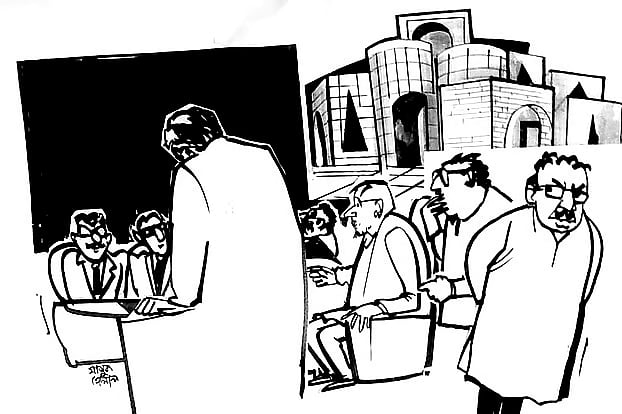
A government that is not even two months old can fairly be described as an “infant government.” And surely one can hardly expect mature, adult behaviour from an infant government.
However, just as morning shows the day, the government’s initial phase gives us an idea of what it will do in the days to come. At least when it comes to reforms, BNP’s attitude is far from positive.
During its 18-month tenure, the interim government issued 133 ordinances, which are supposed to be decided upon within 30 days of parliament convening. But the government is passing only those that will benefit it politically. Those that raise questions of accountability are either being postponed or repealed, with the excuse that “better laws” will be made in the future.
Bangladesh does not lack good laws. But good governance is rare. Our politicians are true democrats while in opposition, even ready to sacrifice their lives for democracy. But once in power, they forget about democracy.
The BNP achieved its best results in the 12 February election. Previously, they had also secured more than a two-thirds majority, but at that time their main rival was Awami League. Now it is Jamaat-e-Islami. With Awami League absent from the national parliamentary election, both BNP and Jamaat had a relatively open field.
Due to various calculations and considerations, it is unlikely that Jamaat-e-Islami will be able to maintain the level of success it achieved in the national election, in local government elections. The results of the by-elections held last Thursday in two constituencies in Bogura and Sherpur show that BNP-backed candidates won by large margins.
According to unofficial results, in Bogura-6 (Sadar) constituency, the BNP candidate defeated the rival Jamaat candidate by a margin of 75,000 votes. Meanwhile, in Sherpur-3 (Sreebardi–Jhenaigati), the BNP candidate defeated the Jamaat candidate by a margin exceeding 100,000 votes. In the national parliamentary election, except for a few constituencies, the vote difference between the two parties ranged between 2,000 and 10,000. This clearly suggests that the influence of power is at play in the by-elections. There is a strong possibility that the same will occur in local government elections as well.
In this context, the Local Government (City Corporation) (Amendment) Bill was passed on Thursday in the 13th National Parliament. The opposition opposed the bill. In particular, the way the government has appointed party-affiliated administrators to local government bodies, namely city corporations and district councils, even before enacting the law has become a major concern for the opposition.
We must thank the government for removing party symbols from local government elections. The Awami League government introduced this provision in 2015.
The state minister for local government attempted to counter the opposition’s arguments, but his remarks were essentially an attempt to cover up the issue. He said, “If they oppose it just for the sake of opposition, that is another matter. If this law is not passed, then the old oppressors will return to those positions.
Secondly, this law states that local government elections will no longer be held under party symbols, including national symbols such as the ‘sheaf of paddy.’ If this law is not passed, then we will have to return to elections under party symbols. We will again have to allow those Awami League mayors and councilors, who were elected unopposed, to return to their seats within seven days.”
But we must thank the government for removing party symbols from local government elections. The Awami League government introduced this provision in 2015. One of the main reasons local government bodies had turned entirely into subservient institutions of the ruling party was the use of party symbols in elections. As a result, even the minimal distinction that existed between local government bodies and the ruling political party disappeared.
After elections to local government bodies began to be held under party symbols, the opposition parties at the time boycotted the elections, and rival factions within Awami League engaged in “friendly matches,” a practice that continued up to the 2024 national parliamentary election.
In this harsh and unfortunate reality, all parties in parliament agreed on removing party symbols. However, the provisions allowing the appointment of party-affiliated administrators and the dismissal of elected representatives under executive authority were not considered acceptable to them for obvious reasons.
In response to the opposition’s criticism, the state minister cited the examples of Dhaka South and North City Corporations, but that argument does not seem particularly strong. Despite a court verdict, BNP candidate Ishraque Hossain was not allowed to assume the post of mayor of Dhaka South; that was certainly unjust. However, that does not justify the government appointing party-affiliated individuals in all city corporations. If administrators are appointed based on parliamentary constituencies, then the opposition deserves representation in at least one-fourth of the institutions. In our country, those in power tend to equate democracy solely with majority rule. It should also be noted that appointing a leader of the National Citizens’ Party as an administrator in Dhaka North has not escaped criticism either.
Just as appointing party affiliates in local government bodies has increased BNP’s power, their strength in parliament will grow further once elections to the reserved women’s seats are completed. BNP and its allies are expected to secure at least 35 seats, while the opposition and independents combined may get around 15. BNP has stated that nominations will be given to those who played a role in the democratic movement and who are capable of demonstrating competence in parliamentary activities. Even now, there are many representatives in parliament who are unable to present questions or proposals, requiring the Speaker to intervene repeatedly.
During the Awami League government's tenure as well, we saw how several ministers and state ministers displayed a lack of skill while presenting bills. Such repetition is not desirable. Media reports indicated that the Leader of the House had arranged training for party MPs. Now it appears that this training has not been sufficient. In reality, our leaders play strong roles on the streets and can electrify public rallies with loud speeches in party meetings, yet they often demonstrate equal levels of incompetence in running the government and parliament. Not everyone, of course, there are exceptions.
Most members of this parliament are here for the first time. As a result, the public may view them with some degree of sympathy, but not for long. Both the government and the opposition must remember that having only a handful of skilled parliamentarians is not enough to make parliament the center of national politics. Everyone has to play a role, to varying degrees.
* Sohrab Hassan is a journalist and poet.
* The opinions expressed here are the author’s own.