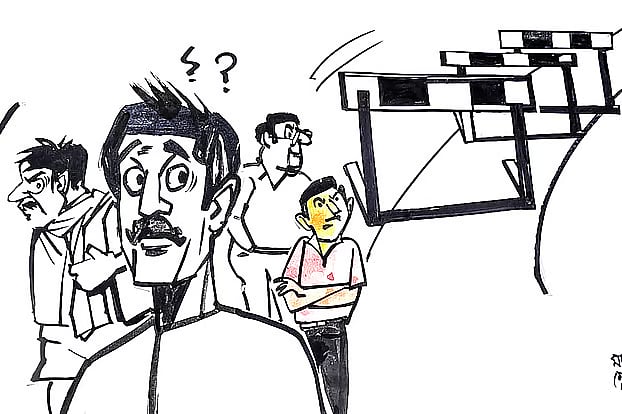
At one time, when we said “LDC,” we meant Lower Division Clerk. In our offices, they were known as “low-grade assistants.” In the international arena, Bangladesh is identified as an LDC (Least Developed Country). That's dowright disreputable. Countries in this category rank at the very bottom by global standards.
We don’t like to call ourselves “underdeveloped”. Instead, we prefer the term “lesser developed.” There’s a certain sense of pride in that wording, as if we are developed too, just a little less so.
Countries are generally divided into three tiers: least developed, developing, and developed. Developing countries are often referred to as middle-income countries. In reality, there is no tier below LDC. According to the United Nations definition, these are countries that rank lowest in socioeconomic and human development indicators. In a sense, they can be called the poorest.
Yet the poor have a strong sense of dignity. In their mannerisms, speech, and behaviour, they try to convey that they are very important. Let’s clarify this with an example. Our top leaders and their associates often claim that our leader is a “global leader.” Not long ago, I came across two book titles. One was ''Bangabandhu Theke Biswabondhu'' (''From Bangabandhu to Friend of the World''), and the other was ''Desh Ratna Theke Biswa Ratna (From Jewel of the Nation to Jewel of the World). When it comes to exaggeration, we are undoubtedly among the best.
The greatest asset of any country is its people, but our leaders do not consider the people an asset. To them, people are a burden. That is why in 1975 our government formally applied to be included in the LDC list. Bangladesh had only just become independent. The country was trying to recover from a war-ravaged economy.
The international community had strong sympathy for this country. The population indicator was viewed flexibly at the time, and taking advantage of that, we became an LDC. In the 1970s, Vietnam was poorer than us. Yet Vietnam did not become an LDC. They had no desire to lose national dignity and be labeled an “international beggar.” That sense of self-respect has taken them far, whether in football, agriculture, or industry. Bangladesh, meanwhile, still lags behind.
Once a country becomes an LDC, it is very difficult to break out of that cycle. The defining features of many third-world countries are authoritarianism and corruption. They borrow money and live lavishly. A small class holds immense wealth, while the rest remain at the bottom.
Many of our less-educated or half-educated leaders say things without knowing or understanding them. They don’t even have the curiosity to learn, or they assume they already know everything. Former Prime Minister Sheikh Hasina often said, “Bangladesh was underdeveloped. My father elevated the country to LDC status. I have turned it into a middle-income country.” She seemed to think that LDC was some kind of certificate or stepping stone of development. It didn’t occur to her that there is nothing below it.
Because of being an LDC, we receive many concessions. For example, “soft loans” from international organisations. The loans we receive from the World Bank or the Asian Development Bank carry service charges of at most 1 per cent. These loans are to be repaid over 40 years, with a grace period of the first 10 years, meaning no installments have to be paid during that time. We can imagine what the value of money might be after 40 years. In a sense, these loans are almost like grants.
In addition, there are various benefits available to least developed countries. We can export goods to many industrialised countries on preferential terms. The bilateral aid we receive from developed nations, especially from Europe, North America, and Australia, comes entirely in the form of grants. We are able to obtain patented medicines from abroad at lower prices, without having to pay any royalties. Many people from our country travel to Bangkok or Singapore for medical treatment, where medicines are more expensive, largely because of royalty costs. Without LDC status, we would not receive these advantages.
Out of 193 member states of the United Nations, 46 are classified as LDCs. Most of them, that is, 33, are in Africa. There are 9 in Asia, and in the Arab region only Yemen. In the Pacific region there are three, and in Latin America only Haiti. In the Asia-Pacific region, several countries still remain LDCs despite having higher per capita income and better living standards than us. For them, a key criterion is “environmental vulnerability.” Many of these are small island states, while others are “landlocked,” surrounded by multiple countries and without access to the sea.
Bangladesh has surpassed the LDC thresholds in all indicators. Yet there is widespread lament over the benefits that will no longer be available once we graduate from LDC status. No matter how much the country’s GDP grows, most people remain poor, what will happen to them? Using this argument, there are ongoing appeals and lobbying efforts to further extend the timeline for LDC graduation. At the forefront of this campaign is a group of businesspeople and their allied intellectuals. They seem intent on keeping the country poor. Those involved in ready-made garment exports argue that they will not be able to compete with exporters from other countries. But is that really the case? If Vietnam can do it, why can’t we?
Once a country becomes an LDC, it is very difficult to break out of that cycle. The defining features of many third-world countries are authoritarianism and corruption. They borrow money and live lavishly. A small class holds immense wealth, while the rest remain at the bottom. Instead of striving to make the country self-reliant through productive work, there is a strong tendency to roam around with a begging bowl. “Let the country go to ruin, as long as I am doing well.” This seems to be the mantra that absorbs our leaders and so-called “distinguished” citizens.
Looking at the pomp and luxury of our leaders and officials, who would say we are poor? Every year, we travel to New York with great fanfare and large entourages to attend the annual session of the United Nations General Assembly. Before buying a lift, we travel to Germany or Italy to inspect it. To carry a pillow from the ground floor to the fifth floor, we produce a bill of six thousand taka. A laptop worth fifty thousand is purchased for three lakh. In scorching heat, we sit indoors with doors and windows shut, wearing suits and ties, running the air conditioner and keeping the lights on.
Even then, we want to remain an LDC. Despite having sufficient capacity, we carry on with a deeply wasteful economy while stretching out our hands like beggars across the world. It’s no wonder people call us “destitute.”
We have already spent 50 years as an LDC. How much longer? How long will we remain in this state? When will we come of age?
* Mohiuddin Ahmad is writer and researcher
* The opinions expressed here are the author’s own.