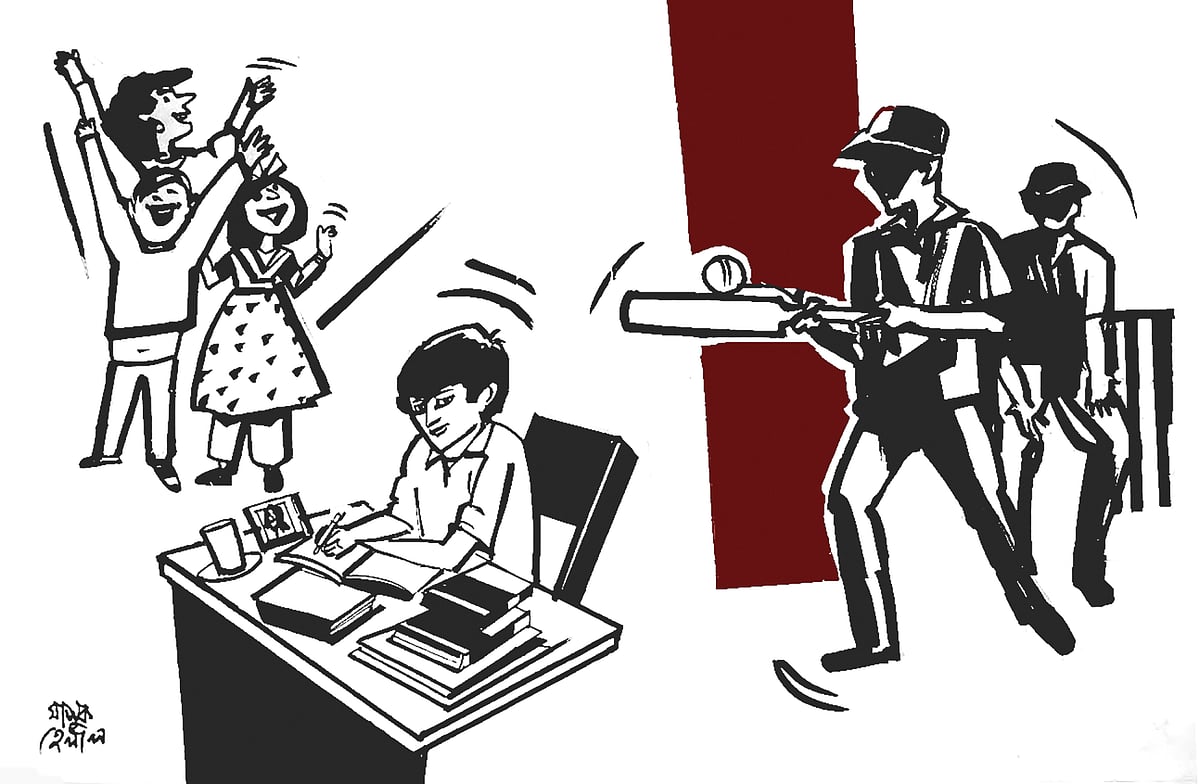
Let me start by saying that I am not a degree-holding educationist. However, I have been thinking, writing, and working on school education for the past 50 years. If this experience gives me some right to speak on the matter, and if some people recognise its value—as I have seen some instances of—it is based on this that I want to say a few words to ensure that the new government's new initiatives in education do not falter.
In our country, the number of students at the school level across all mediums exceeds 35 million. This is a huge number. Moreover, both the child and their education are extremely sensitive and prioritised matters for all family members. This is perhaps manifested through the national emotional response to public examinations by parents, schools, teachers, and the media. We know that nothing like this happens in the developed world. But we have to think about our own country and people. Especially for an elected government, it is a democratic duty to try to fulfill the people's aspirations. Therefore, assuming that nothing can be done overnight, work must proceed.
However, to achieve the goal, the path must also be properly created and followed. Talent and skill must be acquired individually, but their practice is often collective or class-based. The one thing that cannot be excluded in any field, whether individual or class, is practice—in one sense, experience, direct experience.
Those who have played football on the field and those who are fans by watching it on TV will inevitably have a different understanding and view of football. The one with field experience and access to good coaching will be an advanced individual in this regard. Undoubtedly, the coach's significance is immense, but it is significant only for those who play themselves.
Therefore, to untangle our problem, the first need is to crack the blind faith in the results-centric mindset prevailing in education. For that, the discussion must be brought into the social sphere. Through long experience, I understand that the alliance between teachers and parents in results-driven thinking is tremendously strong, and the media fuels it. They not only create a nationwide stir by focusing solely on results, but every newspaper publishes possible exam questions and model answers through independent education pages! Although we understand that this is a self-destructive path in education, it would be advisable for the ministry to sit with the media for a social dialogue and ensure their assistance on the way to creating genuinely talented and skilled individuals, at least to safeguard against failure midway.
I will discuss the final point regarding this matter later because there are some other tasks the government needs to do first.
Due to various international and local initiatives, the number of students in our country has been increasing rapidly since the 1980s. While registration at the primary level has reached 100 per cent, dropout rates have not been stopped. Still, it can be said that the nation has become interested in education. But the government has not been able to keep pace with the increase by establishing schools and hiring qualified teachers. For so long, the colonial education that was yielding results was significant, but now the structural collapse has occurred under the pressure of additional students.
Although private initiatives increased to fill the gap, not all entrepreneurs had the knowledge or expertise required in this sensitive, complex, and important matter. On one hand, there was a crowd of over a hundred students per class or section in prestigious government schools, and on the other hand, there was no system to fulfill the demands of education. Yet, the only yardstick available to measure a school's reputation and a student's success and importance was exams.
Consequently, fueled by the strong desires of teachers and parents, the government too continued exam-oriented education. Despite various statements, in practice, doing well in exams became the main task of education. This led to two events—students essentially became examinees, and a fundamental shift occurred in education where exams became more important than learning, tutors more important than teachers, coaching centres more important than schools, and note-guides more important than textbooks.
Although there was an attempt for a radical change in the education system during the tenure of the past government, that government fell due to a mass uprising. Now the new government is working for a new system and education structure to be implemented in 2028. We wish for their success, albeit with a worried mind, because no government so far has successfully implemented its promises or visions in education.
I hope I have provided some insight into the intensity and extent of the educational crisis. Who doesn't know that the first need for its remedy is to increase investment in education suitable for formulating and implementing an appropriate plan? It can be said that if mega projects are to be undertaken, they must be in education. It seems almost impossible to bring qualitative change in education without a big budget and large initiatives. I would only say that money has not been lacking in education in the past either, but the nation has failed to reap the benefits. Therefore, considering all aspects of the problem, long-term planning must be done and divided into several phases, and their success must be ensured.
Lastly, I will discuss a matter I mentioned before. It seems to be a very serious problem. Due to a long practice of exam-oriented rote learning, for many days—i. e. , several generations—there have been practically no active students; they were passive students.
Those who memorised answers to others' questions (mainly teachers or coaches) and impressed everyone with good grades are the ones who have created a crisis of talent and skill among the educated in the country. And who doesn't know that an intelligent (or cunning) person in crisis takes steps down the path of corruption and wrongdoing, which in turn creates a crisis of morality in society? This is where the trap of the main crisis in education lies. Yes, this crisis cannot be solved overnight, but it must start immediately.
This task must be addressed in two ways—on one side, there must be provisions for direct experience in the education system to cultivate students' talent and skill, and concurrently, arrangements must be made to attract talented, skilled young individuals who can inspire positively and be education-friendly into teaching. Again, this task is enormous, and there will be many challenges and questions of budget allocation at every step.
Therefore, the ideal setup for a race to the goal cannot be done overnight. This is something the entire nation, including the media, must understand, and they must participate with a positive attitude. However, before bringing these matters into the public sphere, sufficient deep discussion at the expert level is necessary.
#Abul Momen is a poet, essayist, and journalist.
*The opinions expressed here are the author's own.
#This article, originally published in prothom Alo print and online editions, has been rewritten in English by Rabiul Islam