In almost every part of the world, aggressive nationalism is now valued. A significant component of this ideology is keeping the ''other'' in distress. This is the magic of its popularity in many regions. Bangladesh's international borders have fallen under the grip of this aggressive nationalism.
For a long time, Burmese nationalism has kept Bangladesh in a state of near-perpetual unrest on its southern border. In 2017, they pushed almost a million people. Even after that, Rohingyas, Mros, and Khumis continue to come from that side. Shortly, it will be the ninth anniversary of the major Rohingya wave. Meanwhile, a human wave has begun from the Indian side of the border.
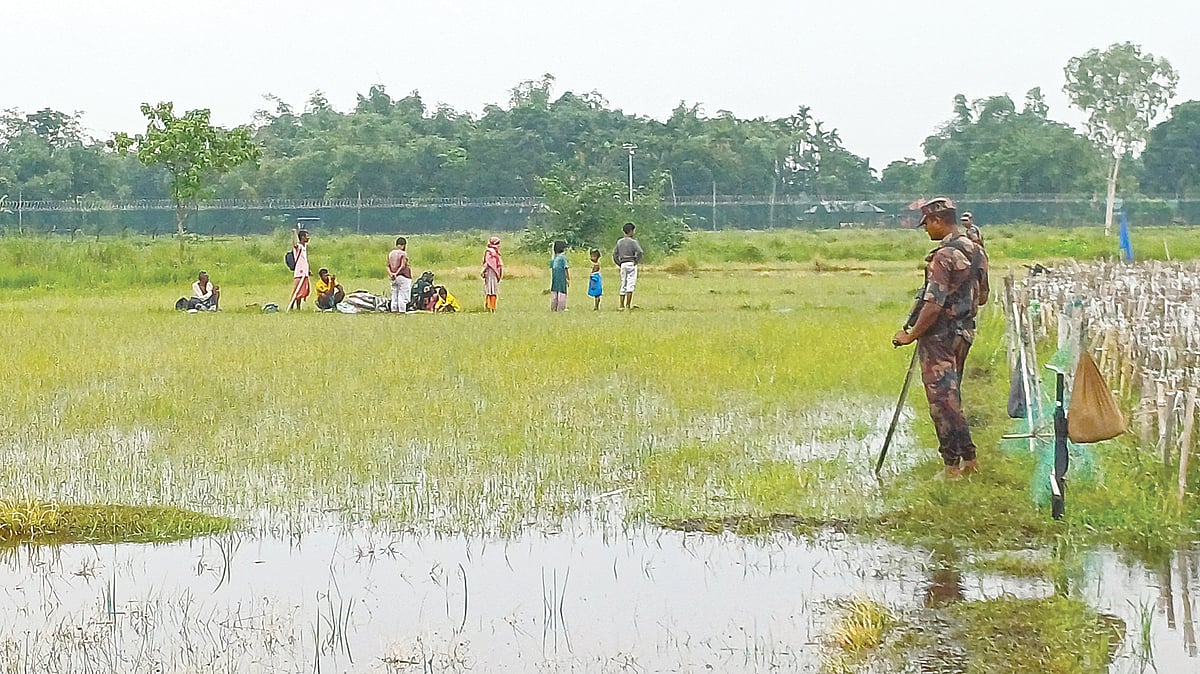
Push-in issues are not new for Bangladesh. However, it can be said that a push-in tsunami has started as soon as the new government took office. In the last two weeks, attempts have been made to push people of various ages across nearly ten places every 24 hours. Bangladesh is keeping those pushed men, women, and children stranded at the zero line.
Across miles and miles of the border, there is now a scene of humanitarian disaster. These people are burning and soaking in the harshness of summer, while politicians and the media on both sides witness this. Both states are also mobilizing local people in support of their initiatives along the border. As a result, a semi-belligerent situation has arisen at various spots along the border.
When the Rohingyas were expelled from Arakan, the ''international conscience'' had become quite vocal; however, nothing similar is evident this time. Even those who were vociferous in urging Bangladesh to open its borders for the Rohingyas are absent now.
For nearly three decades, India’s administration has intermittently carried out such push-in programmes. During Sheikh Hasina's regime, this programme was somewhat suspended or stopped. Sometimes, seeing such initiatives halted or suspended, it is assumed that it is a sort of political maneuver by the Indian rulers. This time, for particular reasons, that move is advancing with a more rhythmic force.
With the establishment of governments of the same ideology at the centre and in West Bengal, Tripura, and Assam, the push-in has now taken a coordinated form. Politicians and media associated with the RSS-BJP family have begun newly creating public opinion in favour of this move. Indians are being convinced that the country will be safer if the people exposed to sun and rain at the zero point are taken into Bangladesh. These people are seen as obstacles on India’s path to development.
According to the Sangh Parivar, those being pushed in are ''illegal Bangladeshis’ and ‘security threats. '' The problem is that among those who were successfully pushed into Bangladesh in recent times, many were Indian citizens. Due to poverty, Bengali language, and Muslim identity, many fell into the push-in mass programme. But on the other hand, the theoreticians of the push-in programme claim that only ''selected insects'' are being thrown away. That is, those who fall victim to the push-in are likened to ''pests, '' and Bangladesh is the place to throw them. The Indian administration often boasts that it assisted in Bangladesh's liberation war, which is not untrue. Naturally, questions arise as to why there is a sudden surge of tension in India's Bangladesh policy.
Geopolitical commentators are speculating answers to this question. Some say the push-in has begun in a new format as part of conveying a special political message or applying pressure. What is that ''message''? Perhaps Bangladesh's Foreign Minister Kholilur Rahman knows it. He must have informed the government too. Ordinary Bangladeshis know nothing about this. They only see emerging provocations and terror at the border.
India always considers Nepal, Bhutan, Sri Lanka, the Maldives, and Bangladesh as part of its self-declared security zone. As part of this, they keep an eye on Bangladesh’s political situation, foreign policy, military and economic measures.
They have preferences and opinions on all such matters involving Bangladesh. Some of these opinions they express explicitly, while some they imply indirectly. Bangladesh understands some, pretends not to understand others, and ignores a few.
Despite being India's small neighbour, Bangladesh is an independent, sovereign country. Which political ideology’s government will be in power in Bangladesh is a matter for the people of Bangladesh to decide, just as who forms the government at India's centre and states is a choice for India’s citizens. Leaders of both countries should be ready to work with the ruling parties of any ideology in the other country. Therefore, if the push-in resumes as soon as the BNP government comes to power after it was halted, it will certainly be considered poor diplomacy on India's part. Because this will be seen as an attempt to disrupt the nascent journey of democracy in Bangladesh. It will also increase counter-nationalistic extremism here.
Some geopolitical commentators also mention the ''Teesta Mega Plan’ as a backdrop to the new wave of push-ins. The rightful share of the Teesta River water for Bangladesh is recognised by the Indians. Both countries were on the verge of signing an agreement. Then it was said that Delhi wants to give the water, but the deal is stalled due to Mamata Banerjee’s objections. But how long will Bangladesh wait?
If India does not release water in the inter-river, then Bangladesh has two alternatives: going to the United Nations or seeking solutions through infrastructural means.
The government of Bangladesh is pursuing the latter path. Whether the lack of water can be addressed infrastructurally in the Teesta's downstream is a highly debated issue. Environmentalists are talking about these matters. If India objects to such a plan and chooses the push-in route by raising objections to Bangladesh’s tech-reliant solutions for water with China’s friendship, how just, proper, or good-neighbourly would that be?
Even if Bangladesh intends to enhance its economic and military capabilities through agreements with other countries, India’s objections should not be acceptable. India continuously strengthens ties with Israel and undertakes various military projects, which is not pleasant for Bangladesh as a Muslim-majority country. India also has extensive and broad relationships with China in numerous economic matters. Therefore, there should be no rationale for Indian objections to Bangladesh’s desire to build relations with any country on economic, technical, or military issues.
At one time, the Indian government strongly advocated a ''Neighbour First’ foreign policy. Surely, this policy values the emotions, needs, and rights of the neighbours. Is the ongoing widespread push-in, right after a new government takes office in Bangladesh, in alignment with that policy?
The Bangladesh government can take various paths now. Firstly, it can bring the inhumane conditions of the people, who are victims of the push-ins, to the attention of the international community. It can also attract the attention of international human rights organisations. Simultaneously, it can request a list of the so-called undocumented Bangladeshis from the Indian government and take steps based on investigations of that list. If any Indian citizen is pushed this way under the guise of a push-in, that should also be highlighted to the international community.
The border situation is quite tense at the moment, and Bangladesh has already deployed the highest number of guards in its history at the border. Despite any additional provocations from the Indian side, refraining from responding will be a sign of prudent intelligence, although the border still needs to be made more secure.
Considering that the crisis India is creating at the border is a humanitarian one, Bangladesh needs to move forward and tackle this situation. This is the time for Bangladesh to display its diplomatic skills.
Pushing relationships to the zero line is a risky gamble from India’s side. Aggressive nationalism loves to gamble, while democracy stakes its claim on the power of dialogue and negotiation.
#Altaf Parvez is a researcher on South Asian history.
*The opinions are the author's own.
#This article, originally published in Prothom Alo print and online editions, has been rewritten in English by Rabiul Islam