David Bergman’s column
Youth Poll shows BNP and Jamaat battling for dominance, with high number of undecideds
A new scientific poll has been published focusing on Bangladeshis aged between 18 and 35 — a demographic that makes up roughly one-third of the total electorate.
The survey was conducted by the Bangladesh Youth Leadership Center (BYLC), an organization established in 2009 to provide leadership training to students from English, Bengali, and Madrassa educational backgrounds. Between 10 and 25 October, the BYLC polled 2,545 respondents, chosen through randomized sampling designed to reflect the country’s geographic and demographic diversity.
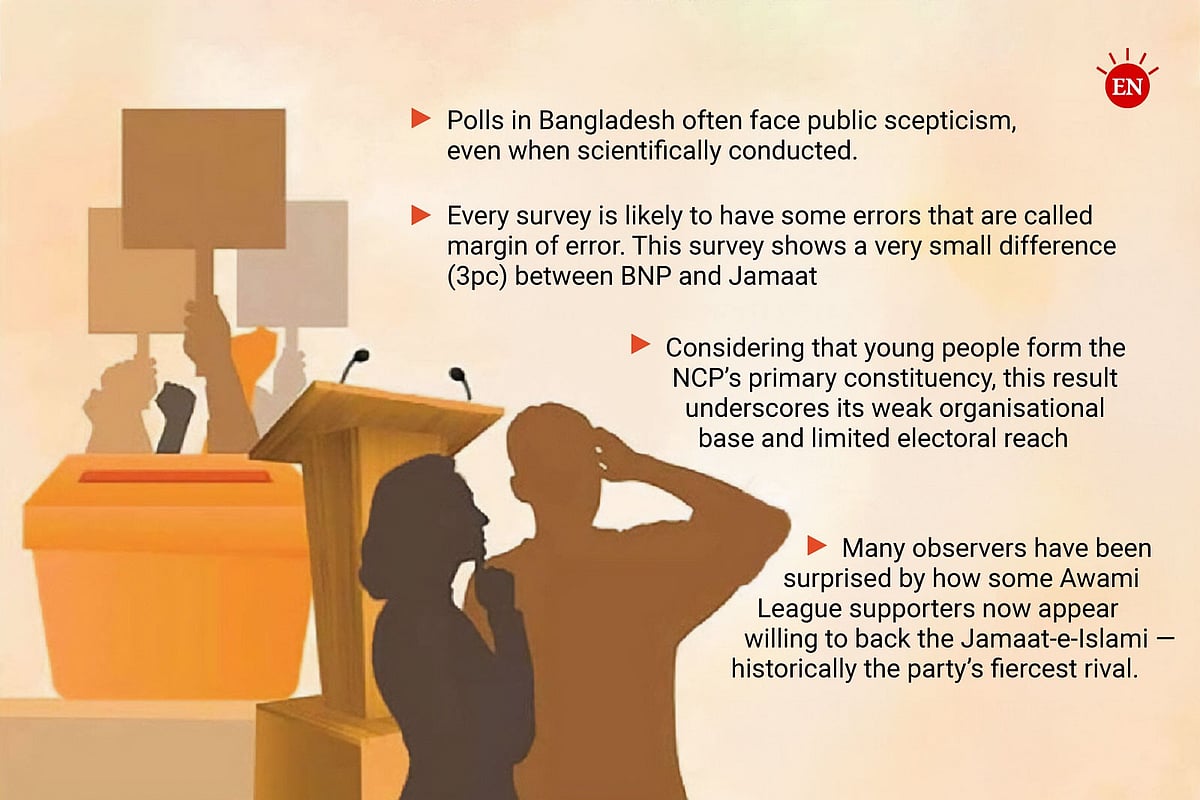
Polls in Bangladesh often face public scepticism, even when scientifically conducted. Many argue that a few thousand respondents cannot represent the complexity of Bangladesh’s population, or that citizens are reluctant to reveal their true political preferences to strangers.
While a healthy degree of scepticism of polls in general is warranted, dismissing them entirely risks missing valuable insights — particularly since results from multiple surveys since the fall of the previous government have shown broadly consistent patterns.
Here are the six key takeaways
1. High voter intention among youth
A striking finding is the youth’s strong intention to vote. Among those polled, 90 per cent identified as registered voters, and of these, an overwhelming 97 per cent said they plan to vote in the upcoming national election. This suggests that young Bangladeshis remain highly engaged in the country’s democratic process.
2. BNP and Jamaat-e-Islami neck and neck
The poll indicates a tight race between the Bangladesh Nationalist Party (BNP) and the Jamaat-e-Islami, with the BNP holding a slight three-point lead (BNP 20 per cent, Jamaat 17 per cent).
While a healthy degree of scepticism of polls in general is warranted, dismissing them entirely risks missing valuable insights — particularly since results from multiple surveys since the fall of the previous government have shown broadly consistent patterns.
Given that the margin of error likely encompasses this difference, both parties appear to have comparable levels of support among young voters.
Regional variations, however, tell a more nuanced story. The BNP enjoys stronger support in Chattogram (19 per cent vs. 10 per cent), Dhaka (24 per cent vs. 19 per cent), and Rajshahi (39 per cent vs. 27 per cent), while Jamaat leads in Khulna (29 per cent vs. 13 per cent).
It is of course worth mentioning that with a first past the post constituency system, the overall percentages can be misleading as how well a party does depends on how “efficiently” the vote is spread in different constituencies.
The rise of Jamaat-e-Islami stands out as one of the most significant developments in post-Hasina Bangladesh. Jamaat’s involvement in supporting Pakistan in 1971, including its role in war crimes, appears to have lost much of its former stigma. Its attempt to reposition itself as a “moderate” religious party does also seem to be working. Yet, with only 17 per cent support, Jamaat remains well short of majority appeal.
Many observers have been surprised by how some Awami League supporters now appear willing to back the Jamaat-e-Islami — historically the party’s fiercest rival.
For the BNP, meanwhile, 20 per cent is a disappointing figure. Many analysts had expected the party to be the chief beneficiary of the Awami League’s collapse. The BNP is historically believed to command at least a third of the national vote, with many commentators concluding that, as Awami League’s authoritarianism increased, its support had become much higher. However, BNP’s relatively modest showing suggests that, with the Awami League no longer a key protagonist, its support has dropped off.
3. Awami League retains notable support
Perhaps surprisingly, 10 per cent of the young respondents said they would vote for the Awami League, making it the third largest party despite its years of authoritarianism and its deadly role in July and August 2024. Given the current climate — when the Awami League is subject to constant public vilification and taking part in its activities is criminalized — this figure indicates a significant undercurrent of residual loyalty, suggesting that the Awami League’s base remains resilient. It should be noted that the poll was undertaken before the conviction at the International Crimes Tribunal for crimes against humanity of the former prime minister and home minister.
4. Disappointing start for the National Citizen Party
The National Citizens Party (NCP), formed by students who led the July 2024 protests, registered only 4 per cent support among respondents. Considering that young people form the NCP’s primary constituency, this result underscores its weak organizational base and limited electoral reach. Without strategic alliances, it is unlikely to secure parliamentary representation.
5. The undecided and the silent voters
The poll’s most consequential finding may be the large share of undecided voters. About 30 per cent of young people say they have not yet made up their minds, leaving substantial room for shifts as the election approaches.
An additional 18 per cent declined to reveal their preference — a group that could include a significant number of “shy” Awami League supporters reluctant to speak openly. If even half of this group leans toward the Awami League, the party’s real support could surpass that of either the BNP or Jamaat individually, though still below the combined opposition.
6. The fate of the former Awami League vote
Assuming the Awami League remains barred from contesting, the poll offers clues about where its former supporters might turn. Over half (56 per cent) say they would abstain from voting, whilst those that would vote, shifting their support to the BNP (20 per cent) or Jamaat (18 per cent), with 41 per cent still undecided.
Many observers have been surprised by how some Awami League supporters now appear willing to back the Jamaat-e-Islami — historically the party’s fiercest rival. There are likely two main explanations for this shift. First, at the local level, BNP activists have reportedly been particularly punitive toward former Awami League members, prompting some to view Jamaat as the lesser of two evils. Second, a segment of Awami League voters may see a Jamaat victory as vindication — proof that the Awami League was right in claiming it was the only true barrier preventing Bangladesh from sliding toward a religious state.
Conclusion
The BYLC youth poll shows how the BNP and Jamaat are battling for dominance but neither commanding broad enthusiasm. The Awami League’s enduring loyalty base and the large pool of undecided voters mean that Bangladesh’s political future remains very fluid.