Opinion
When floodwaters recede, fairness should not
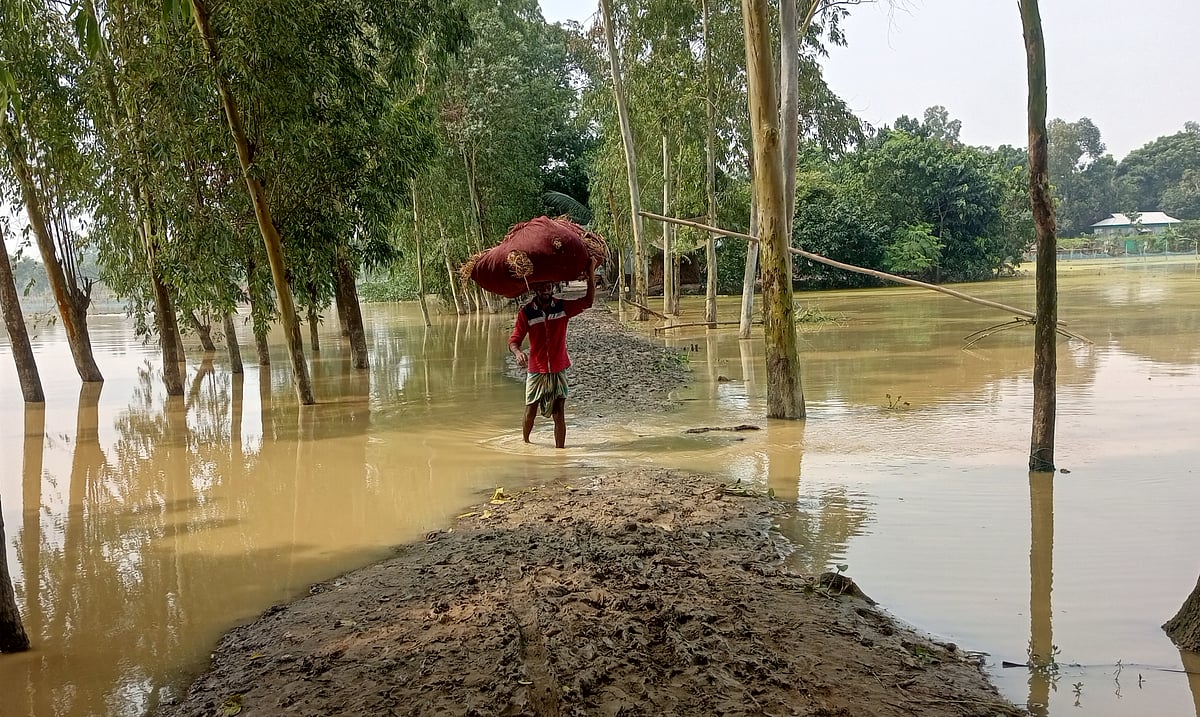
Every flood leaves behind two kinds of damage. One is easy to measure. Homes collapse, roads disappear, crops rot in the fields. The other takes longer to show itself. It shows up weeks later, when some villages have started rebuilding and others are still waiting for help that never quite arrives.
I grew up in Satkhira town. The town center usually escaped the worst of it, but the villages beyond it did not. Every monsoon, I watched the same thing happen. Some places got relief fast. Others sat and waited, and the wait often had nothing to do with how bad the damage actually was. Growing up close enough to notice this without living through it gave me an odd kind of front row seat. I could see who got left behind, and eventually I started asking why.
Years later, working in machine learning, I got an answer I didn't expect. This wasn't just about who had louder voices or better roads into their village. It was baked into the data itself. There's a term for it: allocation bias.
When aid agencies decide where recovery money goes first, they lean heavily on historical records, essentially asking who got help last time. The problem is that those records carry the same unfairness they're supposed to help fix
The 2022 floods in Bangladesh affected 7.2 million people and caused an estimated 405.5 million dollars in damage. When aid agencies decide where recovery money goes first, they lean heavily on historical records, essentially asking who got help last time. The problem is that those records carry the same unfairness they're supposed to help fix. A district that got skipped over after one flood tends to get skipped over after the next one too. Not because it needs less, but ecause the system already learned to look past it.
Unlearning a bad habit
My co-researcher and I built a framework to try to break that cycle. The idea comes from fairness research in healthcare AI, where a very similar problem shows up: models trained on years of biased treatment data end up repeating the same mistakes instead of correcting them.
The method is called adversarial debiasing, which sounds more complicated than it actually is. Picture two students working through the same problem set. One student is trying to figure out how urgently a district needs aid. The other student is only shown that first student's reasoning, nothing else, and has to guess which district it's about. If the second student can guess correctly too often, that tells you the first student was leaning on location as a shortcut instead of actually judging need. So during training, we penalize the model every time that shortcut shows up, over and over, until it starts paying attention to things that actually matter: rainfall, poverty rate, population density, how much damage there really was.
We tested this against real numbers from Bangladesh''s official Post-Disaster Needs Assessment, covering 87 upazilas in 11 districts hit by the 2022 floods. The gap between how well-off and how poor districts scored dropped by 41.6 per cent. Regional fairness gaps fell by 43.2 per cent. And once we corrected for bias, 70.6 per cent of upazilas ended up with a different priority ranking than before.
One example still sticks with me. Sunamganj has a poverty rate of 42.7 per cent and suffered 159.6 million dollars in flood damage, with 94 per cent of the district underwater at one point. Under the old system, it ranked fourteenth for aid priority. Under ours, it moved up to sixth. Habiganj, at 71 per cent inundation, had a similar story. Neither district was ever going to fix its own ranking. The historical data just kept repeating the same mistake.
A small price for a better list
I should be upfront about the tradeoff here. Our fairer model gave up about 2.7 percentage points of raw predictive accuracy compared to the standard version. If you only look at benchmark numbers, that reads as a loss.
I don't see it that way. A model that's very good at predicting who got help last time isn't the same thing as a model that's good at knowing who actually needs help now. Getting that wrong systematically, over and over, for the same districts, does far more damage than a bit of random statistical noise ever could. And in exchange for that small dip, our framework got roughly 40 per cent more consistent. The rankings held steady instead of jumping around depending on which scenario you fed it. When you're making decisions during an actual crisis, you need a list you can trust, not one that just looks precise on a slide.
Speed matters here too. The model runs in under a hundredth of a second per prediction. A flood doesn't wait for a report to be finished, and neither should the tool meant to respond to it.
Beyond one paper
I don't want to oversell this. It's one framework, tested on one country''s data, from one flood year. It isn't a finished policy. What it does show is that the technical pieces needed to make disaster aid fairer already exist. The thing standing in the way isn't capability anymore.
A few things would have to happen for that to actually matter.
Agencies need to audit their historical allocation data the same way they'd audit any dataset before trusting it with decisions about who waits and who doesn't.
Fairness has to sit next to accuracy as something you check, not something you mention once in a footnote.
Districts that keep getting overlooked need to be flagged as a pattern, not rediscovered as a surprise every single flood season.
None of this has to slow anything down. A framework running in real time while correcting for bias is proof that speed and fairness aren''t actually in tension.
And it should connect to something that already exists: Bangladesh''s National Plan for Disaster Management already talks about building back better. This is one concrete way to do that, instead of leaving it as a line in a policy document.
I still think about those villages just past Satkhira town, and the families there who waited longest for help that should have reached them first. Fairness in disaster response isn't some abstract statistic. It's the difference between a family that gets to rebuild this season and one that's still waiting for the next flood to remind everyone they exist. The tools to fix that already exist. What's missing is the decision to actually use them.
* Farjana Yesmin is an independent researcher & machine learning scientist specialising in Trustworthy AI, Federated Learning, and Healthcare Applications
* The views expresses here are the writer's own