Opinion
Why do rivers die
Why do rivers die? Rabindranath Tagore gave a simple yet profound scientific answer to this question. He wrote that rivers (streams of water) die when attempts are made to tightly control and possess them through embankments and domination.
Now scientists are beginning to say, “Living with rivers is more sustainable than trying to dominate them.” In other words, coexisting with rivers is more sustainable than trying to control them.
But to me, this seems to suggest not just coexistence, but a kind of submission to the river—accepting its dominance.
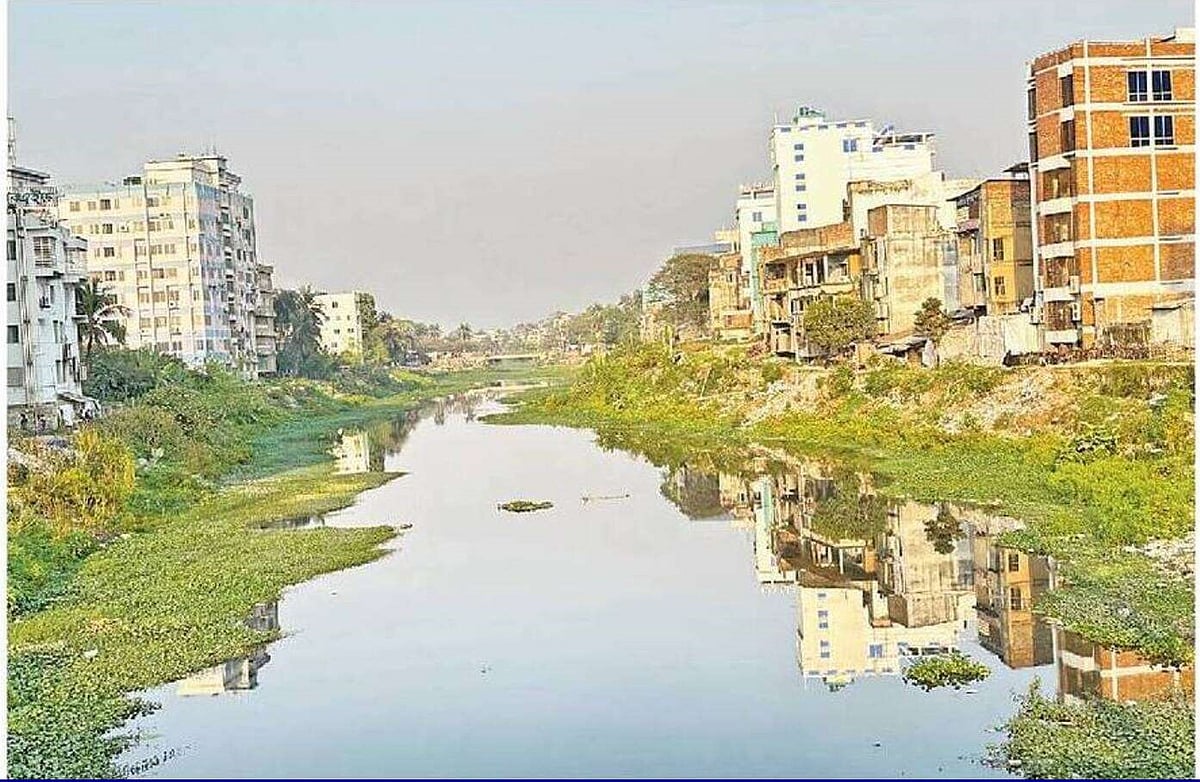
In Bangladesh, in a 2019 ruling, the High Court declared all rivers, including the Turag, as “living entities.” This means rivers have legal rights and protections similar to those of humans.
According to this ruling, occupying or polluting rivers is legally punishable like an attack on humans, and rivers can, in principle, seek legal redress through the courts.
The interpretation of “living entity” states that a river does not mean only the flowing water; it includes its banks, bed, and entire ecosystem. A river is considered a living being capable of feeling in a metaphorical legal sense and has its own right to flow.
If that right is violated, the court is expected to stand on the river’s side. Protection is to be ensured against occupation or destruction of rivers. In essence, actions such as river encroachment or heavy pollution, including industrial waste dumping, can be legally challenged.
Yet despite all this, people involved with river management still do not treat rivers as they should. Environmentalists and river advocates call this mentality “hubris.” In ancient Greece, hubris did not simply mean pride; it referred to extreme arrogance or excessive confidence that leads a person to defy moral law, social norms, and even the gods.
Recently, agricultural entrepreneur Delwar Jahan from Manikganj shared photos on Facebook showing concrete embankment construction along the Kaliganga River and called for an end to such anti-river activities.
He wrote that riverbanks are rich in biodiversity, home to various plants and habitats formed by seeds carried from different places. In river ecology, riverbanks are important transition zones between land and water, known as ecotones, which are among the most biodiverse areas. He argued that covering these areas with concrete or blocks is a serious ecological violation that blocks plant growth and natural expansion.
He also questioned where the people behind such embankment concreting come from. His question carries both frustration and irony. In response, someone wrote that such actions come from a “hubris-affected mindset” driven by so-called engineers attempting to showcase disruptive river-control technologies.
One may ask: why is there a need to concrete the banks of a calm river in Manikganj? Field observation shows that on the opposite bank, a privately owned industrial facility had already begun embankment protection work.
Once one bank is hardened, pressure shifts to the opposite bank, causing erosion there as well. Since anyone can establish industrial facilities after purchasing riverside land, the question arises: do they have the authority to control river management?
In Bangladesh, everyone seems to act as a guardian of rivers, yet there is no effective custodian. Across Panchagarh’s Dahuk, Sirajganj’s Jamuna, Pakshi’s Padma and the Gorai, embankment concreting continues unchecked.
Engineers are not necessarily “hubristic”
We know the name of Indian engineer GD Agarwal. He died on 11 October 2018 after an 111-day hunger strike demanding the uninterrupted flow and ecological integrity of rivers. After graduating in civil engineering from Roorkee University in 1952, he joined government service.
Later, as the first member secretary of India’s Central Pollution Control Board, he realised how administrative complexity and lack of political will were destroying rivers and the environment.
Through his scientific understanding, he concluded that a river is not merely a water channel. He demonstrated that flowing rivers contain a special type of virus called bacteriophages, which destroy harmful bacteria and help maintain water purity.
When rivers are blocked and made stagnant through embankments, these viruses die, and the river’s natural self-purifying capacity is destroyed.
He understood that river protection cannot be achieved only through laboratory work or academic writing; it requires mass awareness and moral pressure on governments. From his experience, he observed how more than 450 small and large dams were planned on the Ganga alone, fundamentally altering the river’s upper ecosystem.
His struggle for the Ganga began in 2008. Under pressure from his fast, the Uttarakhand government was forced to cancel major hydropower projects such as Loharinag Pala and Pala Maneri on the Bhagirathi River. Reports suggest that as a result of his movement, about 135 kilometers from the Bhagirathi’s source to Uttarkashi were declared an eco-sensitive zone.
Are there alternative ways to protect riverbanks?
We may not have a GD Agarwal, but many are searching for alternatives to protect riverbanks without killing rivers. In Bangladesh, due to strong currents, floods, and seasonal variations, riverbank erosion is a major problem. Traditional concrete or stone embankments are often expensive and environmentally harmful.
In contrast, vetiver grass is a deep-rooted plant that stabilises soil naturally and provides a long-term sustainable solution. Vetiver-based riverbank protection is no longer just a theoretical idea; it has been successfully implemented in countries such as India, Thailand, Vietnam, and Fiji, proving its effectiveness as a sustainable method.
In the Sundarbans region of West Bengal, vetiver grass is being used to address repeated embankment failures. In one pilot project, around 3,350 vetiver plants were planted along a 200-metre embankment, significantly reducing soil erosion and increasing stability.
Expansion on a larger scale is now being planned locally.
Riverbank protection measures should ensure that natural river flow is maintained, biodiversity is not harmed, and long-term sustainable solutions are achieved.
* Gawher Nayeem Wahra Writer and researcher wahragawher@gmail.com
* Opinions are those of the author alone