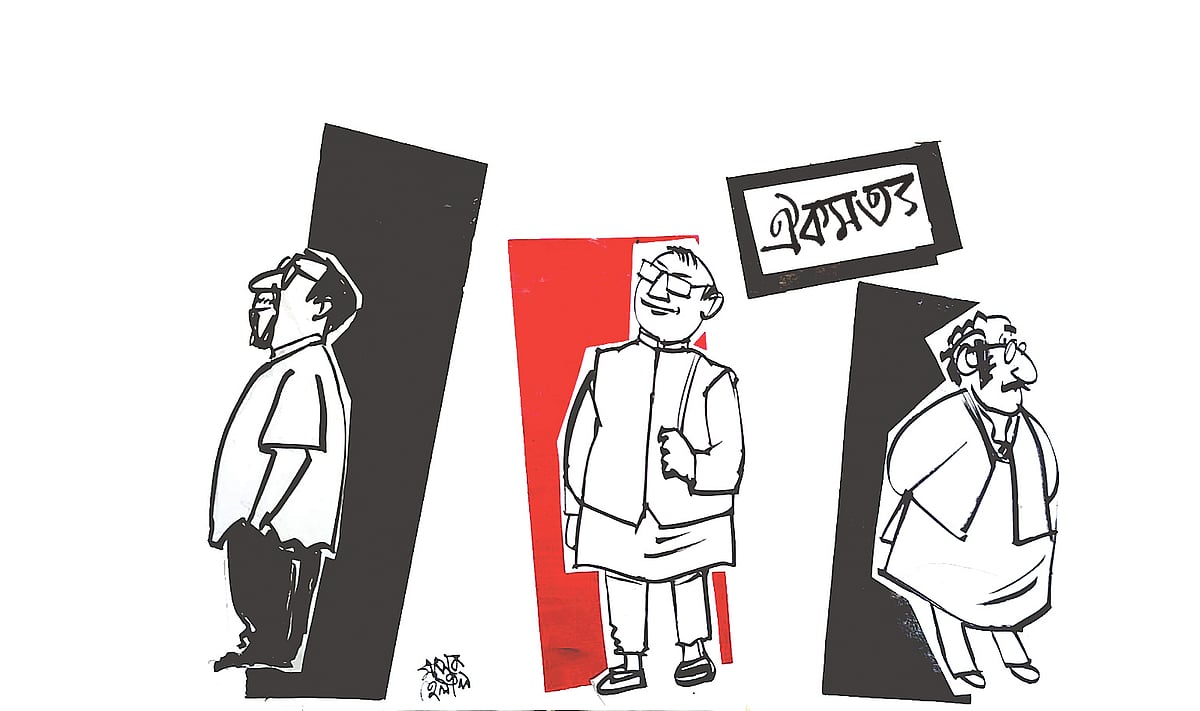
We keep hearing the same question from birth: "How are you?" The same answer follows: "I’m fine." But are we really fine? Is there even room to be fine?
Everywhere we look, there is scarcity. Prices of essentials are rising at a geometric rate. Once they go up, they never come down. Pay commissions, dearness allowances—these benefits apply to, at best, 5 per cent of the working population. It might be even less. So, how are the rest surviving? For the vast majority, the state has become irrelevant—because the institution does not serve their needs.
For those who benefit from the state, elections are a key matter. But what exactly is an election? According to those in power, it is the ultimate solution to all problems. They say that having an elected government ensures social stability, law and order, and smooth governance—peace and peace everywhere!
From 1973 to 2024, we have witnessed 12 national elections. Those who reaped the benefits of those elections always praised them. They claimed to have received the people’s mandate. And to them, "mandate" means the freedom to do whatever they please. In the process, they’ve trampled on the Constitution, cut it to pieces, and left it in shambles. Each group wants to restore whatever version of it suited their rule.
From 1973 to 2024, we have witnessed 12 national elections. Those who reaped the benefits of those elections always praised them. They claimed to have received the people’s mandate. And to them, "mandate" means the freedom to do whatever they please. In the process, they’ve trampled on the Constitution, cut it to pieces, and left it in shambles. Each group wants to restore whatever version of it suited their rule.
Speaking of the Constitution, one thing must be said—it’s often referred to as a sacred text. In this country, there’s no shortage of what’s labeled "sacred." The sacred Constitution, the sacred halls of the Supreme Court, the sacred grounds of universities, the sacred Parliament. There’s an overabundance of "sacredness." Yet, somehow, it feels like the country has become a garbage dump—over which various groups are fighting for control.
What if we prepared an autopsy report of the past 12 elections? People often demand white papers for all sorts of things. Why not one for elections? But no such report exists. Those who "win" elections believe they were flawless—textbook examples of democracy. They insist they have the people’s mandate. But do they, really? If we scan the newspapers and listen to the voices in people’s hearts, we’ll find these elections were more about territorial control and plundering rights than representation. If that weren't the case, why are we even discussing a new political arrangement today?
Now the state, the constitution, and elections are all caught up in this proposed "new arrangement." But what is this arrangement? It’s still unclear. The urban, book-reading middle class interprets it one way; the urban poor and rural farmers understand it differently. The politicians, intellectuals, Sufis, and thinkers who emerge from this middle class explain it in ways that suggest they alone possess the truth—the ultimate cure for human liberation is in their hands. If the nation simply followed their ideas, it would become a paradise. They have manifestos, discourses, and ideological frameworks. But now, those manifestos and discourses have themselves become sources of chaos. No one agrees with the other. To resolve this, they say, elections will allow citizens to decide which path they prefer.
But those who won’t benefit from elections also have arrows in their quivers. They claim elections are not the path to liberation. An election only replaces one party with another—like jumping from a burning oven into a boiling pot. What’s the point of all this? What we need now, they argue, is a revolutionary government.
But those who won’t benefit from elections also have arrows in their quivers. They claim elections are not the path to liberation. An election only replaces one party with another—like jumping from a burning oven into a boiling pot. What’s the point of all this? What we need now, they argue, is a revolutionary government.
After 12 elections, we finally saw a public uprising in July 2024.
Some have even called it a revolution. It is said that the interim government currently in power came to office with the mandate of that uprising. But what are we actually seeing now?
Those who once stood side by side during the uprising are now splintered into factions. They're not just criticising one another — they’re outright tearing each other down. Former allies have become bitter enemies. Barely a year has passed, and this fragmentation has become one of the most striking anti-climaxes of recent times. But why did this happen?
Taking advantage of the situation is the very group that was ousted by the 2024 uprising. They are slowly reemerging — like a turtle cautiously sticking its head out of its shell to survey its surroundings. And now they say, “We were better off before.”
Recently, two events have unfolded that deserve discussion.
First, a rift within the Jatiya Party. We know this party revolves around a single individual. The chairman can hand out or strip away party positions at will. But after all this time, a few leaders seem to have finally come of age. They began voicing concerns about curbing the chairman’s powers. In response, the chairman expelled them and reshuffled the party committee. The “disgruntled” leaders formed their own committee and went as far as expelling the chairman himself. They were joined by former Jatiya Party leaders who had long fallen out of the party’s mainstream.
Tension then arose over control of the Jatiya Party headquarters. Amid this conflict, a group rushed toward the party office demanding that the Jatiya Party be banned. Strangely, they didn’t go to the Jamuna (implying a symbolic location) or the courts—they went straight to the party’s office. I can’t quite make sense of this move. There, chaos erupted. Clashes broke out. The police and military, already frustrated, beat people indiscriminately. Then the Jatiya Party office was set on fire.
The second incident centers around Bhanga, a sub-district.
The election commission recently redrew parliamentary boundaries, merging two unions from Bhanga into another constituency. This triggered intense protests. And as usual, protest meant vandalism and blocking key roads, causing massive suffering to thousands. One thing is clear: local leaders treat their constituencies like inherited family estates. The concept of “my area” is very strong. They don't want interference in what they consider their domain. In our country, nationalism has yet to rise above union, upazila (sub-district), and district levels. So national unity remains a distant dream.
According to the interim government’s announcement, the 13th National Parliament election is scheduled for the first half of February next year. Political parties are still locked in debates over reforms, manifestos, and charters. For the interim government to exit with dignity, holding the election is necessary—but so is achieving a minimum level of consensus on key issues.
Of course, we cannot expect agreement on every single point. In our country, we split parties over a few words in a manifesto, only to form “unity alliances” later. What could be more farcical?
If national consensus means an understanding between political parties, then we cannot wait a thousand years for it. The government must make certain decisions unilaterally. If we had a regimented government, it wouldn’t be an issue.
Take, for instance, Field Marshal Ayub Khan, who in 1961 issued the Muslim Family Law Ordinance. It was during military rule. Except for Jamaat-e-Islami, all parties accepted it. Ayub Khan even jailed the Jamaat leaders. In my opinion, this was the most progressive law of its time in the subcontinent. It remains a noteworthy example.
*Mahiuddin Ahmad is a writer and researcher
*The views expressed are the author’s own.