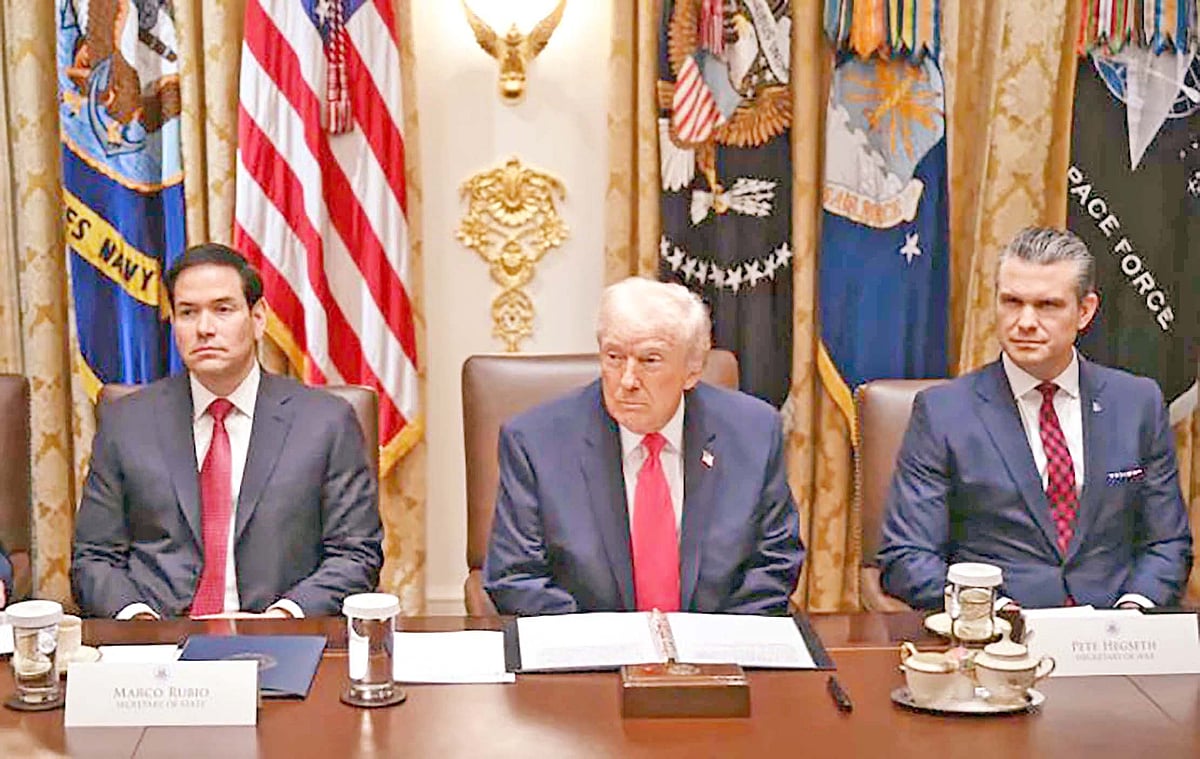
US President Donald Trump has introduced several fundamental changes to the country’s security outlook in the 2025 United States National Security Strategy formulated under his administration. In this strategic document, the United States has redefined its priorities around national interests, sovereignty, and economic strength. Moving away from the expansive global role of the post–Cold War era, the new security policy signals a more inward-looking United States.
This perspective clearly hints at a revival of the Monroe Doctrine, meaning the Western Hemisphere is once again being viewed as the United States’ natural sphere of influence, with the primary objective of limiting the presence and influence of external powers. Under this new strategy, economic and industrial policies are treated as integral components of national security. Particular emphasis is placed on reindustrialisation, strengthening supply chains, and enhancing technological competitiveness.
In other words, alongside military power, economic instruments are now given equal importance in the security strategy. The focus has shifted away from broad multilateral commitments and the promotion of democracy toward interest-based bilateral relationships and greater burden-sharing by allies.
The geopolitical importance of the Middle East has also relatively declined in US security thinking. Instead, strategic competition in the Indo-Pacific region has been prioritised. In this context, the United States appears more interested in economic and technological competition than in maintaining a long-term military presence.
Overall, this policy establishes a new framework for US national security, one that places greater emphasis on economic power centered on sovereignty and on region-specific priorities.
Against this backdrop, the most important question is how this shifting US strategy will affect the geopolitical position of the Global South and what impact it will have on Bangladesh. Countries of the Global South generally depend on major powers for trade access, development assistance, and security cooperation.
As a result, US policy realignment could either narrow these countries’ strategic space or, if managed carefully, create new opportunities. Several issues are becoming particularly important for this region.
Under the revised strategy, economic nationalism is treated as a central pillar of security, while interstate deterrence capabilities in the Indo-Pacific are given renewed importance. At the same time, the United States is moving away from a values-based foreign policy toward using energy dominance as a strategic tool and applying an “engage and expand” approach toward the Global South.
The first and most significant feature of the new US strategy is its emphasis on economic nationalism, with tariffs being used as an important instrument of national security. The recent decision to impose tariffs on Bangladeshi exports indicates that Washington is moving toward a more transactional economic relationship than before.
In the future, access to the US market will no longer be purely a commercial matter but will be closely tied to strategic relationships. This poses a major challenge for Bangladesh. Although the United States has long been the largest market for Bangladesh’s ready-made garment exports, changes in tariff policy are reducing the sustainability of one-way trade flows.
If the United States continues to import goods from Bangladesh, it will expect Bangladesh to increase its dependence on US imports and align its export strategy with America’s nationalist economic policies. In this situation, Bangladesh will need to rethink its approach. On one hand, export market diversification will be essential; on the other, Bangladesh must prepare for more balanced trade negotiations with the United States in the context of economic security.
Another concerning aspect of the new strategy is the emphasis on US energy dominance and plans to expand fossil fuel production, which effectively sidelines efforts to address global climate risks.
For climate-vulnerable Bangladesh—where adaptation and energy transition are critical—this position is understandably troubling. At the same time, the reality is that the United States is likely to seek to expand its geopolitical influence not through climate assistance, but through exports of surplus energy, particularly LNG. In this context, Bangladesh faces both challenges and an opportunity for strategic decision-making. A structured, long-term framework for importing LNG from the United States could help ensure energy security, provided it is pursued in a balanced manner.
Under the new strategy, the United States is no longer emphasising the promotion of democracy and values as strongly as before. Instead, it aims to pursue a foreign policy with less intervention in the internal affairs of other countries, unless those issues directly conflict with US interests. For countries of the Global South, the impact of this shift is twofold. On the one hand, it may reduce political pressure and conditionalities, offering some relief in domestic affairs. On the other hand, weakened moral commitments could fuel authoritarian tendencies and destabilise regional power balances. For Bangladesh, this means that future relations with the United States will increasingly depend on strategic alignment rather than normative considerations.
Although this shift offers some relief at a politically sensitive time, it also creates pressure to adopt a more carefully planned and conscious foreign policy posture. A clear change in tone is evident in the United States’ new approach toward China. Rather than portraying China as an ideological adversary, it is now viewed as a strategic competitor whose rise in the Indo-Pacific must be managed with caution.
In this approach, the United States is stepping back from its role as the “guardian of the world” and seeking to place greater responsibility on regional allies such as India, Japan, South Korea, and Australia. This signals the emergence of a more multipolar security architecture in the Indo-Pacific, where regional powers will play a more active role. For Bangladesh, this posture creates certain strategic opportunities.
In the absence of rigid binary divisions, Dhaka can maintain relations with the United States while continuing cooperation with China, including under the Belt and Road Initiative. If Bangladesh can position itself skillfully in this competitive environment, it stands to benefit across multiple areas, including infrastructure investment, technology transfer, and diplomatic influence.
Under the “engage and expand” policy toward the Global South, the Trump administration is shifting away from aid-based relationships toward investment- and interest-driven partnerships. The recent shutdown of USAID operations worldwide reflects this transition, signaling a move away from development assistance–dependent relations in favour of strategic, interest-based partnerships.
This shift has created a new reality for Bangladesh. Although mineral resources are not a major issue for the country, rising risks of extremism, terrorism, and human trafficking in border regions mean that security cooperation could become a key area of engagement with the United States.
If existing counterterrorism and law enforcement initiatives can be aligned with new US priorities, Bangladesh’s security capacity could be strengthened through mutual interest–based cooperation rather than aid dependence.
The US security strategy makes it clear that Washington now seeks to use trade as its primary tool for advancing strategic interests. In this context, it is crucial for Bangladesh to build a balanced economic partnership with the United States. There are opportunities to enhance security cooperation with Washington amid the resurgence of regional terrorism. At the same time, Bangladesh must remain cautious, as other powers may pursue similar interest-driven approaches.
Overall, in a rapidly changing global order, Bangladesh has no alternative but to adopt a coherent and forward-looking strategy to safeguard its interests and maintain diplomatic balance.
*Lt. Gen. (Retd.) Muniruzzaman is President, Bangladesh Institute of Peace and Security Studies
#The opinions expressed are those of the author.
#This article, originally published in Prothom Alo print edition, has been rewritten in English by Rabiul Islam