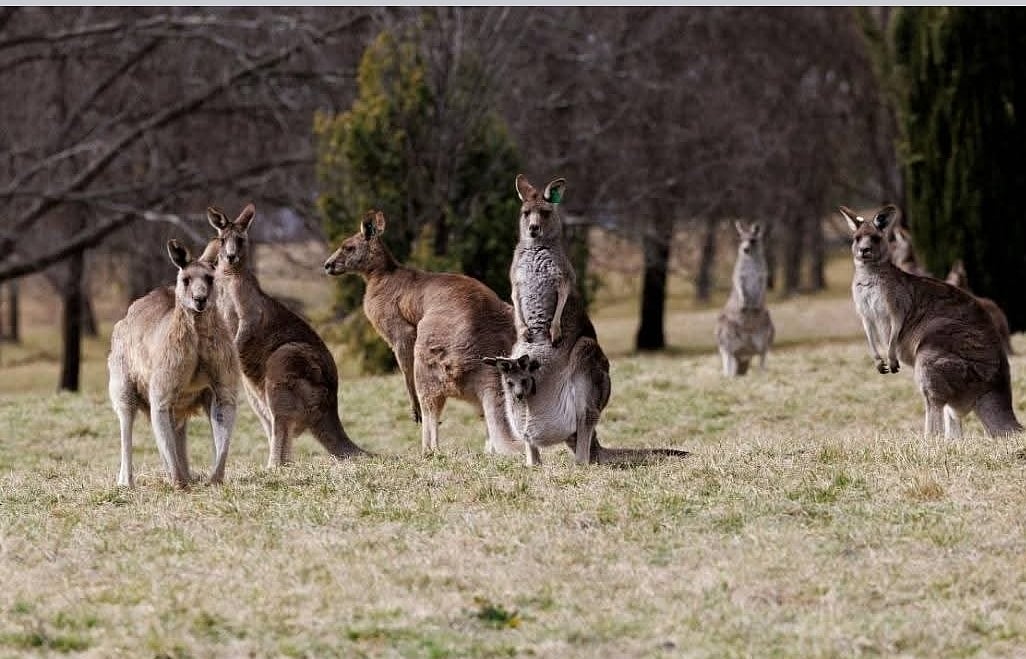
We squealed like excited children on a school trip - "Kangaroos!" We could hardly be blamed. For most of us, this was the very first time were we seeing this rather wondrous creature, some even with little joeys tucked away in their pouches.
We were a motley crew -- five women from Bangladesh -- three journalists, a human rights activist and an up-and-coming politician. We were part of a Canberra Fellowships Program offered to us by Australia's Department of Foreign Affairs and Trade.
On this particular segment of the trip, we were on, what one of us dubbed as "a kangaroo safari." The Governor-General of Australia, the Hon. Sam Mostyn, had hosted a morning tea for us at the Government House. After an enlightening and interactive meeting, she most graciously took us around the grounds in a sort of longish golf cart and that's where we had our first kangaroo sighting.
Personally speaking, this was my first trip to Australia. Koalas, kangaroos, Shane Warne, Crocodile Dundee, Hugh Jackman were the things that would spring to mind at the mention of Australia. Of course I knew a lot more, but much remained on the peripheries of the mind. So this trip was an eye-opener, and it opened new horizons on so many fronts.
Meeting the media
A visit to the ABC studio introduced us to some jaw-dropping technology like unmanned robotic cameras, floor-to-ceiling screens in the news studio, and all sorts of futuristic equipment.
What was most interesting to us journalists was interacting with ABC News Verify, the Australian national broadcaster's fact checking and verification unit. Matt Martino, Lead of ABC News Verify, discussed with us how they tracked and debunked false and misleading information online, and also how they verified content and information while working on hard-hitting investigations.
During the elections, "horse race journalism" tended to focus on who was winning and who was losing, rather than candidate policy and political agenda
We were given a further look into the global perspectives of fact checking and political misinformation in particular, while visiting the University of Melbourne's Centre of Advancing Journalism (CAJ). Dr Nicholas Payne, Coordinator of CAJ's Key Skills subject, spoke on the problems of political reporting in Australia. He spoke of how, during the elections, "horse race journalism" tended to focus on who was winning and who was losing, rather than candidate policy and political agenda.
He also spoke of the danger of political journalists considering themselves to be "insiders". That reminded me of SM Ali, the founder editor of Daily Star, who so many years ago had shared words of wisdom: "Don't get too familiar with political leaders, calling them 'Amu bhai', 'Tofail bhai'. Later you won't be able to write anything critical of them." True that!
Women of substance
As an all-woman team, it felt good to meet so many women powerhouses during this trip, women with voices that made a difference. And one such woman was the renowned journalist, senior news broadcaster at ABC, Leigh Sales.
During our informal roundtable with Leigh Sales, she spoke very frankly and at length at the problems faced by women in media. Her words really resonated with us. As women journalists, we are quite often at the receiving end of unsavoury comments, social media abuse and bullying as well as security issues. When a woman like Leigh Sales shared her experiences and trauma, we asked her how she dealt with all this and still came out so strong and confident. She readily responded with some pragmatic tips that keep her safe and sane. We can all take a page out of her book.
Never has a prime minister been so assiduously stalked. Cast as a political liar and policy charlatan, Julia Gillard was also mercilessly and relentlessly lampooned for her hair, clothes, accent, her arse, even the way she walks and talks.Kerry-Anne Walsh in her book The Stalking of Julia Gillard
She said that once she leaves office, she simply stops scrolling through social media. She shuts out the bullying and toxicity by not even looking or listening to it. She told us, "Counsel young journalists to insulate against such attacks." She said, "The best champions of women are women and it helps that gradually more women are entering editorial roles, bringing diversity to media." She elaborated that women were more conscious of matters like childcare, special needs and such.
Another point she made echoed our concerns. "Being the only woman in a room, it feels like your ideas are not being listened to. Make sure your voices are heard," she stressed.
Pathways to Politics for Women
In Melbourne we met with Meredith Martin, the founder of Pathways to Politics for Women and Associate Director of Cultural and Public Engagement at the University of Melbourne.
As journalists, said Meredith Martin, we may not be politicians but we are very much the part of the political scene. And women in politics, as well as others, need a voice. It was intriguing to learn that even in the developed world, women in politics can be subject to harsh gendered online abuse.
The young politician in our group from Bangladesh could relate with the experience of Susanne Newton, a Pathways to Politics for Women fellow and former mayor of Darebin, a city outside of Melbourne. As mayor and politician, Susanne Newton faced toxic personal online attacks and even now hasn't quite overcome the trauma. She stressed the need for advocacy about what can be done practically to tackle this. While blocking such abusers, she said it is also important to keep their comments as a record for the sake of evidence.
Even a strong leader like the former prime minister of Australia, Julia Gillard, was victim of stereotyping female politicians. Her clothes, face and figure got more attention that her policies and leadership. In her book, The Stalking of Julia Gillard, former journalist and political commentator Kerry-Anne Walsh writes rather bluntly, "Never has a prime minister been so assiduously stalked. Cast as a political liar and policy charlatan, Julia Gillard was also mercilessly and relentlessly lampooned for her hair, clothes, accent, her arse, even the way she walks and talks."
The author's words were reinforced when we visited the Parliament House where paintings of former prime ministers lined the hallway. All the male prime ministers had portraits of them standing up, or sitting down and in various poses. But Julia Gillard's portrait was just of her head and shoulders. Having faced enough attention to her body and clothes, she chose just to have her face on the wall.
Tim Watts MP
It was heartening, therefore, when we met with the member of parliament and Indian Ocean Special envoy, Tim Watts. He spoke of his strong support for affirmative action for women, saying that everyone benefits from it, men and women alike.
It was interesting meeting with Tim Watts too, because he had a large Bangladeshi diaspora in his constituency. He proudly spoke of the Bangladeshi-origin achievers who were contributing to Australia's economy, such as Robin Khuda, Australian Financial Review's 'Business Person of the Year.'
Back to the birds and billabongs
After a whirlwind trip of meeting so many people, visiting so many institutions and enjoying such delicious food (I could write a book on that!), we drew to the end of our trip with a tranquil and enriching Aboriginal Heritage Walk at the Royal Botanical Gardens Victoria. It gave us a look into the First People's heritage and living culture in relation to the plants and landscape there.
We saw trees and herbs with all sorts of medicinal qualities, beautiful flowers, birds and the calm waters of the billabongs.
We left Australia, enriched by the experience, warmed by the friends we made along the way, and a little wistful.