Opinion
Individual freedom and state surveillance
My close friend from my school days had ranked on the merit list in the HSC board examinations. After completing my honours degree, I went abroad for further studies, but my academically brilliant friend could not. Her family did not allow her to go abroad alone for study while she was unmarried. She was never able to break free from that family rule.
Many years later, I was reminded of that friend, who could not break the invisible chains imposed by society, when I read the news on 8 August 2026 that three adult women had been stopped at Dhaka International Airport from travelling to Nepal. The immigration authorities said they were prevented from travelling because they were unmarried women. On 29 September, the High Court issued a rule asking the immigration authorities to explain the legality of preventing them from travelling and also directed them not to stop the three petitioners from travelling in future without legal grounds.
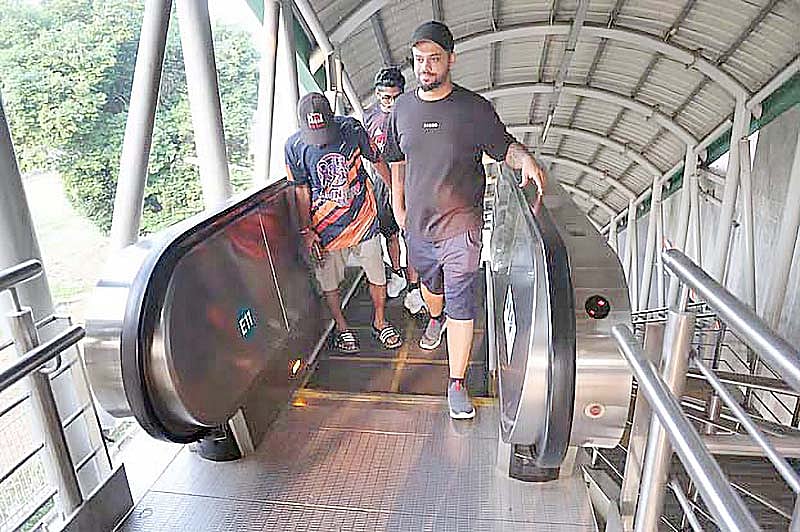
Meanwhile, on 27 September, an athletics coach alleged that a police officer detained him for nearly 40 minutes at Farmgate metro station because he was wearing shorts. He was told that his clothing was ‘indecent’ and that she should wear trousers or full-length pants. An analysis of the two incidents suggests that the authorities concerned are not merely preventing individuals from exercising their constitutional rights; they are also prescribing how people should conduct themselves according to their own preferences.
The question is: will people in Bangladesh be able to freely exercise the fundamental rights guaranteed by the Constitution, or will we have to pay the price for personal freedom by becoming entangled in rules made at someone's whim?
First, we need to see whether Bangladesh has any law governing what people can wear. No, there is no such provision. Rather, Article 31 of the Constitution of Bangladesh states that no action detrimental to a person's life, liberty, body, reputation or property may be taken except in accordance with law. Moreover, under the Bangladesh Passport Order, 1973, a passport may be refused, restricted or cancelled only on specific legal grounds. Therefore, preventing ‘unmarried women’ from travelling abroad or harassing people for wearing particular clothes may reasonably be viewed as unlawful and an abuse of power.
How a state treats its ordinary citizens, particularly women, has a profound impact on society in many ways. For example, when the state takes various measures to advance girls and women, it not only helps women move forward but also encourages society to accept and embrace that progress.
Yet recently, we have seen the opposite as well. During the tenure of the former interim government, women were repeatedly harassed in various places and in various ways in the name of ‘moral policing’. For instance, a female student of Dhaka University was harassed over wearing an orna, and the person who harassed her was later welcomed with flowers like a hero and helped secure bail.
In another incident, two women were beaten in public on a launch, while efforts were later made to justify the assailant's actions as ‘disciplining them as an elder brother’. We have also seen incidents in which women were forcibly held down and had their hair cut in public.
At the time, Bangladesh Bank also issued a directive concerning the dress code of its officials and employees, which was later withdrawn following strong criticism. Such incidents cannot be viewed in isolation. They are merely individual googly balls cleverly thrown from the Pandora's box of insidious attempts to control people's private lives.
The main purpose is to observe how ordinary people react to these incidents. A particular ideological group seeks to gradually establish its desired norms of behaviour in society, in different ways and in different places. For example, when other unmarried women read the news that three women were barred from travelling abroad because they were unmarried, they may eventually begin to think, ‘If I want to travel abroad, something similarly unpleasant could happen to me.’ This may cause them to self-censor without even realising it.
The problem is that in our country, even issues of serious public interest tend to disappear from public memory soon after generating intense debate, overwhelmed by a constant stream of new stories. But incidents of this kind deserve to be discussed repeatedly. Equally important is the need for the government to take prompt and specific action against those responsible for such violations of personal freedom.
One may ask why it is necessary to examine the reasons behind these incidents seriously. Why is clear guidance from the government necessary? Let us explain. When three women are told, ‘You are unmarried, so you cannot travel abroad alone’, and a man is told, ‘Your clothes are indecent, so you cannot use public transport’, the two incidents may appear different on the surface, but there is a common thread in the underlying logic of the authorities involved.
In both cases, the authorities first imposed an arbitrary standard of what constitutes the behaviour of a ‘proper’ or ‘decent’ citizen and then abused institutional power to control the behaviour of those who fell outside that standard. When a social or moral standard imposed in this way is enforced through state authority, personal behaviour ceases to be merely a matter of individual choice and gradually becomes a matter of state control.
The gendered implications of these two incidents are also not the same. When questions are raised about an adult woman's marital status and her parents' permission despite her having a passport, visa and all the necessary documents for travelling abroad, it indirectly suggests that an adult woman is not an ‘independent individual’ but merely a subordinate, lesser person under the authority of men and her family. At a time when the world is striving for gender equality, the emergence of such incidents in Bangladesh in 2026 is deeply undesirable and disappointing.
Therefore, we cannot limit the issue to questions of personal freedom such as ‘who can wear what’ or ‘whether a woman can travel abroad alone’. When the state or state authorities begin judging a person's choice of clothing, movement or decision to travel abroad against supposed standards of ‘decency’, ‘morality’, ‘family honour’ or ‘appropriate behaviour’, a fundamental question arises: who decides what behaviour is normal, decent or acceptable? And who has given the state the power to enforce such standards?
It must be made clear whether a citizen has the right to make independent decisions about their own life, or whether their civil rights will be applied differently based on their gender, marital status or clothing. I therefore believe that repeatedly questioning such unwarranted and discriminatory decisions, when they are enforced by law-enforcement or security agencies, is our civic and intellectual responsibility.
#Umme Wara is Associate Professor, Department of Criminology, University of Dhaka
*The views expressed here are the author's own.
#This article, originally published in Prothom Alo print and online editions, has been rewritten in English by Rabiul Islam