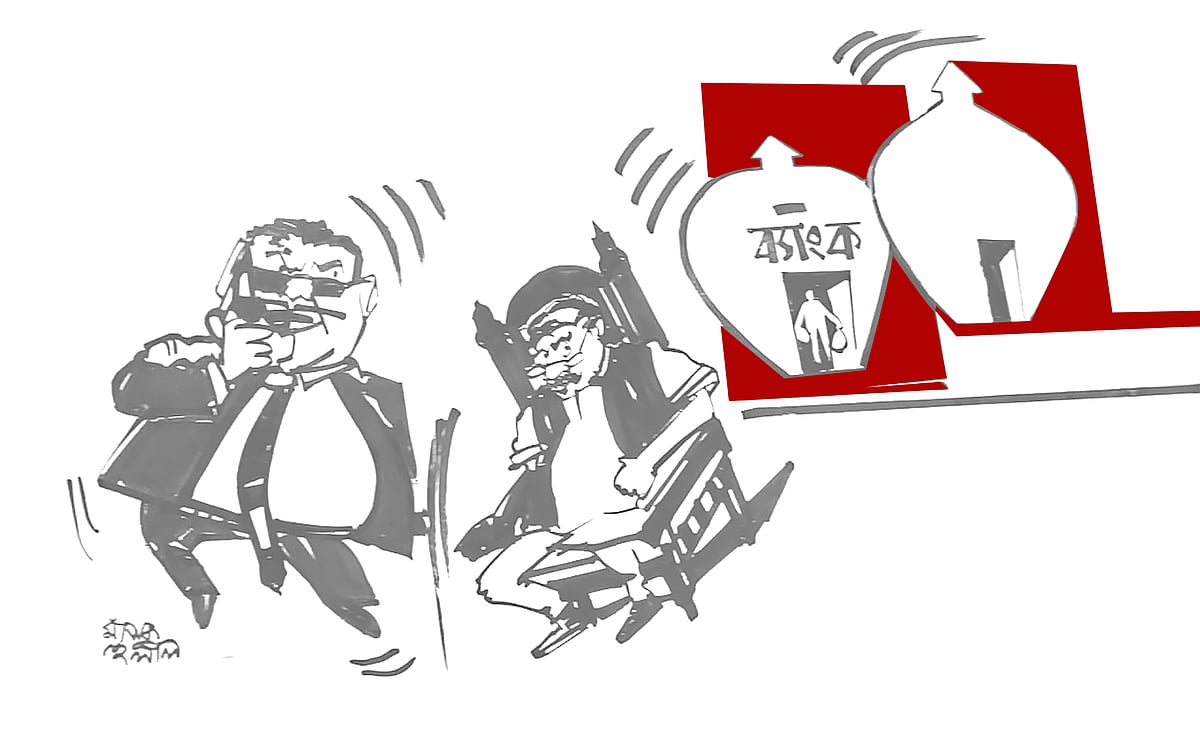
The BNP government has drafted a law allowing the ownership of five consolidated banks to be returned to their previous owners. This will be considered a historic mistake. Since 1982, private banks have started being established in the country. Currently, the number of private banks has increased to nearly fifty. Bangladesh now has a total of 61 banks. Experts have long argued that, although the country does not need so many banks, successive governments have granted numerous private banking licences in the interest of “crony capitalism.” The highest number of banks were established during the regime of dictator Sheikh Hasina.
The awarding of these licences was done to provide unbelievable opportunities for capital plundering by Hasina's relatives, influential leaders of the Awami League, oligarchic businessmen, and ''robber barons.'' Despite repeated objections from the late Finance Minister Abul Maal Abdul Muhith, Hasina could not be restrained from making such erratic decisions.
Many of the wealthy businessmen and industrialists during Bangladesh's 55 years have been owners or directors of some bank. While they may not be able to borrow too much from their banks, they could easily obtain loans from each other's banks. This way, they have established almost monopolistic control over the total bank loans in Bangladesh. Various studies have found that nearly 82 per cent of the country's non-performing bank loans are stuck with them.
Although it may not be fair to label them as Bangladeshi versions of America's ''robber barons,'' the entanglement of economy and politics, and the patronage of ruling authorities have become defining features for most of Bangladesh's wealthy individuals. Among these, the distribution of bank ownership is identified as a major form of patronage.
According to a 2018 survey by the US research firm ''Wealth-X,'' 355 millionaire wealthy individuals in this country have positioned Bangladesh as one of the world's champions in the rise of wealthy people. In my view, bank loan plundering has played the most crucial role in the growth of wealthy individuals in Bangladesh.
Reports in newspapers revealed that a business group in this country was provided with bank loans amounting to Tk 220 billion. During Hasina's regime, another businessman, S Alam, was allowed control over seven banks in the country. A ''suo moto'' rule by a High Court bench to investigate him was halted by an order from the Supreme Court's ''Chamber Judge.''
While several of Sheikh Hasina's relatives have become owners of banks, there is no trace of how they met the ownership condition of depositing at least Tk 200 million. Perhaps other business bank-directors have cleared the debts on behalf of these relatives. During Hasina's regime, extending the terms of bank owners, directors, and their family members became a ''culture.'' Undoubtedly, owning banks or becoming a director has become the most reliable avenue for easily becoming a millionaire in this country.
Between 2009 and 2024, the banking sector suffered the most looting, resulting in 11 of the 61 banks facing bankruptcy. Among these 11 banks, seven were owned by the S Alam Group from Chittagong—Islami Bank Bangladesh, SIBL, First Security Islami Bank, Union Bank, Commerce Bank, NRB Global Bank, and Al-Arafah Islami Bank. Allowing one person to control seven banks is unprecedented anywhere in the world.
Until 2017, Islami Bank was primarily controlled by Jamaat-e-Islami. At that time, it was the largest of the country's private sector banks, handling about 30 per cent of the remittance flow from expatriates. Such a powerful bank was brought under S Alam's control under the direct instructions and support of the dictator Hasina.
From 2017 till 5 August 2024, within seven years, S Alam looted around Tk 700 billion from Islami Bank in various ways, bringing it to the brink of bankruptcy. S Alam has looted and smuggled approximately Tk 2000 billion from seven banks under his control abroad. A relative and close associate of S Alam, the government's land minister Saifuzzaman Chowdhury, plundered the United Commercial Bank. The institutions of Beximco Group, owned by Hasina's advisor Salman F Rahman, owe over Tk 500 billion in overdue loans across various banks.
Recently, to save the five looted banks from bankruptcy, a ''United Islami Bank'' was launched. Research by the White Paper Committee, led by Debapriya Bhattacharya, revealed that through Hasina's 15.5 years of loot dynamics, a total of 234 billion dollars have been plundered and mostly laundered abroad, amounting to about 16 billion dollars annually.
It has been conclusively proven to economists over the past one and three-quarter years since the uprising on 5 August 2024, and her ousting from power, that even if Hasina had not lost power as a dictator, she could not have saved the country’s economy from the inevitable aftermath of an ''economic meltdown.'' From this perspective, we have indeed been spared the embarrassment of becoming another Sri Lanka. However, there is a significant doubt about whether the laundered 234 billion dollars can ever be brought back to the country.
The current government, perhaps following the path of the interim government, may be able to halt the decline in foreign exchange reserves through export earnings and the growing remittance flow. Still, the billions laundered abroad by capital smugglers will never be recovered by the nation. Instead, until the fall of Hasina's government, during 15.5 years, the Bangladesh government has submerged Tk 18.35 trillion in debt, most of which has been laundered. This laundered money will enable Hasina, her family, relatives, a few oligarchic businessmen, and several thousand money launderers to enjoy their remaining lives abroad in comfort and luxury!
Now the BNP government is paving the way for these capital smugglers to return to prosperity by arranging for the banks' ownership to be returned to their previous owners. The removal of Ahsan H Mansur immediately after taking power and the appointment of a businessman as the governor of Bangladesh Bank have led to suspicions among informed circles that the BNP government is possibly heading towards the rehabilitation of capital looters. According to the latest figures, the amount of classified loans in the banking sector of Bangladesh is 31 per cent of total bank loans. Is the current government unlikely to focus on recovering this vast non-performing loan, as indicated by the move to return bank ownership to former ownership circles?
#Moinul Islam is an economist and retired professor, Department of Economics, University of Chittagong
*The opinion expressed is of author's own.
#This article, originally published in Prothom Alo print and online edition, has been rewritten in English by Rabiul Islam