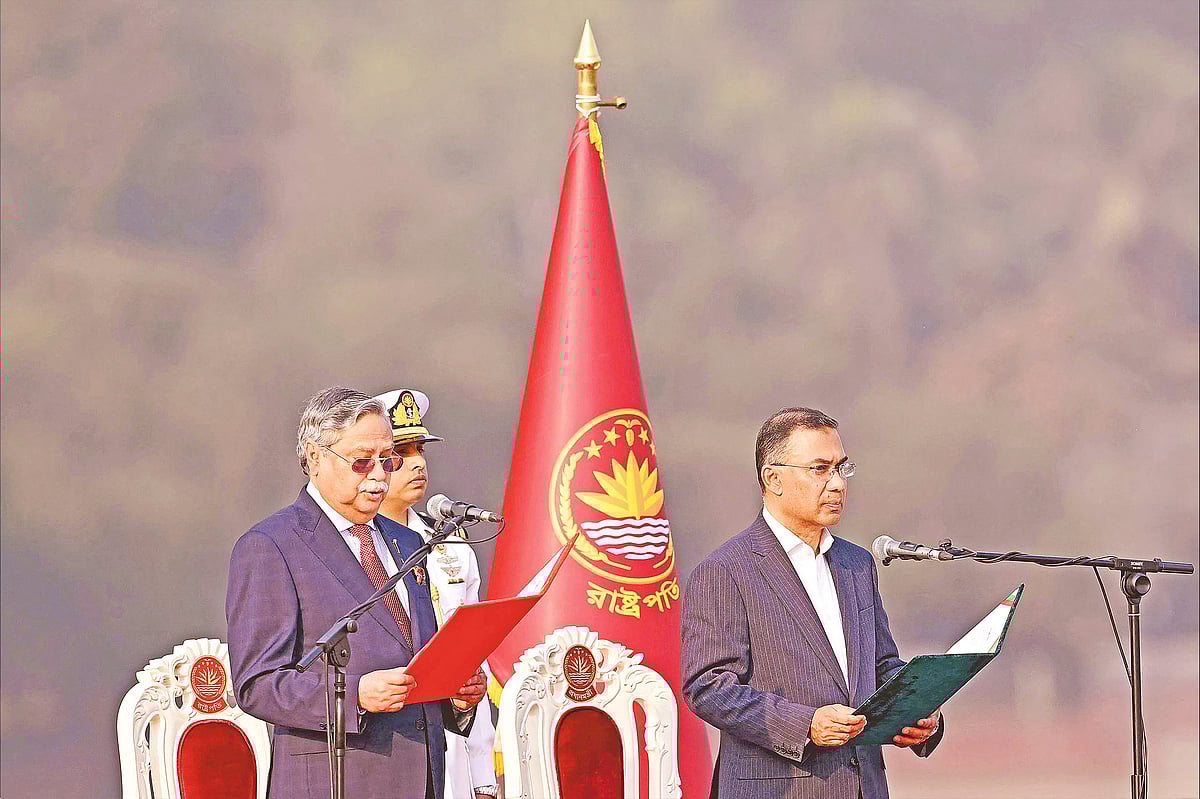
There was no doubt that Tarique Rahman, the chairman of the BNP, would be the Prime Minister in the government led by the BNP. On Tuesday morning, the BNP parliamentary party unanimously elected him as the leader of the parliament. It is customary for the president to invite the leader of the majority party to form the government.
The BNP had stated that the new cabinet would include a mix of youth and senior members and that its size would not be very large. It is true that the young have received prominence in the cabinet. However, questions remain about how prepared those who have been given responsibility for various ministries are, or how much they have prepared themselves for these roles.
There's no doubt that regional balance has been severely disrupted in the selection of cabinet members. According to reports from Prothom Alo, no ministers or state ministers have been taken from 25 districts. It has been found through investigation that districts where the BNP performed poorly have also been deprived of ministers. People from those areas may feel insulted.
Among the 25 mentioned districts are poverty-stricken Kurigram, Gaibandha, Rangpur, and Nilphamari, as well as Meherpur, Satkhira, and Chuadanga. Even though the BNP won all seats in Madaripur, Shariatpur, and Gopalganj, no minister or state minister has been taken from there either. Political analysts believe that the northwest and southwest regions, seen as Jamaat-dominated areas, were punished accordingly. But what wrong have the representatives of the last three districts committed? Only one state minister has been taken from Greater Faridpur.
An imbalance has been noticed in the distribution of departments too. For example, a state minister has been appointed alongside a full minister in the Ministry of Information and the Ministry of Chittagong Hill Tracts. Both ministries are small. Typically, ministers from local representatives are appointed in the Chittagong Hill Tracts. This time, too, it was done. But a state minister has been added from the plains, which might increase suspicions among the residents of that region. So, is a state minister appointed just to supervise the minister? We also know what happened when a state minister was appointed alongside a minister in the Ministry of Information during Sheikh Hasina's government.
In the 1990s, even though the Awami League and BNP did not formally create shadow cabinets alternately, both parties developed alternative leadership who would analyse government decisions and proposals on their subjects and, in some cases, present alternative proposals. Once, while in opposition, the BNP even presented an alternative budget. After that, our parliamentary democracy did not work. The ruling party seized everything with the strength of its majority, and the opposition relied on the streets as a remedy for all injustices.
The third point to consider in forming a cabinet is that conflicts of interest should not arise while ministers and state ministers perform their duties. For example, it is natural for questions to arise about the role of a businessman if he is responsible for the trade or finance ministry. In the past, neither the Awami League nor the BNP gave importance to conflicts of interest when forming governments. It was hoped that the BNP government would remember this in the changed circumstances this time. But it cannot be said that they remembered it in all cases.
Tarique Rahman has been given responsibility for the Cabinet Division, the Ministry of Defense, and the Armed Forces Division in the new cabinet. This is not unusual. However, some ministries have been given to senior and junior ministers where there is no relationship between their experience and the work of those ministries. There are examples where someone more experienced in a particular subject has been given a different ministry instead of that one.
The appointment of Ehsanul Haque Milon to the Ministry of Education is expected to please the people involved in the education sector. Previously, as a state minister, he took strong and effective steps to prevent cheating in public exams. However, it should also be considered how appropriate it is to give responsibility for higher, secondary, and primary education to one person. The interim government also appointed two advisors for education.
On the other hand, while agriculture can be paired with food, attaching fisheries and livestock or combining industry and textiles-jute with trade may not be appropriate, I think.
Some small ministries have more than one minister. Again, appointing one person to two or more important ministries is also inconsistent. Railways could be combined with road transport, but not with shipping in any way. Although physician and DAB leader Zahid Hossain has been included in the cabinet, he has been given the Ministry of Social Welfare. Meanwhile, Sardar Mohammad Sakhawat Hossain has been given the Ministry of Health. Questions have also been raised about the appropriateness of these decisions.
In terms of nominations in the cabinet like in parliament, women's participation is very low. One full minister and two state ministers. Were there no other competent female leaders in the BNP's women's leadership who could become ministers? The party, which has vocally advocated for women's empowerment, does not seem to have done justice to women. The same applies to the representation of minorities.
After the landslide victory in the thirteenth national parliamentary election, the BNP suggested that this time a small or medium-size cabinet would be formed. However, the cabinet that was sworn in with grandeur in the open compound of the South Plaza of the National Parliament last Tuesday cannot in any way be called small. The night of the swearing-in of the 50-member cabinet, including the Prime Minister, the government also presented the nation with 10 advisors in ministerial and state ministerial positions.
In developed democratic countries, extensive preparations are made before including someone in the cabinet. Potential ministers are prepared to work in the relevant ministry. The shadow cabinet of the opposition party is a key example of this. Those who will take over power in the future prepare themselves this way. But such a tradition has not yet developed here. Since the BNP has been outside parliament for many years, there might have been limited opportunities for this.
There is considerable curiosity and debate in the political arena about the inclusion of Khalilur Rahman as the Foreign Minister in the cabinet. He was the National Security Advisor of the interim government led by Professor Muhammad Yunus. At one time, BNP leaders rigorously criticised him. Why was he placed in a significant cabinet position? The reason may be that there is no one suitable for the foreign minister position in the BNP. Or he is so influential that the BNP had no other option but to include him in the government. It seems the Tarique Rahman-led government will face criticism from the opposition in the coming days regarding his appointment.
Overall, the BNP''s new government appears somewhat chaotic and lenient towards the interests of various factions. Though there was talk of bringing novelty, it was not strongly reflected in the cabinet. A dynamic leadership and accountable government are what people expect.
# Sohrab Hasan is poet, and journalist
*sohrabhassan55@gmail.com
#The views expressed are the author's own.
#This article, originally published in Prothom Alo print and online editions, has been rewritten in English by Rabiul Islam