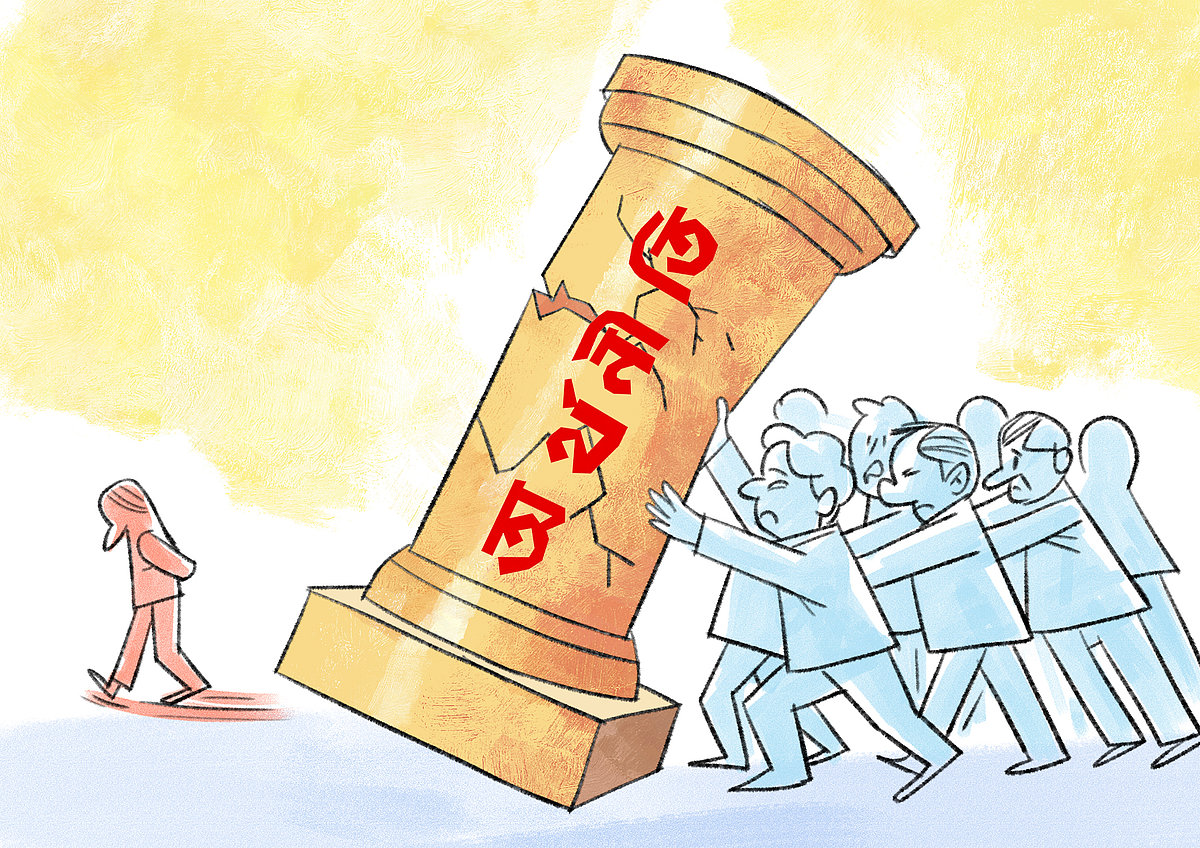
A few weeks after the interim government took office, a committee led by Debapriya Bhattacharya submitted a nearly 400-page white paper. This document remains important for understanding the concept of ‘institutional theft’ during Sheikh Hasina’s tenure. It highlighted how around $16 billion was siphoned abroad annually, 23 to 40 per cent of development project expenditures were embezzled, and how the statistics of GDP, inflation, and poverty were manipulated to create an inflated growth narrative amid a debt burden of more than Tk 18 trillion. I call this manipulation ''Hasinomics''. Even though the white paper contains what happened, understanding how it happened is essential to preempt future .
The underlying structure of Hasinomics
Firstly, after the first decade of the current millennium, the economy was stalling due to limitations in infrastructure, skills, and the investment environment. Instead of focusing on improving skills or the investment environment, the ruling elite opted for a surge in infrastructure development. The issue wasn’t financial; it was political economy. A non-refundable offer was placed before the emerging oligarchs—support the government's political agenda and in return receive mega projects and business opportunities without any oversight. What was the outcome?
While there were some visible results, if the mega projects truly spread benefits across the economy, there would have been an impact on productivity calculations. But that didn’t happen. The country couldn’t move beyond exporting ready-made garments and manpower. Compared to the size of the economy, imports or foreign investments were significantly lower than almost all Southeast Asian countries. This raises the question, was there no chance for an active industrial policy? Or did the bargaining between oligarchs and rulers stall the policy?
Secondly, there are even more uncomfortable issues. Weak revenue, the financial risks of power purchase agreements, and the woes of the banking sector are generally viewed as separate problems. But seen alongside the informal money transfer system ‘hundi’, it’s clear that the massive informal sector was not an accident of Hasinomics; rather, it was part of its framework.
Starting with taxes, due to political bargaining, the ruling elite couldn’t impose taxes on the wealthy, nor could they impose higher taxes on the general public out of fear of political backlash. Thus, low tax revenues were a destined outcome. Meanwhile, a weakly overseen banking sector was essential for ‘crony arrangements’ with oligarchs.
Part of that money was transferred abroad through hundi, bypassing formal accounting. The flip side of this transaction was informal remittances, which kept consumer spending buoyant domestically. In this sense, structural transformation was impossible during Hasina’s era. Transformation meant the end of informality, and informality was the fabric of Hasinomics.
Without the July uprising, it’s hard to predict how disastrous the outcome of this model would have been. However, it’s possible to conjecture. The chronic current account deficit would eventually force an increase in domestic savings. Sooner or later, electricity bills would have to be paid, the banking crisis would deepen—there wouldn’t be a way out. With fiscal constraints pressing down, social security spending would decline. The potential for growth by increasing crony capital and informal labour would eventually run out, trapping Bangladesh in a lower-middle-income status, with even greater inequality. Unfortunately, even after the fall of the Hasina government, this outcome remains quite possible.
Where is the implementation plan
The interim government was aware of the problem. The economic white paper was a document looking back; meanwhile, a task force led by KAS Murshid submitted a nearly 550-page report to look forward. Instead of grand five-year plans, they emphasised quickly implementable steps, such as forming a regulatory reform commission, an oversight committee for the National Board of Revenue, revamping the BRTA, creating a new independently operated aviation entity instead of a loss-making airline, and allowing polytechnics to offer two-year technology bachelor's degrees.
But virtually none of these have seen the light of day. The reason is probably quite simple—the interim government did justice to its name concerning economic matters. They merely managed the emergency situation, leaving the burden of structural reforms for the elected government.
The elected BNP government has taken a long-term vision. During Prime Minister Tarique Rahman’s time, the Planning Commission introduced the five-year strategic framework with the slogan ''From Fragility to Prosperity''. It is a ''living document'' reviewable annually, based on a three-phase strategy of recovery, re-establishment, and reconstruction.
The target is a trillion-dollar economy by 2034, and to increase foreign investment from 0. 45 per cent of GDP to 2. 5 per cent. Structured around five pillars—social security, education-health, energy and industrialisation, good governance, and social harmony—it also includes trade liberalisation, export diversification, and a stability fund.
All three documents acknowledge that the manipulations during Hasina’s era have left deep scars. However, are the questions raised earlier about industrial policy truly of the past? Or do the same questions await a democratic government?
The politics of weathering the crisis storm
During the tumultuous days of July, alongside political graffiti, images of the Japanese manga ‘One Piece’ were painted on Dhaka’s walls. Eventually, this symbol spread to the Gen-Z movements in Indonesia, Nepal, the Philippines, and Madagascar. The flag in the story was a symbol of freedom in the fight against authoritarian rule. But the intense anger that drove the youth to splash paint on the walls and spill their blood on the streets—the economic escape routes from its sources, such as slow growth, high inflation, and unsustainable debt burdens—are still not visible. The multifaceted crisis in banking, energy, inflation, revenue, and foreign transactions rooted in the ousted regime could at any time derail any long-term strategy.
Experiences from other countries also provide ample cause for caution. When movements were gathering momentum on Bangladesh campuses, almost simultaneously, Kenya’s Gen-Z protesters stormed their parliament against a finance bill proposing tax hikes and service cuts. The bill was brought by a government that came to power promising reforms after the financial devastation left by their corrupt predecessors. Reforms are difficult; and that difficulty tempts the government to avoid tough decisions and even revert to old habits.
But that path isn’t safe either. In 1990, economists Rudiger Dornbusch and Sebastian Edwards showed that focusing on growth and distribution while ignoring stability and external constraints ultimately leads to crisis in macroeconomic populism. On the other hand, research by the Nobel-winning Turkish-American economist Daron Acemoglu and colleagues suggests that democratisation boosts per capita income by about one-fifth in the long run. Another Turkish-American economist Dani Rodrik’s 1999 research shows that countries that manage social conflict well are also remarkable at handling external shocks.
Whether bank reform, energy, or revenue constraints, the government must soon make tough decisions, where both the ailing domestic economy alongside external world risks are increasing. A democracy that doesn’t just end with elections but heals social and political wounds can open the path to prudent macroeconomic policy. Perhaps that is the economic condition for holding true to the promises of July’s blood.
# Jyoti Rahman is the Chairperson of the Panam Institute and an Applied Macroeconomist
*The opinions expressed here are the author's own.
#This article, originally published in Prothom Alo print and online editions, has been rewritten in English by Rabiul Islam.