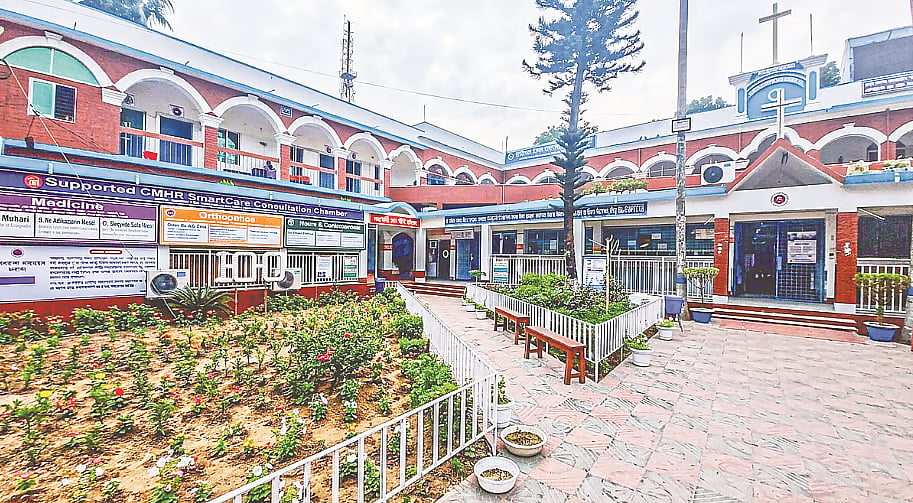
Rajshahi’s Mission Hospital: Evergreen even after crossing a century
The Christian Mission Hospital in Rajshahi city has passed the century mark. It is now busier than ever. Shishir Moral writes about the hospital.
Early last year, Ahmed Ehsanur Rahman—a scientist at the International Centre for Diarrhoeal Disease Research, Bangladesh (icddr,b) and a member of the Health Sector Reform Commission formed during the interim government—told me the story of an old hospital record-keeping system. It was the story of the Christian Mission Hospital in Rajshahi city. For decades, the hospital had meticulously recorded the birth details of every child delivered there; such a “Birth Register” is rarely seen.
Since the late 1980s, I had visited Rajshahi city many times, yet I had never been to the Christian Mission Hospital. Hearing about the Birth Register from Ehsanur sparked my desire to see the facility. In April 2025, Ehsanur and I spent half a day touring the hospital.
Subsequently, at the beginning of December last year, I visited the hospital again and stayed at its guesthouse for two days. Walking through hospitals is a habit of mine, and this visit was no exception—I made methodical rounds morning, afternoon, and night, speaking with patients, guards, officials, nurses, physicians, and administrators. My greatest curiosity centred on the Birth Register.
Later, on 18 December last year, my report on the hospital was published in Prothom Alo. The hospital has now crossed the 100-year milestone. Due to the country’s political situation last year, the hospital authorities did not feel comfortable organising any centenary celebrations; those events are taking place on 26 and 27 November.
A 100-year journey
Across various countries and regions of Asia and Africa, the arrival of Christianity was often accompanied by education and healthcare, giving rise to schools and hospitals. Christian Mission Hospital shares a similar history, chronicled in a souvenir published to mark its centenary. Although formally established in 1926, its seeds were sown several decades earlier.
Following the Great Rebellion of 1857–58, the Presbyterian Church of England decided to open a mission in Rajshahi. At their request, Bengali evangelist Reverend Behari Lal Singh from Kolkata arrived in Rampur Boalia in 1862, beginning his work by setting up a village primary school and a prayer hall. After his death in 1874, his widow single-handedly carried on the mission of educating women and girls for three years.
►This history is recounted in a commemorative publication prepared to mark the institution’s centenary. Although the hospital was established in 1926, its roots go back several decades further. ►The central vision of the hospital’s future plans is to combine modern medical science and higher education while preserving its heritage and commitment to compassionate care, so that people in northern Bangladesh can access world-class healthcare at affordable prices.
In late 1877, a young Scottish physician, Donald Morison, arrived in Rajshahi and began treating patients. He trained local youths as “dressers” and went on to establish a small five-bed hospital in 1887, launching regular medical services in 1890.
Later, JA McDonald Smith arrived in Rajshahi in 1900, followed by Donald Morison’s son, Robert Morison, in 1904. In 1911, Smith built the first full-fledged hospital on the banks of the Tulshiganga River, midway between Naogaon and Santahar. However, due to crises stemming from the First World War and acute shortages in human resources, the Naogaon hospital closed in 1923, though its building still stands today.
In a vaulted room of the main building, the hospital’s founding history is inscribed on white stone: construction began on 22 October 1924 and was completed in January 1926. The builder was Babu CK Das, and the chief mason was Azmat Mistri.
The hospital embarked on its permanent journey in 1926 when Robert Morison and Bengali Hindu physician Bhupendranath Bhaya jointly launched permanent operations at the Boalia Mission Compound. That same year, the “Westminster Hostel” was constructed in Srirampur to house Hindu and Muslim students of Rajshahi College. The hostel building later became the hospital’s permanent address.
When Robert Morison departed in 1929, Bhupendranath Bhaya single-handedly kept the hospital alive until 1940 by running the outpatient department. In 1932, Reverend Priya Kumar Baroi joined as pastor, remaining associated with the institution for half a century. During the Second World War and the Bengal Famine of 1943, Himangshu Kumar Sarkar and Haripada Guha took the helm. Following the Partition of India in 1947, Westminster Hostel fell vacant after Hindu students migrated to India.
In 1948, Scottish surgeon Ian Patrick and Bengali physician Upendranath Malakar assumed responsibility. Aided by more than 20 beds donated free of charge from the Ranaghat Mission Hospital in India—which had closed after Partition—and four male nurses who came from there (Kshitish Chandra Baroi, Francis Hiranmoy Bepari, Harendranath Sarkar, and Indubhushan Mondal), the hospital was reborn in April 1950 inside the converted Westminster Hostel. In 1953, Scottish physician Elizabeth Conan joined the hospital, serving for 21 years.
Liberation War and beyond
During the Liberation War of 1971, the hospital closed temporarily when roughly 120 staff members—including physicians Malakar and Conan, and sister Jean Degenhardt—took refuge in India, though the building remained intact. Following independence, the “Elizabeth Conan Memorial Nursing Institute” was established in 1973, and a children’s ward opened in 1974 with support from the city of Kristiansand in Norway. When the Church of Bangladesh was formed in 1974, the hospital came under its administration.
After physician Malakar retired, the proliferation of new private clinics across the city subjected the hospital to stiff competition and financial strain, yet it never shut down completely. It launched a Community Health Programme in 1989, an Eye Clinic in 1991, and a Primary Healthcare Programme in 1994—supported by American missionary physicians Leslie and Cynthia Morgan—extending medical services to 29 villages.
During the Covid-19 pandemic in 2020, the hospital contracted with the government to treat coronavirus patients for six months. Afterwards, fears of infection and a dilapidated physical structure left it devoid of patients and on the brink of closure. Under the leadership of Church of Bangladesh Moderator Bishop Samuel Sunil Mankhin and the Board of Trustees, Pradip Chand Mondal took over as Chief Executive Officer in January 2021. He renovated the buildings, introduced modern medical equipment, and overhauled the administrative structure. With specialist physicians joining from 2022 onward, the hospital rebounded in full swing. The institution is celebrating its centenary under the slogan “The Hospital That Stayed.”
Official records
The Rajshahi District Gazetteer, published in 1976, records another account of the hospital’s history. According to the gazetteer, Christian Mission Hospital began its work in Rajshahi city in 1877, commencing regular hospital operations in 1890, though activities slowed between 1937 and 1948 due to staffing shortages. Constructed at its current site in 1950, the 66-bed facility housed children’s, women’s, and men’s wards, drawing patients from Khulna, Jashore, Kushtia, Pabna, Bogura, Dinajpur, and Rangpur.
The gazetteer also provides patient statistics for 1966: 1,426 inpatients were admitted for treatment that year (an average of five admissions daily), while 14,005 patients received outpatient care (averaging 45 outpatients a day).
The old publication further reveals financial figures: in the 1965–66 fiscal year, the hospital earned Tk 157,612.38, alongside Tk 38,043.82 in grants from England, against total expenditure of Tk 192,303.79.
A modern information system in the past
Christian Mission Hospital preserves patient records with remarkable care. Precisely how far back this practice of recording birth details goes is unknown, though a 66-year-old “Birth Register” still survives. Hospital CEO Pradip Chand Mondal told Prothom Alo, “Alongside renovations for the hospital’s centenary, we began organising the library and uncovered these old ledgers—as well as books and documents even older than the registers. These are priceless assets.” Indeed, they are priceless assets for the entire country.
The Birth Register logs the date of each delivery, the names and addresses of the mother and her husband, foetal position, mode of delivery (normal or Caesarean), the baby’s sex and birth weight, and the names of the attending chief physician, midwife, and assisting nurses, accompanied by a brief clinical note on the physical condition of both mother and newborn—all written neatly in fountain pen.
The oldest ledger recovered by hospital authorities contains an entry in English reading: “Mrs. Makbul, admitted 13 December 1959 at 6:15 pm. Membranes ruptured at 1:15 am. Normal delivery completed at 1:28 am. Placenta and membranes expelled completely at 1:35 am. Minimal bleeding. The condition of mother and newborn is good.”
The ledger further notes that this was Mrs Makbul’s second child—a live female infant who cried vigorously at birth and weighed 4 pounds 7 ounces. It stands as a testament to sound healthcare practice, and such records are invaluable treasures for public health researchers.
The hospital today
At the turn of its century, the hospital is busier than at any point in its history. Today, it operates 135 beds with nearly 100 specialist physicians serving regularly across various departments. On average, around 7,650 patients receive outpatient treatment every month (an average of 228 patients daily in 2026), with women and children accounting for roughly 60 per cent of all patients.
About 1,500 inpatients are admitted monthly, and more than 100 patients receive inpatient care in the wards on any given day. The hospital places special emphasis on normal deliveries: whereas 7 per cent of births were normal deliveries in 2021, that figure has more than quadrupled to 30 per cent in 2026.
New dreams
The core philosophy of the hospital’s future blueprint is to blend modern medical science and higher education—through medical and nursing colleges—while preserving its heritage and compassionate care, ensuring people in northern Bangladesh have access to affordable, world-class treatment and creating employment for future generations.
CEO Pradip Chand Mondal has unveiled a vision to establish three major educational and service institutions in the coming years: a Medical College, a Nursing College, and an Institute of Health Technology—alongside achieving financial self-reliance, maintaining care for the underprivileged, and expanding primary healthcare services.
* Shishir Morol is a Special Correspondent at Prothom Alo. The opinions expressed are the author’s own.
* This article has been rewritten in English by Shameem Reza