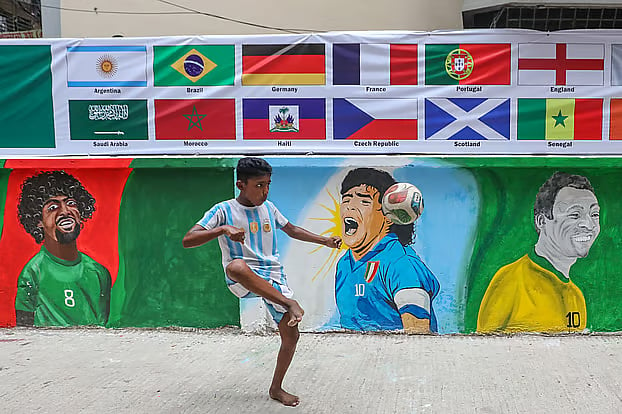
Let’s be honest: from where Bangladesh football stands at the moment, playing at the World Cup is possibly not going to happen in the near future.
To put it bluntly, I don’t expect to see that day in my lifetime.
Twenty years from now, if one is not struck down by some unforeseen incident or terminal disease, I will be 74 and, well, Bangladesh team making it to the biggest footballing stage by then still appears to be a long shot. Forgive me, but one needs to be practical.
Those who have seen the rise, fall and the resurgence of football here will agree that unless we get some supremely talented players, making it to the World Cup will be tough.
However, if FIFA decides to introduce a new system by which two Asian teams are randomly picked from a bowl then perhaps there’s a chance. And why would there be such a system?
Well, for starters, it’s not just about football passion but also about making money. Lot’s of it! So, two picks from a pot will mean two new countries as markets for merchandise and other items.
However, sense dictates if capturing market is the prime consideration, then one might as well choose two large nations in terms of population: China and India. However, that’s another debate.
1990: dreams were bigger than reality
For Bangladesh, at this moment, World Cup is a show where others play and we find pleasure, passion and jubilation supporting them.
Just a day earlier, the Dhaka University campus was abuzz with excitement as Argentina supporters brought out boisterous rallies featuring revving bikes and raucous youth in Argentina colours.
Brazil is not far behind either but since the last time they won the cup was in 2002, the Brazilian samba beat has slowed down a bit. Another trophy and they will be back with a vengeance.
But you must be intrigued by the title, right? Actually, we did dream about going all the way just like many others because one small sporting success in Bangladesh always fires up our hopes.
Disregarding reality, castles are built in the air Let Bangladesh win two regional SAFF trophies, and one will see expectations reach high heaven.
Coming to the point, in 1990, the world was under a new air of freedom as the Iron Curtain came crumbling. A wave of optimism swept across the globe with football in Bangladesh reaching a high point.
The local club Mohammedan went to the final stages of the Asian Club Cup in 1988-89 after beating Iran’s Persepolis (Pirouzi back then), the under 14 team from BKSP blanked their Brazilian counterparts 7-0 and the national side beat Thailand 3-1 on home soil in the World Cup qualifiers.
Then in 1990, the Bangladesh Red side won the President Gold Cup tournament held in Dhaka beating South Korean University selection in penalties. Although a university side, the commentators and the sports magazine referred to the visitors as simply South Korea which only fuelled the local frenzy.
Thinking back in retrospect, it was an illusion, a delicious one too because the nation was in a daze.
The local boys beating Brazil at the Dana and Gothia Cup became the national headlines, but the truth soon became clear when we saw clips of the match. Brazil fielded their under 14 but our boys looked more like 18-year-olds. Anyway, in our craze, the age disparity was put aside.
An autocratic regime already on a precarious ground tried to deflect national unrest and discontentment by overblowing the sporting success.
This was also a World Cup year.
Italy 1990 coincided with a middle class economic revolution in Bangladesh as people’s income rose and owning a colour TV became mandatory.
The glitzy opening of the World Cup blended with our small successes to trigger a collective dream. Naturally, the reality was only too harsh.
Waking up to smell the coffee
The fantasy did not last long, because despite having a formidable South Asian side, Bangladesh repeatedly failed to win gold at the South Asian Games football.
The trophy finally came in 1999 when the team, starting with a shocking 2-1 defeat to Maldives, pulled up the socks to beat India and Nepal in the semi-final and final respectively.
Bangladesh then went on to win the 2003 SAFF championship in Dhaka but by then it had become clear to most football lovers: for us, the World Cup is the regional championship.
Since 2003, Bangladesh never won the regional title – an indication to the gradual slide of the national side.
Thankfully, the Hamza Shomit Fahamedul triggered resurgence has renewed hopes. No, not of the World Cup but ‘our’ World Cup – the SAFF trophy. Even that will be quite a task because both Sri Lanka and Pakistan now feature expat players.
As a football freak, it’s often difficult to accept that we will not see our team at the game’s highest show anytime soon. But hey, such is life and we need to take it on our chin.
Playing the World Cup qualifiers for the first time in 1985, Bangladesh showed promise, beating both Indonesia and Thailand at home but that momentum was lost in the following years.
In the 2026 World Cup, Jordan is playing for the first time and Iraq is back after 40 years.
Both teams lost their first matches and their chances of going back with a point appear slim.
If we categorise just the Asian Arab teams then the third tier Arab dies will feature Syria, Kuwait, Palestine and Lebanon. Overcoming them still remains quite a challenge.
Accepting reality, we need to look forward to our World Cup, slated to be held late this year or early 2027. The venue is Dhaka and the determination to once again be the regional title holders.
Until that happens, let’s wave the flag of those currently playing at the World Cup. The most flag sold are of Argentina, tells me a flag seller followed closely by Brazil. It’s the same case in the case of jerseys, as I find talking to road-side sellers in Gulistan.
But rest assured, on the long bamboo stick holding flags of World Cup teams, the top one is of Bangladesh and beside the neatly lined jerseys on the stalls there is also the white and green of our team.
One major success and our imagination will be on fire, weaving hopes – someday, just someday, we will be there!
* Towheed Feroze is a former journalist!