The monsoons are here and it rains off and on throughout the day. Some times for a few hours and sometimes for days on end. This is a time when some people write reams of poetry, some cook khichuri and some, forced to stay at home, sit and curse the weather. The roads are waterlogged. You go out and come home soaked. That's city life.
In the village, monsoon is a different scene. The farmer waits in anticipation for the rain. Without rain, the crops will wither and dry. The farmer has no pen and so no poetry from him! He goes to the field, scythe and spade in hand. He plants all sorts or saplings and seedlings, clears the weeds or just idles away the time.
The urban and rural scene is so different. It has been swelteringly hot in the cities over the past few years. There been a big upheaval in the country. You can feel this in the cities. In the villages, people see it on television. The routine of city life does not exist in the villages. Movements, uprisings, public rallies, seminars, human chains, blockades -- all urban. When it rains nonstop for a few days, the prices or green chillies shoot up, vegetables are unavailable or rot. The people are angry. Why are the prices so high? The food minister must resign!
All this is absent in the villages. They are well aware that vegetables grow less in this season. If there is excessive rain, the vegetable patches are inundated. Chilli plants dies. The supply or agricultural produce drops. But the city folk's demand or wants don't abate. They get furious. We don't have greenhouses in our country to grow vegetables throughout the year. It is only natural that prices will spiral. The city gentry lack the economic savvy of the farmer.
Even death differs in the cities and villages, particularly when it comes to unnatural deaths. Deaths due to road accidents are higher during this span of time. Every day people are dying or bus, truck car and motorbike collisions. In the villages, there are no so many vehicles. The people die there of snake bites, drowning in the pond. People suffering from Covid are getting admitted into hospital, some die. The media reels off the statistics. But even more people die struck by lightning or drowning in ponds. The media does not cover that extensively.
If someone can manage to join the committee of a party's student front, youth front, fisherman front, weaver front or intellectual front, there's no stopping him! The floodgates of money will open up
There are journalists scattered all over the country now. There are district, upazila, and even union correspondents. They send in news. So sitting in the cities, people read about leaders visiting the villages from the cities, delivering speeches, they read about people from two villages clashing with locally made weapons and so on. In the cities, garbage piles up at the street corners. There are dustbins in some places, none in other. There are persons essential for maintaining the health, hygiene and aesthetics of the cities. We would call them 'methor,' sweepers or some such thing back in the day. Now we address them as sanitation workers. When they go on strike, the city turns into sheer hell in a matter of two days. There is no such thing in the villages.
That was all about nature. But life is not only about the sky, the breeze, light and water. There is one thing seen in the city lanes and alleyways. And that is politics. Bro, when's the election? What news is there of reforms? Will NCP or Jamaat share seats with BNP? The big leaders of small parties are quite shrewd. They weigh every word before they speak. It is hard to tell in which direction they lead. If they could latch on to a powerful party and manage to enter that big building on Manik Miah Avenue! They are not growing any younger, this may be the last chance!
In the villages, these are not issues. According to our last population census, 30 per cent of the people live in the cities, 70 per cent in the villages. Yet it is the city people that run the country. If it rains continuously for one hour, the headlines scream: "Rain creates public suffering, roads submerged in water, rickshaw pullers demand double or triple fare, crisis for commuters." The poets may sprouted all sorts of romantic rhymes to the rains, but then they don't have to rush in the rain to office with their files and paraphernalia. They can scribble down lines as they please.
The rural farmers are thrilled when it rains, they crops will thrive! They have no wars or worries over reforms, the constitution, tariff or such fancy phrases. Whether they know it or not, the villages are colonies of the cities. The savings which the rural folk earn through backbreaking labour, goes to the cities. It is embezzled there, siphoned out of the country. The city elite are smugly complacent -- the villages are no longer like before. People have proper clothes, sandals on their feet, mobile phones in their hands. Paved roads are ripping through rice fields. That's development.
If the earnings of the rural people goes up by 2 taka, it goes up by 10 for the urbanites. The village boy is employed by selling his father's land to go to an Arab country and slog away. Or by plying an autorickshaw along the rural roads. There is no death of employment in the cities. No job? They join a political party. If you stick a political label to yourself, money will come flying in. You just know how to catch it. Not everyone can.
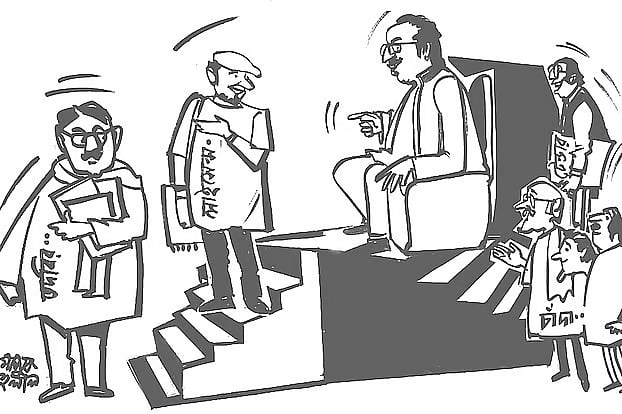
If someone can manage to join the committee of a party's student front, youth front, fisherman front, weaver front or intellectual front, there's no stopping him! The floodgates of money will open up. If asked, what is your profession, the answer is simple -- politics! I do not understand how politics can be a profession. There was a time in this country where parties had a couple of permanent workers. They would get an allowance from the party. They money would come in from abroad or by collections within the country. They businessmen and industrialists would pay. There were a few politicians who would pay from their own pockets, but they were few in number and now a near extinct species.
If you get into a political party’s committee, you don’t need any other profession. You can make a living just by extortion. And where is extortion not present? You have to pay to get a student into a good school, to get a file moving off someone’s desk in an office, to secure a hospital bed, to land a job, even to get into a party committee.
And that’s just the beginning. Toll is charged for letting hawkers sit on the footpath or even if someone sets up shop there on their own. There is toll on vehicles. When building a house, the owner or the contractor has to pay up. If you don’t pay, the local thug breaks your bones. Sometimes they even kill. Fighting and killings over extortion shares are an everyday affair.
We’ve found a convenient name for it: the "underworld." Its producer and director is a godfather. We hear about who the godfather is in any city or district through word of mouth. The full story rarely appears in the media.
In recent memory, there was Joynal Hazari in Feni, the Osman family in Narayanganj, Sheikh Helal in Khulna, Hasanat Abdullah in Barishal, Haji Selim in Old Dhaka, Salauhddin Quader Chowdhury in Raozan, countless others like them. Nothing moved without their orders. They were products of politics. Politics showered them with rewards.
When power changes hands, the godfathers change too. The job remains the same, only the slogans change: “Allah Hafez Party” or “Khoda Hafez Party.” You can tell their party allegiance just by their choice of words.
Had the political parties not sheltered and nurtured these godfathers, this country could have become a land of gold.
* Mohiuddin Ahmad is writer and researcher
*The opinions expressed are the author’s own.