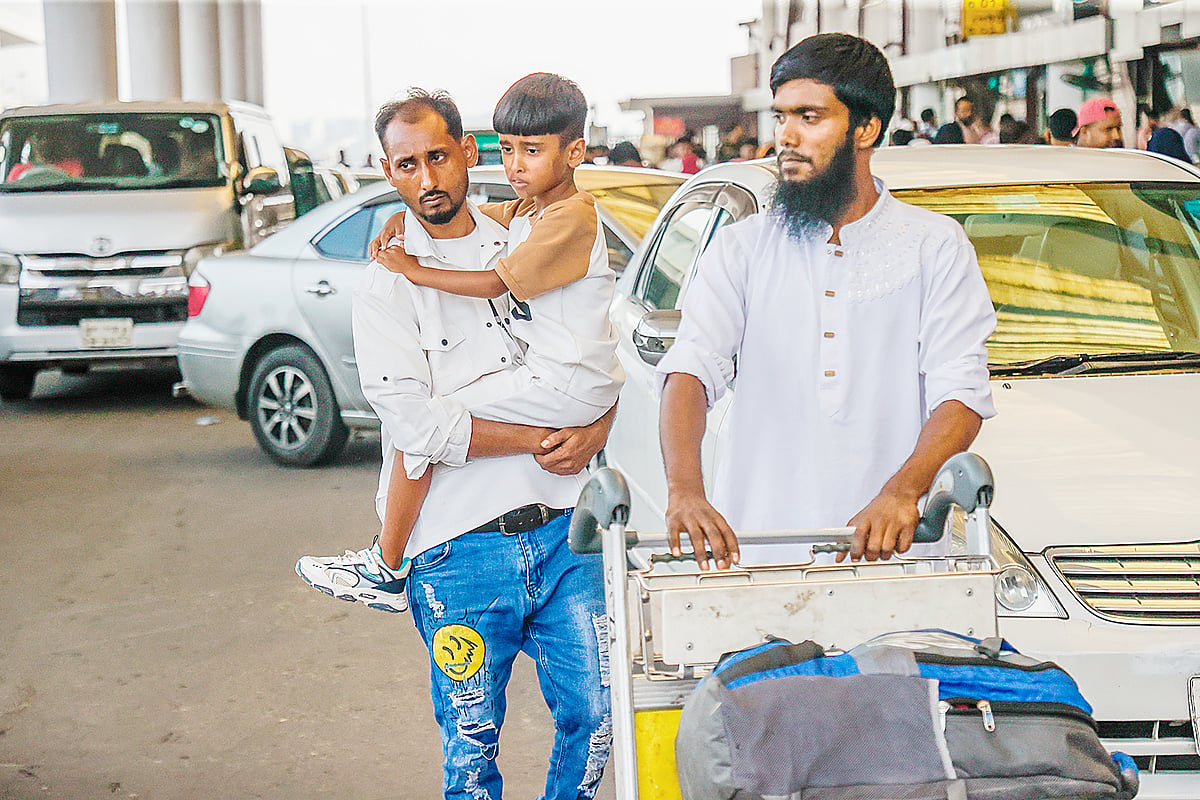
The Middle East security crisis has exposed the deep vulnerabilities in Bangladesh's migration economy. The question now is not just how many workers can be sent abroad, but how secure their lives, investments, and futures are.
The attack on the Saudi Arabian airport, flight cancellations, stranded workers, and visa uncertainties are not just temporary travel disruptions, but warning signals for Bangladesh's migration economy. Saudi Arabia is the workplace for millions of Bangladeshis and a significant source of foreign exchange earnings. The instability there impacts Bangladesh's employment, rural economy, and national income.
According to a report from Prothom Alo, as of 12 October, job approvals for overseas employment have decreased by nearly 32 per cent compared to the same period last year, with a decrease of almost 46 per cent in Saudi Arabia. During the same period, a large number of Bangladeshi passengers faced disruptions at various Saudi airports due to security reasons.
This crisis cannot be solely blamed on the current security situation in Saudi Arabia. Rather, this situation reveals some long-standing policy failures that remain hidden during normal times through numbers. The migration economy of Bangladesh has grown, but has its risk management matured in the same way?
Bangladesh's success in foreign employment is usually judged by how many workers went abroad and how much remittance was received. But a fundamental question is ignored behind these calculations: if such a large portion of employment depends on just a few countries and one region, how sustainable is that success?
According to Prothom Alo's data, about 62 per cent of total remittances came from Saudi Arabia, the United Kingdom, the United Arab Emirates, Malaysia, and the United States in the first 11 months of the fiscal year 2025-26. Saudi Arabia holds special importance in this list. Changes in security, recruitment policies, or the labour market there will have repercussions on Bangladesh's employment and foreign exchange earnings.
This dependency was not created overnight. Sending workers to the Middle East has been easier for a long time; on the other hand, efforts to enter promising markets in Europe, East Asia, and others, like language education, skill development, certificate recognition, and establishing institutional relationships with employers, have progressed comparatively slowly. As a result, when opportunities for recruitment in Saudi Arabia increased, we felt relief, and when a crisis arose there, we became busy searching for alternatives.
This is not just a market failure; it's also a weakness in state planning.
Access to any country's labour market is never a permanent right. Saudi Arabia will also change its recruitment pattern following its economic transformation, labour policies, national employment programmes, and private sector demands. For Bangladesh, it's important to anticipate those changes and adapt. However, one thing needs to be clear: the current security crisis does not mean that Saudi Arabia's labor market will permanently close. There might be a demand for foreign labour in the country's economic transformation and development projects. But just because there's demand doesn't guarantee that Bangladeshi workers will get jobs as before.
That's why Bangladesh's strategy should be to maintain opportunities in the Saudi market while reducing dependency on a single market.
The success of Bangladesh's migration is measured by the number of workers who went abroad and the remittances received. But where is the account of wages, contracts, security, and legal protection? When flights are canceled, workers unable to return to work face risks to their jobs and visas; when the journey of new workers is stalled, the burden of debt increases. Even if employment is disrupted due to conflict, the losses fall on the workers and their families. The redress for fraud, excessive recruitment costs, and wage deprivation is also complex.
Therefore, in bilateral discussions with Saudi Arabia, it's not just about increasing recruitment but ensuring the collection of arrears, contract implementation, safe working environments, legal assistance, and ensured return in times of crisis. Bangladesh should aim to not only export workers but also establish effective state representation in protecting their rights. The success of migration is not in the number of workers but in their protection and dignity.
The idea that the Saudi labour market will close for Bangladesh is not correct. However, the ''Saudi Vision 2030'' policy may change the type of opportunities in economic transformation. Even though demand may increase in construction, tourism, healthcare, and logistics, the importance of skills, experience, language proficiency, and technical qualifications in recruitment will increase.
At the same time, policies on Saudisation, recruitment costs, wages, and working conditions will affect the potential of foreign workers. Thus, the old strategy of sending a large number of general workers is not enough. The future will be determined by which professions will employ how many workers, with what qualifications, and at what wages. Bangladesh's preparation will be the key condition for surviving in competition.
Bangladesh has two paths ahead. Reliance on old recruitment and skill-based transformation. In the first path, the number of workers sent may increase, but the crisis and uncertainty will remain. In the second path, Bangladesh must develop skilled workers according to Saudi Arabia's demand in healthcare, technical work, tourism, maintenance, and technology-driven professions. For this, quality training, language education, recognised certification, and direct communication with employers are necessary.
Simultaneously, the real obstacles to entering alternative labour markets like Japan, South Korea, and Europe need to be removed. Diversity in labour markets and skill development should form the foundation of Bangladesh's long-term migration strategy.
What should the government do now to handle the crisis? The current crisis in Saudi Arabia must be viewed as both an urgent humanitarian situation and a long-term economic warning signal.
First, an urgent initiative should be taken to resolve visa, employment, arrears, and financial losses by listing workers stranded in Saudi Arabia, unable to return to work, and waiting to travel.
Secondly, the discussions with Saudi Arabia should not only include flights and recruitment but also ensure job legality, wages, compensation, legal assistance, and safe return.
Thirdly, investments in alternative labour markets, skill training, and language education need to be increased. Handling the crisis isn't just about bringing workers back but establishing a system so that in the next crisis, their fate isn't left to uncertainty.
Finally, the government needs to accept an uncomfortable truth: sending workers abroad is important for Bangladesh, but relying solely on sending workers will not provide a permanent solution to the employment problem. It's crucial to increase productive employment in the country, strengthen technical education, and equip the youth with skills that will be valuable both at home and abroad.
The current crisis in Saudi Arabia cannot be predicted when it will fully recover. The country's labour market may recover and new opportunities may arise. But the real question for Bangladesh is, will we take temporary measures when a crisis arises, or will we prepare ourselves before the crisis hits?
Therefore, the government faces two responsibilities—protecting those who are currently in jeopardy and establishing measures so that future workers do not face the same uncertainty and vulnerability.
# Dr Selim Reza is an associate professor and coordinator of the Centre for Migration Studies (CMS) at North South University.
*The views expressed here are the author’s own.
#This article, originally published in Prothom Alo print and online editions, has been rewritten in English by Rabiul Islam