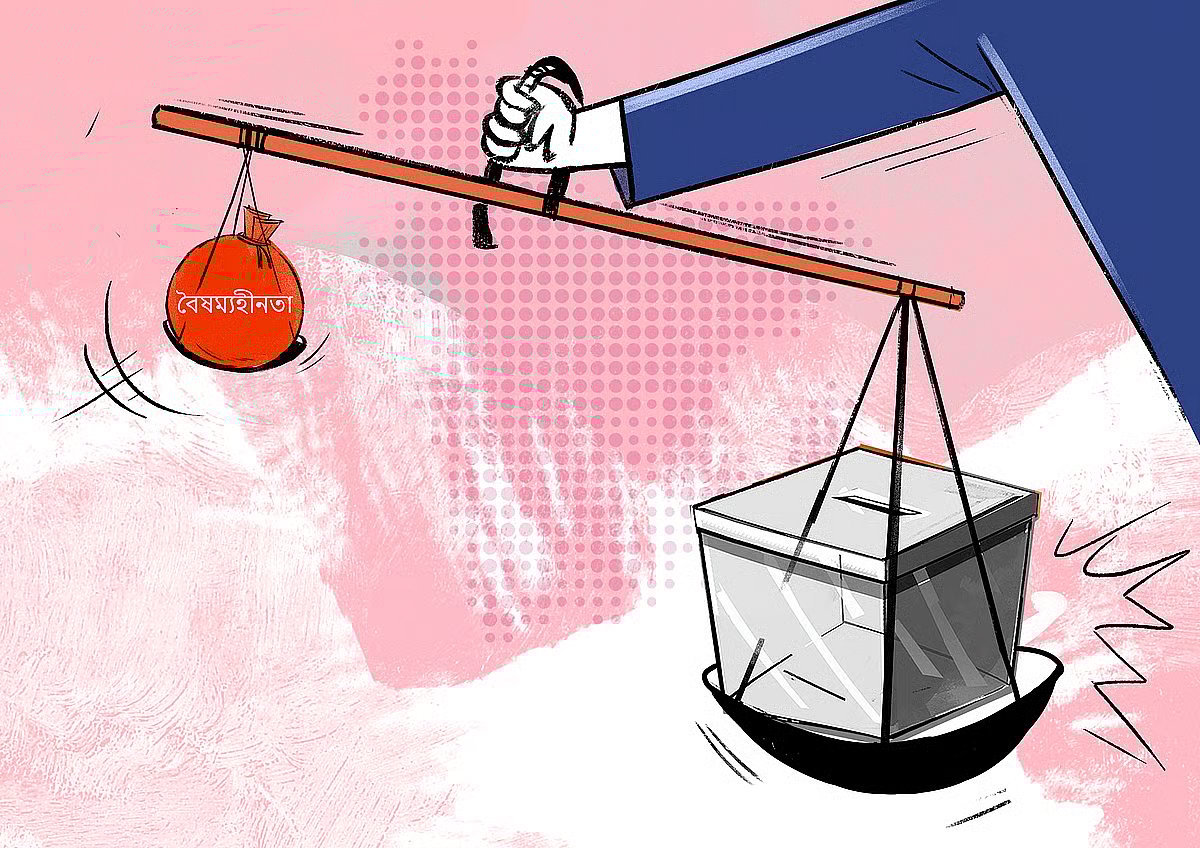
Opening a newspaper these days, one cannot miss the year-end reviews on a wide range of issues. Statistics and surveys published across various media outlets in 2025 help us grasp the country’s overall condition. What emerges from these accounts is a troubling picture of continued violations of fundamental rights and citizen security in the post–July uprising period.
This raises serious concerns and casts doubt on how much of the spirit of the uprising has been lost. After all, ordinary people took to the streets in July demanding a “discrimination-free” society, a “new order,” and “justice.” At the end of the day, people seek peace<bha>;</bha> they seek visible improvements in their quality of life. I believe it is necessary to objectively observe and analyse how much of these expectations have actually been fulfilled.
Various studies show that in transitional contexts, people articulate their aspirations in multidimensional ways. While states or international organisations may define “peace” in terms of treaties or ceasefires, ordinary people understand peace as the ability to live their lives—not as an abstract concept.
In this regard, a theory proposed by Norwegian sociologist and pioneer of peace studies Johan Galtung is particularly relevant. He did not view peace merely as “negative peace,” or the absence of violence; instead, he linked it to “positive peace,” which includes people’s real-life capabilities, the dismantling of structural inequalities, justice, and human dignity.
It is therefore worth examining how far the trial processes against leaders of the ousted government after the mass uprising have actually helped establish “positive peace” in the everyday lives of people in Bangladesh. This is because, alongside judicial proceedings, the interim government has completely ignored calls to form commissions for peace and reconciliation. Such commissions can help break cycles of revenge and pave the way for peaceful coexistence in everyday life.
We have also seen that 59 members of the Bawm community in the Chittagong Hill Tracts, including children and adolescents, have remained detained without trial for months. Amnesty International expressed concern over this issue and wrote to the Chief Adviser on 12 December. But have we received any response from the government on this matter?
In the aftermath of the July mass uprising, a number of its leaders have been seen benefiting socially, economically, and politically across various sectors—often creating new forms of inequality. This has, at times, led to divisions and discontent even among the uprising’s participants.
Without adequate preparation, uprising leaders were seen forming political parties. Instead of speaking for working people, they largely confined themselves to electoral politics. Rather than prioritising party constitutions or people-oriented programmes, they spent most of their time chanting populist slogans. Moreover, numerous incidents of power abuse and extortion in different areas have brought the moral stature of the movement into question in the court of public opinion.
The roots of this unchecked display of power lie in a directive issued by the Ministry of Home Affairs, which stated that no cases or legal actions could be taken against activists for incidents related to the mass uprising. Later, the “July Charter” announced in 2025 included provisions ensuring immunity for those involved in events during the uprising.
Additionally, at a meeting of the Law and Order Advisory Council Committee on 5 January, a decision was taken to issue an indemnity ordinance granting legal protection to July movement activists. The question is: does this immunity extend beyond the temporal boundaries of the July uprising?
On 25 December last year, after a female July movement activist was arrested in an extortion case, the law adviser himself posted a Facebook status on 5 January stating that the accused woman would soon receive legal redress. Within a few hours, she was granted bail. While bail is a legal right, when the government’s law adviser comments on a specific case in this manner, it does not set a reassuring precedent for ordinary citizens.
We have also seen that 59 members of the Bawm community in the Chittagong Hill Tracts, including children and adolescents, have remained detained without trial for months. Amnesty International expressed concern over this issue and wrote to the Chief Adviser on 12 December. But have we received any response from the government on this matter?
Now let us analyse the interim government’s efforts to establish peace and order through the lens of the post-liberal peace model. This concept emerged from the failures of the conventional liberal peace model, which typically defines peace through elections, constitutional frameworks, and institutional reforms. British political theorist and peace researcher Oliver Richmond argues that a country’s peaceful condition cannot be measured through models imposed from above by elite classes. Through the post-liberal peace framework, he views peace as an inclusive, grassroots-driven process—where peace signifies social justice, everyday security, and social dignity.
But how much of the grassroots voice did we hear in the 11 reform commissions formed by the post–July government? Over the course of the year, how much ownership did working people have in the reform proposals put forward by eminent experts? Have the questions related to the upcoming referendum been made comprehensible for ordinary citizens? Have we even asked this question once? Then did the July mass uprising, made universal by the participation of women, students from ethnic minority communities, and rickshaw pullers, end up merely witnessing the swelling incomes of a select few?
If we look at women’s quality of life and political presence during the interim government’s tenure, the picture is deeply disappointing. Alongside incidents of rape and sexual harassment, digital violence and sexual violence on public transport were also alarmingly visible. According to the latest survey by the Department of Women and Gender Studies at the University of Dhaka, women identify the lack of workplace security as the greatest obstacle they face. Regarding political participation, 61 per cent of women want 40 per cent of parliamentary seats reserved for women. Meanwhile, 63 per cent support nominating at least 30 per cent women candidates in every political party. Yet in reality, only 4.24 per cent of all candidates who submitted nomination papers for the upcoming national election are women. Among them, 72 have been nominated by political parties, while the rest are running as independents.
Disturbingly, around 30 political parties have no female candidates at all. After the newly formed National Citizen Party (NCP) recently entered into an electoral alliance with Jamaat-e-Islami, the way its central female leaders resigned reflects the party’s political bankruptcy. In fact, despite a 2008 amendment to the Representation of the People Order mandating 33 per cent women’s participation at all levels of political parties by 2020, no party has fulfilled this requirement. My question, then, is: what kind of discrimination-free Bangladesh has the July movement actually delivered to us?
In conclusion, peace, security, and equality cannot be achieved merely by suppressing a particular group or by redistributing power. The true nature of a society’s power structure and inequalities becomes most evident when one examines the lives of women, minorities, and other marginalised communities. Since these groups largely remain outside centres of power, the real face of society is most clearly reflected in their everyday lives. Therefore, analysing the interim government’s one-and-a-half-year tenure should not be done through the experiences of rulers, beneficiaries, or elites, but through the lived realities of women and other marginalised groups. Otherwise, so-called reforms and the “new order” will remain incomplete and fundamentally flawed.
* Umme Wara, Associate Professor, Department of Criminology, University of Dhaka
* The views expressed are the author’s own.