Analysis
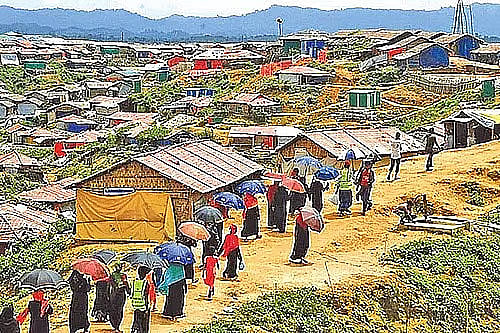
Failure of repatriation affects Rohingyas, and increases pressure on Bangladesh
Myanmar recently said that more than 300,000 Rohingyas living in Bangladesh are former residents of Rakhine. At the same time, Naypyidaw has once again denied their identity as “Rohingya” and brought the term “Bengali” to the fore. Myanmar’s contradictory messages therefore raise the question: has the country’s position on taking back the Rohingyas actually changed, or is it seeking to further complicate the crisis?
Myanmar’s Ministry of Foreign Affairs said on 17 August that, of the list of 828,824 people submitted by Bangladesh, information on 426,545 had been verified. Of them, 308,797 were identified as former residents of Rakhine. But Naypyidaw did not provide any timeline for repatriation. Instead, it said repatriation would not begin until the security situation improved.
Meanwhile, the “Bengali” controversy has resurfaced. Referring to the Rohingyas by this name is a long-standing position of Myanmar. But as discussions on repatriation resume, questions are now being raised about the political significance of bringing that position to the forefront. On the one hand, Rohingyas are being identified as former residents of Rakhine; on the other, their own ethnic identity is being denied.
The question, therefore, is not simply how many people Myanmar is prepared to take back. If Myanmar remains unyielding over the identity and rights of those it says it is willing to receive, how realistic can that repatriation actually be?
Repatriation announced, but no one has returned
In the weeks following 25 August nine years ago, more than 700,000 Rohingyas fled to Bangladesh. At the time, the equation surrounding repatriation was not nearly as complicated as it is today. The entirety of Rakhine was under the control of Myanmar’s military. International pressure was mounting following the Myanmar military’s horrific atrocities against the Rohingyas in Rakhine.
In that situation, and largely under pressure from China, Bangladesh signed a repatriation agreement with Myanmar barely three months after the influx of Rohingyas began. It was hoped that, through an understanding with the Myanmar government, the Rohingyas could eventually be returned.
That reality no longer exists in Myanmar in 2026. Civil war spread across the country following the military coup in 2021. The military has lost control of various areas. The balance of power has also shifted in Rakhine. The Arakan Army is now one of the state’s principal military and political forces. Amid these changes, Myanmar is once again putting forward figures for repatriation.
Rakhine now under Arakan Army
The biggest change in the old framework for Rohingya repatriation has occurred in the balance of power in Rakhine. In late 2023, the Arakan Army launched a major offensive in Rakhine. It subsequently took control of one military base and key area after another. By late 2024, there were also reports that Maungdaw, along the Bangladesh border, had come under the Arakan Army’s control. As a result, the Myanmar military’s control weakened across large parts of the state, including northern Rakhine.
Although Naypyidaw retains control of some important areas, such as Sittwe, the overall reality in Rakhine has changed. This is where the biggest question over repatriation arises.
The Myanmar government says it wants to take back the Rohingyas. But in many of the areas where they are most likely to return, Naypyidaw does not have effective control. So who will ensure their security after repatriation? Who will administer those areas? Who will guarantee their freedom of movement? And who will make the final decisions on citizenship and political rights? Nine years ago, the answers to these questions were relatively clear. They are not anymore.
New risks for the Rohingyas
The rise of the Arakan Army in Rakhine has created a new reality for the Rohingyas. But it has not brought any guarantee of security. The Arakan Army has been accused of persecuting Rohingyas, restricting their movement, forcibly displacing them and subjecting them to forced recruitment. Similar allegations of forced recruitment have also been made against Myanmar’s military. As a result, there is no easy choice for the Rohingyas. On the one hand, Naypyidaw maintains its longstanding position on their ethnic identity and citizenship.
On the other, the Rohingyas’ relationship with the Arakan Army, which controls large parts of Rakhine, is also complicated. In this situation, repatriation is not simply a matter of crossing the border and returning home. The central questions are who will protect them after they return and what rights they will have.
Bangladesh faces a new reality
The changes in Rakhine are also significant for Bangladesh’s diplomacy. Until now, Dhaka has primarily discussed repatriation with the Myanmar government. But as the power structure in Rakhine has changed, questions have arisen over how much this policy reflects the reality on the ground. In June, Foreign Affairs Adviser Khalilur Rahman told Parliament that Bangladesh was working to establish effective dialogue between the Myanmar authorities and the Arakan Army to create a stable environment in Rakhine.
This signals a significant shift. It does not mean recognising the Arakan Army. Rather, the reality is that it is difficult to completely ignore the side that exercises effective control over large parts of Rakhine when trying to create conditions for repatriation. This reality has already become apparent in some incidents along the border. Bangladesh has communicated with the Arakan Army to secure the release of Bangladeshi fishermen it had detained. In other words, the realities on the ground have already created a degree of contact.
The question is how strategically Bangladesh can make use of this reality. On the one hand, it will have to continue repatriation talks with Naypyidaw. On the other, it will also need to maintain necessary communication with the forces exercising effective control in Rakhine. At the same time, international pressure must be sustained so that the questions of Rohingya citizenship and rights do not fall outside the scope of repatriation discussions. Finding a path toward a solution through dialogue at multiple levels, while safeguarding the country’s interests, will be a major challenge for Bangladesh.
Bangladesh and Myanmar decided in November 2018 to repatriate the first group of Rohingyas. Not a single Rohingya was returned in the first phase. After the two countries failed to make progress, China became involved in efforts to repatriate the Rohingyas. The second attempt, mediated by China in 2019, also failed. The Rohingyas refused to return because conditions in Rakhine were not conducive to their return, including the lack of guarantees of citizenship and security.
At a time when Bangladesh is trying to verify lists and negotiate with Myanmar over repatriation, Myanmar is saying that there is no ethnic group called “Rohingya.”
Myanmar’s strategy on the numbers
Myanmar’s sudden announcement that more than 300,000 Rohingyas had been verified, may have piqued the curiosity of many, but this is not the first time the country has publicised such figures. In April 2025, on the sidelines of the sixth BIMSTEC summit in Bangkok, Myanmar’s Deputy Prime Minister and Foreign Minister Than Swe met Khalilur Rahman, then the High Representative to the Chief Adviser of Bangladesh’s interim government. At that meeting, Myanmar initially confirmed that 180,000 Rohingyas had been verified and deemed eligible for repatriation.
The Bangladesh government’s attitude toward such an announcement from Myanmar at the time was essentially to wait for the military junta to put forward a figure. But Myanmar did not say when it would take back those it had deemed eligible for repatriation.
It again said that repatriation would begin once the security situation improved. There was no specific timeline for the return of the Rohingyas. Each time, the process has reached a certain point and then stalled: verification has taken place, but repatriation has not. The picture this time is no different. Here, the distinction between “verification” and “repatriation” is important. Identifying someone as a former resident of Rakhine does not mean that conditions have been created for their safe, voluntary and dignified return.
Old “Bengali” narrative, new questions
Calling the Rohingyas “Bengali” is nothing new for Myanmar. The country does not recognise the Rohingyas among its 135 officially recognised ethnic groups. It has also continued to deny them citizenship rights. But the question now is why this old narrative is being brought to the fore again. At a time when Bangladesh is trying to verify lists and negotiate with Myanmar over repatriation, Myanmar is saying that there is no ethnic group called “Rohingya.” Bangladesh has protested this position. Rohingyas in exile believe it is simply a continuation of Myanmar’s longstanding stance. The refusal to recognise Rohingya citizenship and identity makes it clear, they argue, that the country lacks genuine goodwill toward repatriation.
At the same time, there is another aspect to Myanmar’s recent actions. Its identification of 308,797 people as former residents of Rakhine at least shows that it is not formally denying the issue in its entirety. It is therefore more reasonable to view the “Bengali” narrative not as an entirely new policy, but as a repetition of the old politics of identity. The real question is how much this identity politics is affecting the practical process of repatriation.
* Raheed Ejaz is Special Correspondent, Prothom Alo
* The views expressed here are the writer's own