Opinion
How should we view the July generation's politics?
The second anniversary of the July Mass Uprising has given rise to extensive discussion about its successes and failures. It is true that the uprising brought an end to authoritarian rule. However, tangible clean governance is yet to emerge. Our painful collective past has come to an end, but it has not yet been replaced by a promising present. Even the hope for the future that the July Mass Movement had inspired now seems to be faltering as it confronts the realities of the present.
Renowned historian Dipesh Chakrabarty describes this tendency as "presentism." Politically, we remain trapped in the immediacy of the moment. As a result, we have failed to build a shared national memory.
This raises an important question: to what extent has the prospect of a cleansed political identity, one that was expected to emerge from the spirit of July, actually come into being?
Looking back over the past two years, one might conclude that the people placed the July leadership on a broad highway, but the leaders themselves chose to enter a narrow alley. They have continually made their own path more difficult while blaming others for the obstacles. The fluid and incoherent form that July's political consciousness has assumed is rooted in the leadership's political inexperience and errors of purpose.
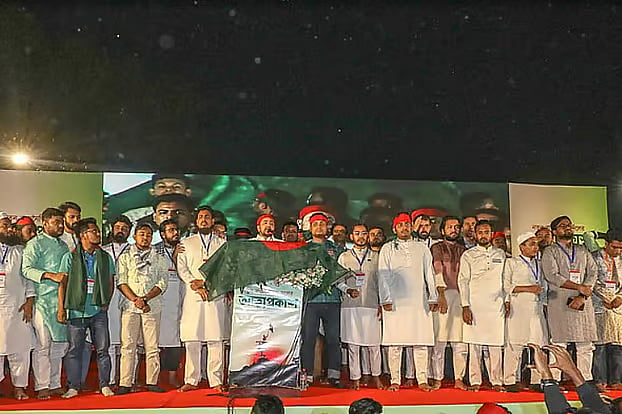
Over 30 years of experience working in the development sector has taught me that partnerships are formed with those who share a common strategic alignment. In other words, if the destination is not the same, there can be no partnership or alliance. The National Citizen Party''s (NCP) partnership with Islamist parties, including Jamaat-e-Islami, reveals what I see as an ideological trap.
Many people wonder whether the NCP intends to function as Jamaat-e-Islami's B-team. This perception arises because contemporary Bangladeshi politics has increasingly featured smaller parties operating as followers or junior partners of larger ones. Secondly, it appears that the NCP's position is driven by a particular anxiety or sense of insecurity, primarily a concern for security. Its closeness to Jamaat may provide the NCP with a degree of protection and security that it believes it cannot obtain from other political actors.
By aligning itself so closely with Jamaat at this early stage, NCP has made it unlikely that it will be able to stand firmly on its own. As a religion-based political party operating within a capitalist framework, Jamaat-e-Islami, by forming an alliance with the NCP, has effectively constrained the latter's potential to develop as an independent political force representing the younger generation.
NCP was effectively taken under the wing of Jamaat-e-Islami before it had even emerged from its political infancy. This has made the rise of the political forces centered on July more precarious. Instead of forming an alliance with NCP, other political parties should have allowed it to develop independently and supported its efforts to find its own path. Unless NCP can break away from the alliance it has built and stand on its own feet, I do not believe it has a viable political future.
NCP's political objectives are not easy to discern. Within a short period, the leaders of the movement have established different political parties and platforms. These include the NCP, the Network for People's Action (NPA), and Alternatives. Their ideological differences have presumably led to the creation of these separate platforms. In effect, this represents a fragmentation of the political forces that emerged from July.
This fragmentation has jeopardised the prospects for developing a unified political identity rooted in the spirit of July. It would be insufficient to describe it merely as an ideological split. NCP''s decision-making process appears to be highly centralised. Democratic practice and the space for dissent within the party do not seem to be well established. The resignation of several progressive leaders over the party''s alliance with Jamaat points in that direction.
In an interview with Prothom Alo on 16 July, Abdul Kader, one of the leading figures of the Anti-Discrimination Student Movement, said: "The problem with NCP is that you are expected to take responsibility, but you have very little opportunity to actually do the work."
A major element of NCP's power-centered political bargaining has been its closeness to right-wing political forces, a relationship that is narrowing the scope of its public acceptability. Moreover, it remains unclear what kind of Bangladesh the NCP ultimately envisions for the future.
The July movement could have opened a straightforward path toward building a people-centered Bangladesh. But that opportunity was not realised. Another important reason is the emergence of numerous self-interested and so-called ideological groups around July. These groups were not always united in opposing the exiled Awami League (whose activities have been banned) or India. Instead, they often became embroiled in visible and, it is alleged, invisible conflicts among themselves. At times, they also failed to distinguish correctly between allies and adversaries.
A new generation has emerged through the July movement. Whether July ultimately fulfills its promise depends on this generation's ability to develop into an authentic political force
This generation mobilised together, marched along a common path, and, through collective action, brought an end to misrule. According to a Facebook post by former Information Adviser Mahfuj Alam, this coalition included four distinct circles: the Jatiyatabadi Chhatra Dal circle, the Islami Chhatra Shibir circle, the left-wing circle, and the free-thought circle. Together, these four circles formed a common nucleus, but that nucleus could not be sustained. In the aftermath of the movement, each of these forces began pursuing its own separate path.
What drove this fragmentation was, above all, the politics of claiming ownership over the success of the mass uprising and the desire for recognition of individual contributions. Among those most assertive in claiming that ownership were Islami Chhatra Shibir, Jamaat-e-Islami, and other like-minded groups. They were undoubtedly important stakeholders in the movement, but they were not its sole proprietors.
Nor was the movement exclusively a student movement. People from all walks of life took part in it. The post-July quest for political preeminence has made unity far more difficult. At the same time, there has been a noticeable lack of political wisdom in effectively translating the spirit of July into practical politics.
At its core, this mass movement was a struggle to build a tolerant, humane, and accountable state for all. More fundamentally, it was an aspiration to construct a modern, inclusive state. If the political forces that emerged from July are able to establish themselves as a genuine political entity, this vision can be preserved. The existing political parties are unlikely to uphold that vision, because they remain bound by conventional politics.
The time has come for the July forces to critically assess the overall situation and determine their future course of action. A new generation has emerged through the July movement. Whether July ultimately fulfills its promise depends on this generation's ability to develop into an authentic political force.
* Khan Md Robiul Alam is a communications professional and educator
* The views expressed here are the author's own.
* This article appeared in Prothom Alo online and has been rewritten in English by Ayesha Kabir for Prothom Alo English