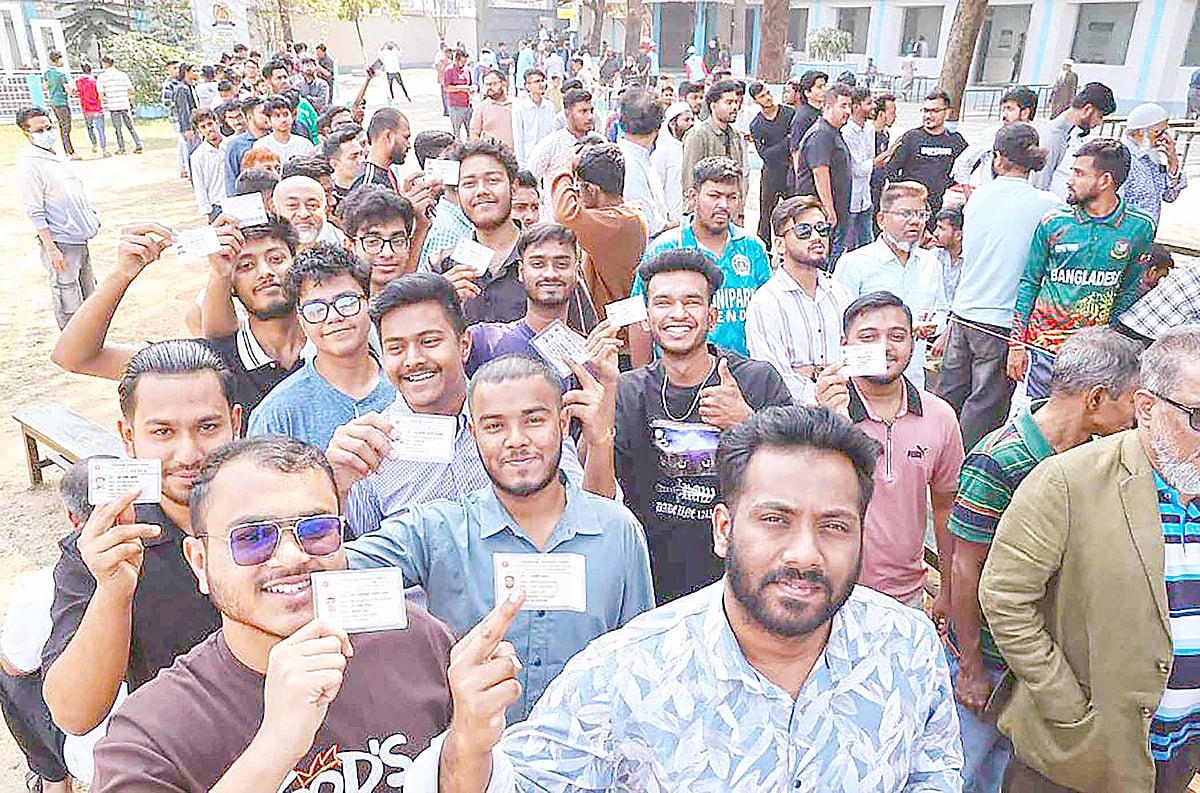
The long-awaited and historic 13th national parliamentary election has been conducted relatively peacefully, overcoming numerous uncertainties and adversities. Voter turnout was reasonably good. However, due to past experiences, many harbour doubts about the real change or benefits that can be achieved despite voting. This lack of trust might be why voter turnout wasn't higher. Nonetheless, the election was generally participatory and inclusive.
Following the defeat of the authoritarian kleptocracy, the interim government banned the activities of the Awami League and its student wing, Chhatra League, resulting in the Awami League losing the opportunity to participate institutionally in the election. Consequently, many, domestic and international, may question how inclusive this election was.
However, it must be noted that the Awami League remained steadfast in its position of declaring the July mass uprising and the interim government as illegitimate and conspiratorial. They also declared the election illegal and vowed to resist it, actively engaging in this effort during the election period. Therefore, one cannot deny the Awami League’s negative and active role in the election and electoral environment.
However, despite the institutional stance of opposing the election, at the grassroots level, Awami League leaders, workers, and supporters participated in the election as voters. Even high-level leaders of the party, who were in prison, exercised their right to vote. A section of the party's supporters may have boycotted the vote, but this applies to ordinary voters as well.
There was competition among the participating parties to attract Awami League votes, especially between the BNP and Jamaat alliance, as well as among various parties and candidates, including the Jatiya Party. Awami League leaders and workers responded, with some directly joining participating parties and actively engaging in campaigns.
As a result, the Awami League played a negative role in the election officially as a party, but unofficially, its members exercised their political rights, including voting. Thus, it is difficult to find an acceptable argument for the position that the election was not inclusive.
In reality, not all voters were able to vote on an equal footing. The influence of wealth and muscle power played a significant role here. Additionally, there was fundamentalism, misinterpretation of religion, patriarchal attitudes, and pressure from the majority in the political and electoral environment. This created a confusing environment for ordinary people, especially women, minorities, people with disabilities, and marginalised voters. In some cases, it also became challenging or even intimidating.
Despite this, the election was conducted in a manner considered acceptable at both national and international levels, and a new parliament and government are set to be formed based on the people's verdict. The BNP alliance will have more than a two-thirds majority in parliament, which may pose risks. From past experiences, we know how significant the negative impact of such a majority can be—people and all current political parties have this experience.
With this lesson in mind, it is hoped that the new parliament and government will act responsibly and avoid an "it's our turn" mentality. This is the expectation of the country's ordinary people.
While there are risks associated with BNP’s major victory, this time the country's voters have been able to avert a situation that could have been even more dire. The significant aspect is that the aggressive expansion of any force based on religious bigotry or misinterpretation has been limited, at least temporarily, in the country's political environment.
One of the demands of Bangladesh’s Liberation War was to stop the political use of religion. In this context, it is disappointing that in this 13th national parliament, religious-based political parties have secured more than a quarter of the seats. But this is the reality. This should not be viewed solely as the result of the July movement. Since independence, political parties have engaged in a kind of unhealthy competition to increase religious influence in the politics of power, allowing such forces to build up.
In this continuity, since the 1990s, the two major political parties in the country have been competing with a "winner-takes-all" mentality, forming relationships with religious-based forces as part of this competition without limitation or regulation. Some incidents in this election also reflect this.
These forces were not only part of the anti-authoritarian mass movements but have also strengthened their positions in an extremely powerful state after the fall of authoritarianism. The Interim Government’s silent and submissive stance during this time of aggressive activities by religious extremist groups over the reports from the Women’s Commission or attacks on shrines and cultural activities empowered these forces further.
On the other hand, the growing negative perception of Islam in the Western world and the Islamophobic narratives of the neighbouring country’s extreme Hindutva government created a sense of threat. These events have further paved the way for the growth of religion-based politics in Bangladesh.
Moreover, Jamaat has increased its organiz\sational capacity as a strategically long-term political entity. Furthermore, they have strengthened their foundations in the political, social, economic, and institutional ecosystem, including education, health, social security, administration, civil-military bureaucracy, banks, and the financial sector. The mainstream politics of the country has consistently failed to meet public expectations, offering religion-based politics an opportunity to present itself as an ''alternative.''
Therefore, this electoral rise of Jamaat, grown on a sustainable foundation, is not a temporary matter. Simultaneously, their unprecedented achievement and how much it will develop subsequently will depend on how BNP, after coming to power with a big victory, will manage the country.
BNP has taken a position in favour of ''Yes'' votes for the ‘31 Points of State Structure Repair’ in this election manifesto and the July Charter. How they will perform duties after forming a new government, how successful they will be, and how the benefits will be provided to the people—when, to what extent, and how—are important. If the new government fails in these areas, it will provide Jamaat the opportunity to become even stronger.
Especially, the primary objective of state reform, achieved through bloodshed, is to ensure government accountability to the people. Although there are some significant proposals to fulfill this purpose, BNP has given a note of dissent, stating that ''the government should not be bound hand and foot.'' The party must reassess how reasonable these proposals are in the current situation and how they might actually become a catastrophe or boomerang.
In other words, BNP must consider how these might impact government activities and how they could influence the people or political process. Ultimately, there is no alternative but to adopt a path of self-purification, freeing from the long-standing custom of viewing political, representative, and governmental positions as licenses for power abuse.
It is essential to remember that the reasons preventing the people's verdict from allowing Jamaat to advance further this time should be identified, and BNP may soon go back to the ''drawing board'' to analyze how they can become more acceptable to the populace. They may focus on developing new plans or strategies for this analysis.
#Ifthekharuzzaman is the Executive Director of Transparency International Bangladesh (TIB).
*The opinions expressed are the author’s own.
#This article, originally published in in Prothom Alo print and online editions, has been in English by Rabiul Islam