Opinion
US trade deal and politics: BNP’s ‘Bangladesh first’ policy and an adverse reality
Political parties across the world continue to introduce new slogans in electoral politics, and Bangladesh is no exception. In 2008, the Awami League came forward with the slogan “Charter for Change.”
In the 2026 election, the BNP adopted the slogan “Bangladesh First”. The three one-sided and coercive elections held in between did not require any slogan to attract voters, because voters themselves were not the centre of attention there.
Although Bangladesh witnessed socio-economic progress during the Awami League’s 15-and-a-half years in power, present-day Bangladesh itself proves that not everyone’s fortunes changed. Per capita income and high growth are not always reliable indicators of development.
Even after 55 years of independence, when we see that one-fifth of the population still lives below the poverty line and many are deprived of basic necessities for survival, the hollowness behind the rhetoric of development becomes apparent.
Against this backdrop, the BNP’s slogan “Bangladesh First” in the 12 February election captured the attention of the majority of voters, which is why the party won more than two-thirds of the parliamentary seats.
While securing a two-thirds majority is a remarkable success for any political party, Bangladesh’s political history suggests that it can also become a source of danger.
The introduction to the BNP’s election manifesto states, “If entrusted with responsibility by the people’s verdict, BNP will build such a Bangladesh where the sanctity of votes will be protected; terrorism, corruption, and inequality will end; no one will be above the law; and every citizen will proudly be able to say, ‘Bangladesh First.’” We hope this will not remain mere rhetoric. BNP’s leadership should strive to build a Bangladesh where people of all religions, races, and ethnicities enjoy equal dignity. No one should face discrimination based on party affiliation, religion, or gender.
BNP has criticised the interim government for failing to procure measles vaccines, yet it has remained silent about the unequal US agreement. Policymakers should understand that by accepting such an unjust agreement, it is impossible to truly uphold the principle of “Bangladesh First.” At the very least, the public has the right to hear the elected government’s explanation regarding the agreement.
The core message of the July mass uprising of 2024 was the end of inequality. Yet during the interim government’s 18 months in office, inequality increased rather than decreased. Mob violence further marginalised already vulnerable communities. Due to growing insecurity, women’s presence in social and political spaces declined even more. A few examples may illustrate this.
The National Consensus Commission formed under the leadership of Professor Muhammad Yunus to reform the state included no women or minority representatives. Individuals associated with the commission themselves admitted that it failed to establish consensus. Shireen Parveen Haque, head of the Women’s Affairs Reform Commission, said that the charter signed by political parties at the South Plaza of the National Parliament was essentially a document protecting male privilege.
Two members of the Constitutional Reform Commission, Sharif Bhuiyan and Firoz Ahmad, published their dissenting opinions in Prothom Alo on 11 May, thereby clarifying their positions before the nation and exposing the commission’s double standards. There were likely a few dissenting voices in the other commissions as well.
The National Consensus Commission also avoided addressing the discriminatory state policies and injustices that have persisted for years in the socio-economic sphere. It did not even speak about democratising political parties. By placing ideologically opposing parties at the same table in the name of reform, the commission produced an awkward compromise that created new crises instead of resolving existing ones.
To make “Bangladesh First” a reality, BNP has pledged to eliminate corruption, inequality, and terrorism. It has also promised to strengthen democratic institutions. But can that be achieved while maintaining the injustices currently prevailing in the socio-economic sphere? An economy whose benefits are enjoyed by only a small elite while the broader population remains deprived cannot reduce inequality. And without reducing inequality, corruption cannot be contained.
Jamaat-e-Islami chief Shafiqur Rahman advised people to view the agreement in light of “reality.” By that logic, however, the various agreements signed by the Awami League government in the past with India, China, and Russia also cannot be questioned, since those too were justified in the name of “reality.”
To truly put Bangladesh first, the government would have to resist all forms of pressure from foreign donors such as the IMF and the World Bank. The question is whether the government is prepared to do so. Family cards and farmer cards alone are not enough to establish “Bangladesh First.” At best, these are temporary relief measures.
Simply feeding people enough to survive does not contribute meaningfully to economic development. Every citizen must have access to dignified employment. Security must also be ensured. BNP promised in its election manifesto to create jobs for 15 million people. But how will that be possible without expanding industries and strengthening economic activity?
The government has already faced an energy crisis shortly after assuming office. While people outside Dhaka are enduring eight to ten hours of load-shedding, ministers continue to claim that rural areas are not experiencing power cuts. Such statements undermine the government’s credibility.
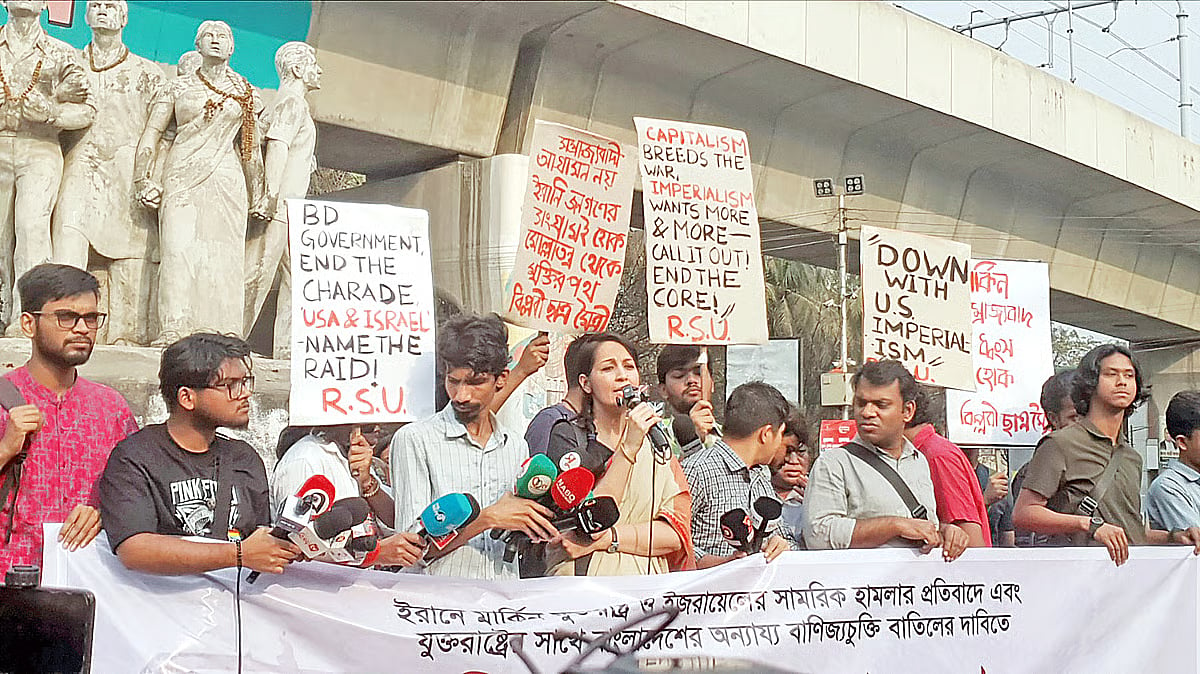
The tariff agreement signed by the interim government with the United States on 9 February, just three days before the election, contains provisions that are severely harmful to Bangladesh’s interests. The agreement imposes conditions from the United States that no self-respecting nation should accept.
According to Prothom Alo’s analysis, the agreement contains six obligations for the United States and 176 for Bangladesh. Foreign Minister Khalilur Rahman, in response, advised critics to compare Bangladesh’s tariff agreement with those signed by other countries with the United States. But even if other countries sign subservient agreements, that does not make such an agreement acceptable for Bangladesh. The foreign minister also did not consider it necessary to mention that after a US court declared President Donald Trump’s tariff measures illegal, some countries suspended or cancelled their agreements.
Although opposition parties such as Bangladesh Jamaat-e-Islami and the National Citizen Party (NCP) created uproar in parliament over the full implementation of the July Charter, they did not utter a single word about this tariff agreement. Jamaat-e-Islami chief Shafiqur Rahman advised people to view the agreement in light of “reality.” By that logic, however, the various agreements signed by the Awami League government in the past with India, China, and Russia also cannot be questioned, since those too were justified in the name of “reality.”
The responsibility of patriotic political leadership is not merely to accept reality but to change it in the interest of the country and its people.
The agreement with the United States was signed during the interim government’s tenure. During the same period, it also signed another agreement with Japan, though that one was not nearly as dangerous. BNP has criticised the interim government for failing to procure measles vaccines, yet it has remained silent about the unequal US agreement. Policymakers should understand that by accepting such an unjust agreement, it is impossible to truly uphold the principle of “Bangladesh First.” At the very least, the public has the right to hear the elected government’s explanation regarding the agreement.
On Sunday, Prime Minister’s Information and Broadcasting Adviser Zahed Ur Rahman stated that the government is not cancelling the trade agreement with the United States but reviewing it. Perhaps through this statement he implicitly acknowledged that the agreement contains provisions that cannot simply be accepted without question. If the government genuinely wants to implement “Bangladesh First,” then a detailed public discussion of the agreement is essential.
* Sohrab Hassan is a poet and journalist.
* The opinion is of author’s own