Opinion
5 August and politics of an unfinished ‘legacy’
Exactly two years ago around mid-morning today, I restlessly kept calling one after another journalist hoping to get some solid information about the government’s situation. None could say much. Sipping black coffee, I looked out the window from the 13th floor. Patches of clear blue sky peeped through the fast moving clouds. An eerie silence cloaked in suspense engulfed my surroundings. The Bata shoe shop roundabout was nearly empty. The internet has once more been shut down since early morning. My sixth sense kept whispering that something big was happening.
I called my net service provider. He was surprisingly quick to respond.
“Mamun, how long will it take to restore the net?” His sharp reply mixed with wit and sarcasm left me somewhat baffled, “Bhaiyya, not until a new political government assumes office.” He cut the line with an amusing chuckle. I got the message.
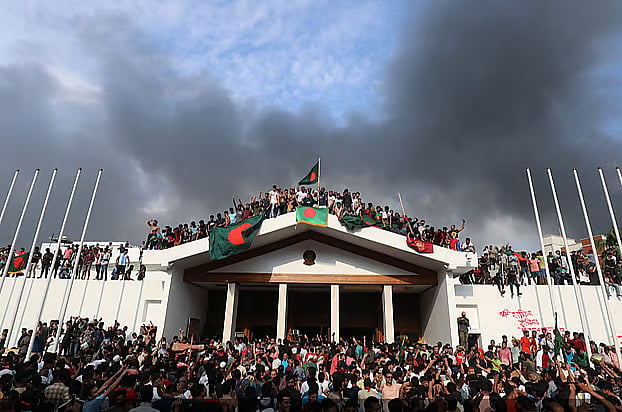
However, reflecting back to that action-packed day unfolding in dramatic fashion - it no longer exclusively belongs to the countrywide wild jubilations or the striking video footage of Sheikh Hasina boarding a military plane in haste. Fast-forwarding two years , and the day now has seemingly evolved into one of the defining political milestones in Bangladesh's contemporary political history—a moment that fundamentally altered the nation's political landscape while raising lingering questions about political leadership, institutional resilience and of course the future of one of South Asia's oldest political parties – Bangladesh Awami League.
The first anniversary of July Mass Uprising Day marked the end of a brutal and dictatorial era, but the second today, compels this writer to engage in serious soul-searching.
For nearly a decade and half, Sheikh Hasina dominated Bangladesh's political arena with unprecedented cunning authority, eye-washed the nation with massive infrastructure development projects, ostensibly sustained economic expansion and projected a tailor-made image in the likes of an indispensable leader. Yet the events of 5 August demonstrated an enduring lesson of politics: No political order remains immune from abrupt change. She simply forgot that history is rarely kind to leaders who mistake longevity for permanence.
Two years into her exile life in India, and perhaps the most intriguing question right now is not whether Sheikh Hasina remains politically relevant. It is why the Awami League has yet to demonstrate convincing signs for an organisational renewal and why serious repentance for the July crimes are manifestly missing among most of its party men?
Looking back at history, political exile has not always been an obstacle for a leader to reorganise and lead a party. Certain leaders have coordinated movements, rebuilt organisations and even returned to power after years abroad. Distance surely complicates leadership, but it does not extinguish it. Elements what ultimately determines success is the sheer sense of belonging to the party, clarity of purpose and the ability to inspire confidence within the party rank and supporters.
It is right on this point where the Awami League continues to face its biggest challenges. The party’s political messaging remains disturbing amid a government imposed ban, yet visibility alone cannot substitute for organisational revival. A party that governed Bangladesh for years now appears to be desperately searching for both strategic direction and an effective mechanism to reconnect with political realities inside the country.
Transiting from governing a party to launching an opposition movement—or, in this case, to a party operating under extraordinary political constraints—is never easy. Nevertheless, history shows that survival ultimately depends on adaptation rather than blind nostalgia.
What’s particularly fascinating is that amid AL’s self-made chaos, Ms Hasina is all set to hold a virtual conference from New Delhi today reportedly organised by the Foreign Correspondents' Club of South Asia (FCCSA) coinciding with the anniversary marking the fall of her government.
Understandably, this political gamble would not only ruffle more feathers in Dhaka, rather push her luck away, since the Indian government has publicly stated that she is no longer permitted to use Indian territory for political activities directed at Bangladesh.
Even more significant is the succession question. For decades, Sheikh Hasina stood at the centre of virtually every important political decision within the Awami League. Her authority became synonymous with the party itself. Such dictatorial and centralised leadership undeniably strengthened internal discipline during her years in office. Yet concentration of authority often carries a hidden cost: The very institution may become exceedingly dependent on one individual. And this is what has happened.
Absence of a clearly designated political successor has consequently become one of the defining features of the Awami League's post-2024 predicament. Political succession is not merely an administrative exercise; it is an institutional safeguard. It reassures supporters, reassesses strategy and signals confidence that a movement can outlive its founder or principal leader.
That question now looms larger than ever.
Who speaks for the Awami League beyond Sheikh Hasina? Who possesses the authority to negotiate, reorganise and inspire? Who represents the party's future rather than its past?
At present, there is no answer for any of the above questions.
And as far as 5 August is concerned, it represents more than just remembrance - it has now turned into a political test. Hasina yet continues to command a toxic loyalty among many supporters. Her decades-long influence on Bangladesh's politics is undeniable, regardless of differing assessments of her record.
Then again, political legacies are seldom secured solely through past accomplishments. The AL political dynasty is eventually confronting the dilemma: Whether to launch a movement through renewal or to safeguard a personality through political "justifications." We too, are witnessing that dilemma fast unfolding in real time.
History will ultimately remember Sheikh Hasina for many "achievements," many controversies and many defining moments. But perhaps its most consequential judgment will rest on a simple question: After leading one of Bangladesh's most historic and formidable political organisations, did she leave behind a party capable of leading without her?
That question remains unanswered. The passage of time, more than political rhetoric, will determine the verdict.
* Shahriar Feroze is the writer is Senior Assistant Editor for The Daily Observer
* The opinions expressed here are the writer's own.