Every state has an unwritten social contract with its citizens. Citizens abide by the law; in return, the state provides security and remedies when crimes occur. In today's Bangladesh, many people feel that this contract is becoming increasingly meaningless. Despite being victims of crime and harassment, they do not receive justice; sometimes it seems the state is incapable of fulfilling its duties, and other times, it appears indifferent. The situation has deteriorated to such an extent that victims are now saying that these occurrences are 'normal' in Bangladesh.
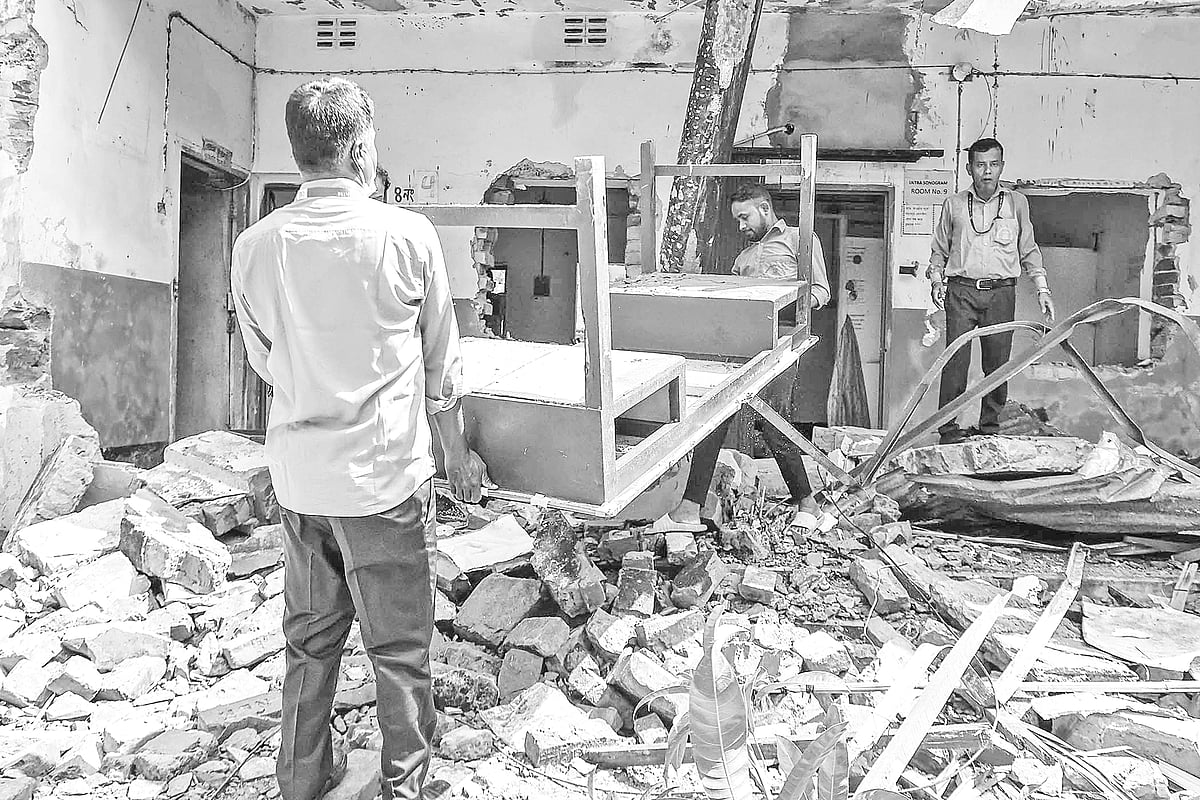
Recently, hundreds attacked the Radda Maternal and Child Health Centre in Dhaka's Mirpur under the cover of darkness. They tied up the security guards and took away medicines, vaccines, and equipment. They then brought heavy machinery to demolish the building. The police arrived after being informed but were unable to stop the looting and destruction.
Within a few days, there was another attack at a housing project in Dhaka's ECB area, including the studio of content creator Salman Muqtadir. Following the vandalism, Salman sarcastically remarked to the Home Minister that there's nothing to worry about since everything is 'normal' in Bangladesh now.
This notion of 'normal' is our greatest danger. If people assume that organised groups can destroy a health centre and the police can't stop it despite being present, and later a few show arrests will claim that action has been taken, what can citizens hope for from the state?
I refer to this situation as a 'Hope Deficit'. It's not a recognised term in political science; rather, it describes Bangladesh's current experience. Issues like electricity or gas shortages and rising commodity prices also affect people's future hopes. But the deficit here is deeper: people are beginning to lose faith that things can be changed by obeying the law, filing complaints or protesting.
The hope deficit and the democracy deficit
We have heard of a 'Democracy Deficit'—wherein despite systems for elections or representation, if citizens' opinions and needs do not reflect power decisions and accountability is weak, democracy is lacking.
The Hope Deficit is somewhat different. There are elections and a government, and laws exist, but if in peril, the average citizen does not believe that the legal and judicial systems will support them. There's also no confidence in impartial investigations into complaints against the powerful. People haven’t stopped seeking justice, but they are starting to lose faith that it will be served.
The ongoing hopelessness centres around the deterioration of law and order and the administration's failure to curb it. The concern is not solely due to the aforementioned incidents. According to the Human Rights Support Society, from March to August of this year, at least 300 incidents of mob beatings and organized violence resulted in 142 deaths. During the same period, the organisation recorded 448 cases of political violence.
Their report also included the ruling party members'' involvement in significant parts of these political clashes. In such a scenario, the urgency of determining the impartiality of investigations increases.
Domestic security should also not be left out of this discussion. According to the same organisation, 320 women were killed in domestic violence between January and June this year, compared to 166 in the same period last year. Labeling domestic violence solely as 'hopelessness' obscures the perpetrator's responsibility and the discrimination faced by women.
However, if a victimised woman does not believe her family, the police, or the judiciary will help her safely escape, it's not hard to grasp the dire impacts of hope deficits in her life.
The state's responsibility
Good governance requires administrative capacity and the will to utilise it effectively. Arresting a few people or transferring some officials post-incident does not absolve the state of its responsibilities. If those who gathered the attackers and those who could stop them remain hidden, the perception deepens that the law exists only on paper in conflicts with the powerful.
The Radda incident clarifies this crisis. For nearly five decades, the institution provided healthcare to low-income mothers and children. A land dispute was known prior, and the police were notified on the night of the attack. Initial police investigations revealed that assets were moved even in the presence of the police, yet no effective action was taken.
The Home Minister acknowledged the negligence of the police station's officer-in-charge, and he was relieved of his duties. The question remains whether the investigation will halt at his negligence. Answers are needed regarding who gathered the attackers, who brought in the heavy machinery, and who planned the attack. Allegations have surfaced regarding the involvement of a Member of Parliament, though he has denied them. An impartial investigation of this allegation is necessary.
Regarding the attack on Salman Muqtadir's studio, the police cited a land dispute. The Home Minister mentioned that if specific extortion allegations were made, the police would investigate them. Detailed information is undoubtedly required for investigating such allegations. However, the responsibility to prevent attacks and initiate investigations upon learning of a crime should not solely depend on whether the affected party files a written complaint at the police station. If listening to the minister's statements makes people feel the state's hands are tied without documented complaints, clearing this perception is the government's responsibility.
The laws in Bangladesh contain ample provisions for prevention. The Code of Criminal Procedure's Article 149 describes the police's role in preventing cognisable offences; Article 150 mandates informing the concerned authority about the planning of such offences. Under Article 157, the police can proceed with investigations based on information or other sources if there is reasonable suspicion that a crime might have been committed. Therefore, the question arises: if the police need to wait for crimes to occur and written complaints to be filed to protect people, what exactly does 'maintaining law and order' signify?
How hope can be restored
Brazilian educator Paulo Freire wrote in 'Pedagogy of Hope' that without a minimum level of hope, a struggle cannot even begin. Hope does not guarantee everything will be fine. Hope is the belief that standing against injustice can bring about some change.
The responsibility to retain that belief is not just on the victims. The media will follow up on incidents; civic organisations will keep demanding unbiased investigations and justice; ordinary people can also contribute by preserving and verifying evidence and disseminating information. Social media can be a potent tool in this endeavour. We witnessed its proof during the mass awakening in July. The people of this country have shown their strength in standing together can be formidable. 'These things are normal in Bangladesh' should not be the final word. Let our first protest today be the claim that security is not a favour, nor is justice a stroke of luck; both are citizens' rights.
#Hasan Ferdous is an essayist and columnist.
*Opinions expressed here are the author's own.
#This article, originally published in Prothom Alo print and online editions, has been rewritten in English by Rabiul Islam.