Hasan Ferdous column
Is Iran's situation different this time?
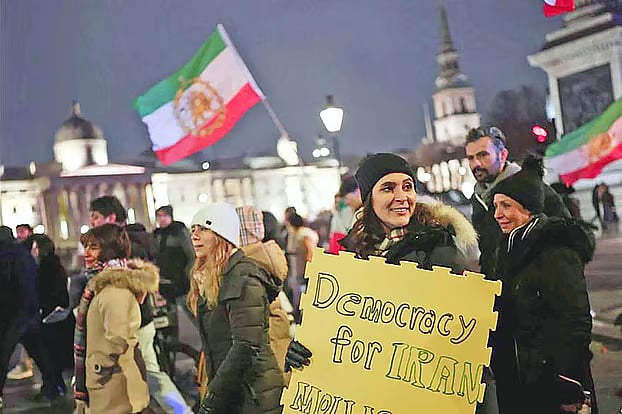
There is no easy way to see clearly what is happening in Iran. Everyone is interpreting reality through their own lens. One group says the Islamic Revolution is not easy to subdue; no matter how hard the United States or Israel tries, this system of rule will survive. Another group believes the revolutionary government in Iran has been so deeply eroded from within that a single strong blow could cause the religious ruling establishment to collapse.
This February, Iran’s Islamic Revolution will enter its 47th year. Over these nearly five decades, the country has witnessed at least half a dozen major uprisings and mass protests. Each time, foreign observers have said that this must be the end of the revolution. Even three years ago, after the death of Kurdish young woman Mahsa Amini in state custody triggered nationwide protests, many thought the regime would not survive. But the government managed to contain the situation then as well. This time, however, the situation truly appears different.
The main reason is that the people of Iran have learned to face death. With the state of the economy, the paths to survival are almost blocked. Simply deploying the military or firing artillery can no longer suppress the population. Today’s Iran is reminiscent of Bangladesh in July–August 2024, where even firing from helicopters could not quell the protests. The current fiery situation in Iran is being driven primarily by the country’s younger generation—both women and men—much like the Monsoon Revolution in Bangladesh.
One explanation for this unique situation has been offered by Iranian-American professor Vali Nasr. According to him, the Islamic Revolution faces threats not only from within the country but also from outside. By outside threats, he means Israel and the United States, both of which have long sought opportunities to remove Iran’s Islamic government from power.
The United States has imposed more sanctions on Iran than on any other country in the world. While these sanctions have severely damaged the economy, they have not completely dismantled the religious ruling structure. Even with the combined use of 30,000 pounds of bombs, Israel and the US have been unable to bring the Iranian government under control in recent times. But this time, the situation is different. As Nasr explains, the legitimacy of the religious rule itself is now being questioned.
The same point has been made by another Iranian intellectual, Stanford University professor Abbas Milani. According to him, this time the government has lost legitimacy on one hand, while the people of the country are clearly demanding change. This statement has a historical context. The Islamic Revolution of 1979, led by Ayatollah Ruhollah Khomeini, was truly a popular revolution, involving people from all levels of society.
The Israeli newspaper Haaretz reported that the Israeli government is funding Reza Pahlavi through social media to make him a future ruler. This alone is enough to delegitimise the ongoing anti-Islamic Revolution protests. Add to that the threat from US President Trump, who has indicated that he could launch a “kinetic attack” or direct military strike in support of anti-government protests at any moment.
Even some segments of the Shah’s loyal security forces sided with the revolution. There was an expectation of change because, under the Shah, the economic benefits were enjoyed mainly by Iran’s elite, while protesters faced imprisonment and oppression. Yet, ironically, nearly five decades after the revolution, the lives of ordinary people have changed very little.
Under the Shah, the most feared institution was the secret police, SAVAK. When Khomeini came to power, his government replaced it with SAVAMA.
Though the name changed, the function remained the same. The Revolutionary Guard and the moral police, known in Iran as Ghasht-e Ershad, continue to suppress dissent. Speaking out means prison. And it is not only opposition politicians or activists who are targeted. Nobel Peace Prize-winning human rights activist Narges Mohammadi has been imprisoned since 2023 on charges of anti-state statements, and another Nobel laureate, Shirin Ebadi, has been in exile since 2009.
The most brutal example of moral policing is Mahsa Amini. She had come to Tehran for a visit from the Kurdish city of Saqqez in the northwest. On 13 September 2022, she was arrested for allegedly not wearing her hijab properly. Three days later, she died in police custody. Her death sparked the “Women, Life, Freedom” movement. In a similar case, Saba Kord Afshari was arrested in 2018 on comparable charges and was released in 2023 due to pressure from the women’s rights movement.
This list could go on, but it would become repetitive. The Islamic Revolution was meant to restore dignity and respect to the people of Iran. Instead, the country has endured one-party rule, nearly four decades of authority by unelected religious leaders, and continuous repression. For these reasons, the legitimacy of the government is now being questioned.
This is compounded by a severe economic crisis—on one hand corruption and mismanagement, on the other decades of international sanctions. In 1979, one US dollar was worth 70 rials; today, it has risen to nearly 1.5 million rials (yes, you read that correctly—one and a half million). Inflation stands at roughly 48 per cent. People’s incomes have not increased, but their expenses have. Even though the government offers a small subsidy per family, it barely covers a few loaves of bread. The anger of a hungry population is therefore inevitable.
The main force behind the current protests is the country’s younger generation. Sixty per cent of Iranians are under 35, and they are exhausted and angry from unemployment and a stagnant economy. I saw a video of an unnamed mother whose son was killed while participating in the protests. When people consoled her, calling her son a martyr, she replied irritably, “Don’t call my son a martyr. He was murdered because he wanted to live.”
According to social media and reports from the Iranian diaspora, at least a thousand or two people have been killed so far at the hands of security forces. It is estimated that for every person who dies, ten more continue to stand. The fearful Iranian religious rulers have shut down the internet (an action also seen in Bangladesh). In response, young people have resorted to alternative means, using clandestine methods to activate Starlink internet terminals. Showing their middle finger to the government, they say, “You still speak in the language of 1979; we speak in the language of 2025–26.”
Even after reaching this point, there is no guarantee that the new generation will succeed against the oppressive religious rulers. Iran’s security forces still firmly support the government. If the repression intensifies, the uprising could collapse. We also know that Reza Pahlavi, son of the deposed Shah Reza, is looking for an opportunity to seize leadership of the revolution. He has backing from Israel.
The Israeli newspaper Haaretz reported that the Israeli government is funding Reza Pahlavi through social media to make him a future ruler. This alone is enough to delegitimise the ongoing anti-Islamic Revolution protests. Add to that the threat from US President Trump, who has indicated that he could launch a “kinetic attack” or direct military strike in support of anti-government protests at any moment.
If such an event occurs, the religious ruling class could easily label the protests as a foreign conspiracy—a tactic that has historically worked in Iran many times.
#Hasan Ferdous is a writer and essayist
*The opinions expressed are the author’s own.
*This arictle, originally published in Prothom Alo print and online editions, has been rewritten in English by Rabiul Islam.