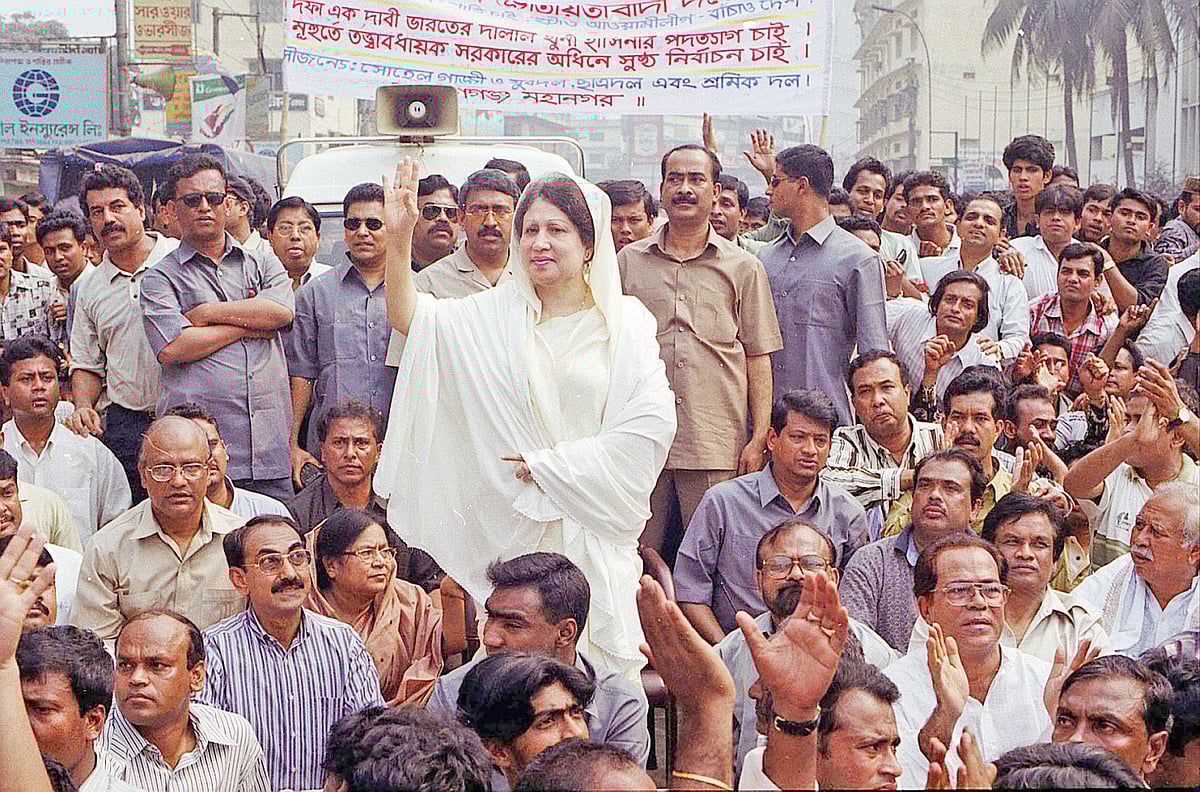
In its preliminary list of candidates for 236 constituencies in the 13th parliamentary election, the BNP has created the biggest surprise by reserving three seats for its chairperson, Khaleda Zia. The three constituencies are Feni-1, Bogura-7, and Dinajpur-3.
According to the election commission’s law, a person may contest in a maximum of three constituencies; previously, the limit was five. During Ershad’s rule, Communist Party General Secretary Mohammad Farhad proposed the “150+150 formula” between the Awami League and the BNP to establish political understanding between their two leaders. Following that, the election commission limited the number of constituencies to three.
From 1991 to 2008, Khaleda Zia contested in several constituencies and won all of them by large margins — she has never lost an election, a rare record in Bangladesh’s politics. Her political rival, Awami League President Sheikh Hasina, lost two constituencies in the 1991 election and one in 1996. Hussain Muhammad Ershad, though he won five constituencies from jail in 1991, lost one in 2014.
After being imprisoned in 2018 during the Awami League government in a corruption case, Khaleda Zia has remained largely inactive in politics. The BNP maintains that the case was politically motivated and baseless. Before her imprisonment, she appointed her elder son and senior vice chairman Tarique Rahman as the acting chairman of the party.
Tarique went into exile during the army-backed caretaker government in 2008 and has since been running the party from London, regularly meeting party leaders and activists online and issuing directives. He also played a key role in finalising the list of candidates. He is expected to return to Bangladesh next month.
Khaleda Zia is currently in poor health and not active in politics. Over the past seven years of the Awami League government, she spent time alternately in prison, hospital, or under house arrest. Despite repeated appeals from the BNP to allow her to travel abroad for medical treatment, the government denied the request. The mass uprising of 2024 led to the fall of the Awami League government, after which former Prime Minister Sheikh Hasina fled to India. On 8 August last year, following the formation of a new government led by Professor Muhammad Yunus, Khaleda Zia was released from prison, and all charges against her were dropped.
Under these circumstances, many believed Khaleda Zia would no longer contest in elections. However, the BNP’s preliminary list once again includes her name for the same three constituencies as before. Given her current health condition, there are doubts about whether she will be able to participate in election campaigns herself. Still, the party continues to place its trust in her leadership.
The main reason is Khaleda Zia’s uncompromising image, both within and outside her party. It cannot be said that she was entirely successful as head of government, but her courageous role in the anti-autocracy and pro-democracy movements is widely acknowledged. In our deeply antagonistic political culture, leaders often attack one another verbally, sometimes even maligning deceased leaders. Witnessing this, Khaleda Zia, while in opposition, once proposed in Parliament that national leaders should not be unnecessarily subjected to personal attacks. The ruling party did not accept the proposal. Since 2014, she has remained outside Parliament altogether.
During the Awami League government’s tenure, the way those in power insulted Khaleda Zia and evicted her from her residence only increased public sympathy and respect for her. No one viewed the mockery of a sick woman kindly.
In countries like ours, it is difficult to assess a leader’s popularity while they are in power, as party loyalists constantly sing their praises — not to mention the state-controlled propaganda machinery. True popularity can only be measured when a leader is in opposition. Khaleda Zia, I believe, has passed that test.
From writer and researcher Mohiuddin Ahmad’s book One–Eleven: 2007–2008, we learn that policymakers of the then interim government offered both major party leaders a safe exit from politics. Khaleda Zia refused the offer; her rival accepted it. That, too, enhanced her popularity.
Before every election, political parties issue grand manifestos, vowing to lead the country to prosperity. The public has little faith in such promises. Even so, they cast their votes based on their trust in leaders and symbols.
This time, the BNP leadership is largely relying on Khaleda Zia’s image to navigate the electoral waters. They believe that even if she cannot personally campaign, her name and participation alone will strengthen the party’s position. Even BNP’s harshest critics regard her with respect.
On 4 November, Nasiruddin Patwary, chief coordinator of the NCP, said at a press conference, “We will not field any candidate in Khaleda Zia’s constituency. We welcome her candidacy. Her uncompromising and fearless leadership has strengthened democracy in Bangladesh.” The Gono Odhikar Parishad has also announced that it will not field a candidate in her constituency. Although such gestures are not entirely consistent with the principles of multiparty democracy, they carry symbolic value as marks of respect toward a leader.
Reactions have already emerged in various places over the BNP’s candidate list. In some areas, violent incidents have occurred, including road blockades and arson. The BNP leadership had hoped to manage the situation easily, but it is proving more difficult than expected. In the end, the BNP leadership may still view Khaleda Zia as a “saviour.” Even candidates who feel deprived may ignore the opinions of others, but they are unlikely to disregard her advice.
Many BNP leaders argue that minor issues are normal in a large party. However, the unrest is not limited to just a few constituencies. Questions about nominations in several areas are not unreasonable. On what basis did the BNP finalise the list? Did they consult with grassroots leaders and activists? One deprived aspirant cited a party organisational leader saying, “I wasn’t even called to discussions because I am considered part of the opposing faction.”
There are also allegations that nominations were given to leaders accused of land-grabbing and extortion, while veteran leaders in several constituencies were left out. Activists are particularly unhappy about the exclusion of those who consistently opposed the Awami League both inside and outside Parliament and spoke out on television talk shows.
By awarding Khaleda Zia nominations in three constituencies, the BNP has demonstrated that even if she remains politically inactive, she continues to be highly influential in the minds of voters. Grassroots leaders and activists believe that her name alone will advance the party, and her image will secure victory.
#Sohrab Hasan is a poet and journalist
sohrabhassan55@gmail.com
*The opinions expressed are the author’s own.