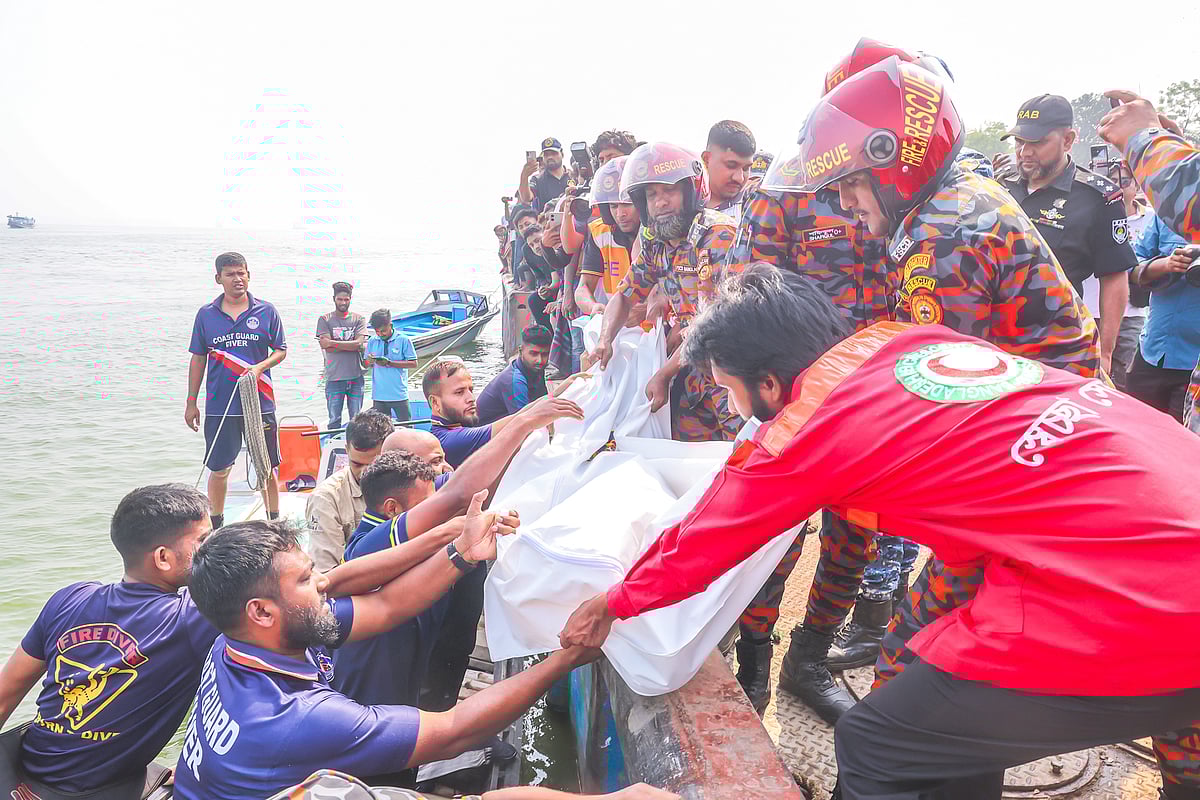
Accidents during Eid holidays
Do people have to resort of local solutions as the last resort?
During the Eid holidays, accidents in this country seem to arrive as if on schedule, as similar accidents occur in the same manner and at the same time. On Sunday, 22 March, the day after Eid, a bus found itself on the railway track at Paduar Bazar rail crossing in Cumilla early in the morning.
The Dhaka Mail Train en route to Dhaka from Chittagong dragged the bus for about a mile. Initially, seven bodies were recovered from the accident site, with the death toll eventually rising to 12.
It took five hours to restore rail communication with Chittagong. As usual, three investigation committees were formed, and there was a promise to provide compensation (though it's termed a grant, not compensation) to the families of those affected.
Before Eid, on 18 March, Wednesday, at 2:30 PM, another passenger train, the Nilsagar Express, derailed in Adamdighi, Bogura. Nine carriages went off the track, disrupting rail communication between Dhaka and five northern districts—Nilphamari, Dinajpur, Thakurgaon, Panchagarh, and Joypurhat.
Five more trains were stranded at three nearby stations, causing immense inconvenience for home-goers during Eid. Passengers atop the derailed train were injured after falling, as were those inside the carriages. Official records state 66 people were injured.
The accident at Paduar Bazar crossing is 'nothing new'. At the time of this most recent incident, newly elected local MP Monirul Haque was undergoing medical treatment in Singapore. From there, he called Road Transport and Bridge, Rail, and Water Transport Minister Sheikh Rabiul Alam, saying emotionally, "I have grown old witnessing these corpses. Brother Rabiul, this isn't a new incident. This has been happening for a hundred years. No one brings justice... Fix the Padua Bazar railway barrier. (Then) I will find peace in life." This conversation was seen on social media.
According to the railway list, there have been eight major accidents in the eastern region over the last eight years, resulting in 67 deaths. Earlier, on 23 October 2023, another 19 people died, and at least 50 were seriously injured in an accident in Bhairab.
On that day, an intercity train bound for Dhaka, the Egarsindur Express, collided with a freight train at the outer point of Bhairab railway station. The investigation report mentioned driver, assistant driver, and guard negligence in observing signals as the cause of the accident.
Conscious readers and railway officials surely remember the Baratakia tragedy. A microbus carrying coaching centre teachers and students was hit by the Mahanagar Prabhati train headed to Chattogram. It was 29 July 2022, around noon. Mahanagar Prabhati pushed the microbus for nearly a kilometer. Thirteen people died, and about five were disabled. Two investigation committees held the microbus driver and gatekeeper responsible for this incident.
Prior to this, on 4 December 2021, negligence by a gatekeeper at the Jhautala railway crossing in Khulshi, Chattogram, resulted in a DEMU train collision that killed three people. This list is seemingly endless. However, the descriptions make one thing clear: the lowest-level workers are always blamed. Here lies the 'full stop'. Those who supervise them remain untouched.
The practice is now to 'let all of them go and catch the gatekeeper'. It's an essential part of the arrangement.
The death toll in the current rail accident could have been higher had day labourer Enamul Haque from Phulbari, Dinajpur, not taken action with a banana flower. While on his way to work along the railway track, he noticed about a foot of the line was broken. The intercity train en route to Panchagarh would arrive soon. Finding nothing else, he tied a banana flower to a stick and stood on the railway track.
The express train approached within just five minutes. Observing the banana flower signal, the driver stopped the train, sparing several hundred passengers from a horrific disaster. Every day, 10-15 trains travel this route, including routes to Dhaka, Rajshahi, Dinajpur, Panchagarh, Parbatipur, and Chilahat.
Just like this country was built by ordinary people, its safety also lies in their hands. Yet, there's no process to involve them. How often will people like Enamul stand with banana flowers out of their own concern? Neither Enamuls nor banana flowers are limitless in this country.
People are not neglectful, but if the country's leaders are, it spreads to homes like a contagious disease. The joy of Eid was destroyed for the children of Dewanganj. A so-called floating bridge built by the municipal corporation turned into a death trap. The municipality knew this, yet it remained operational.
The assistant engineer of the municipality reported that a warning sign had been placed because the bridge was risky. There's a tradition in this country of hanging perfunctory warning signs in front of bridges on many highways. Didn't he know the broken bridge had been temporarily repaired to facilitate access to a nearby eco-park?
Such temporary repairs create a false sense of security. Could this user-friendly kind of repair have been possible without his permission and management assistance? Municipalities have been managed by bureaucrats since 2024. Who will answer whose questions?
An exceptional description of public negligence was given by a bus passenger on a ferry crossing. On the day of the Daulatdia tragedy, he was traveling on the same route that night (25 March). He wrote on social media, "I got on the ferry from Ghat No. 3 on the most renowned transport of the district. I saw that even after a nation-shaking tragedy, no one had a sense of consciousness. Less than 24 hours after the accident, neither passengers nor the bus company cared when the bus got on the ferry. The doors were locked as well, so even if one wanted, there was no way to get off. Neither the bus company nor passengers showed any interest in disembarking. Only I weakly suggested once or twice, ''Wouldn’t it be better to let the passengers off?'' No one heeded that feeble plea."
The people of this country, who can resist the notorious Pakistani forces with bare hands, stand firmly in front of a dictator's armed forces, and stop a train with a banana flower, why do they become so fearful on ferries?
Trade union leader Comrade Jasim Mallick might have been able to answer this question. However, there's no difficulty in realising the vast class differences among them. Though passengers of an AC bus and people going out for work at dawn may appear similar, there’s a huge discrepancy inside their 'machines'.
Yet, it seems those who avert dangers should have a share in running the country, managing the railway system, ferry crossings—everywhere.