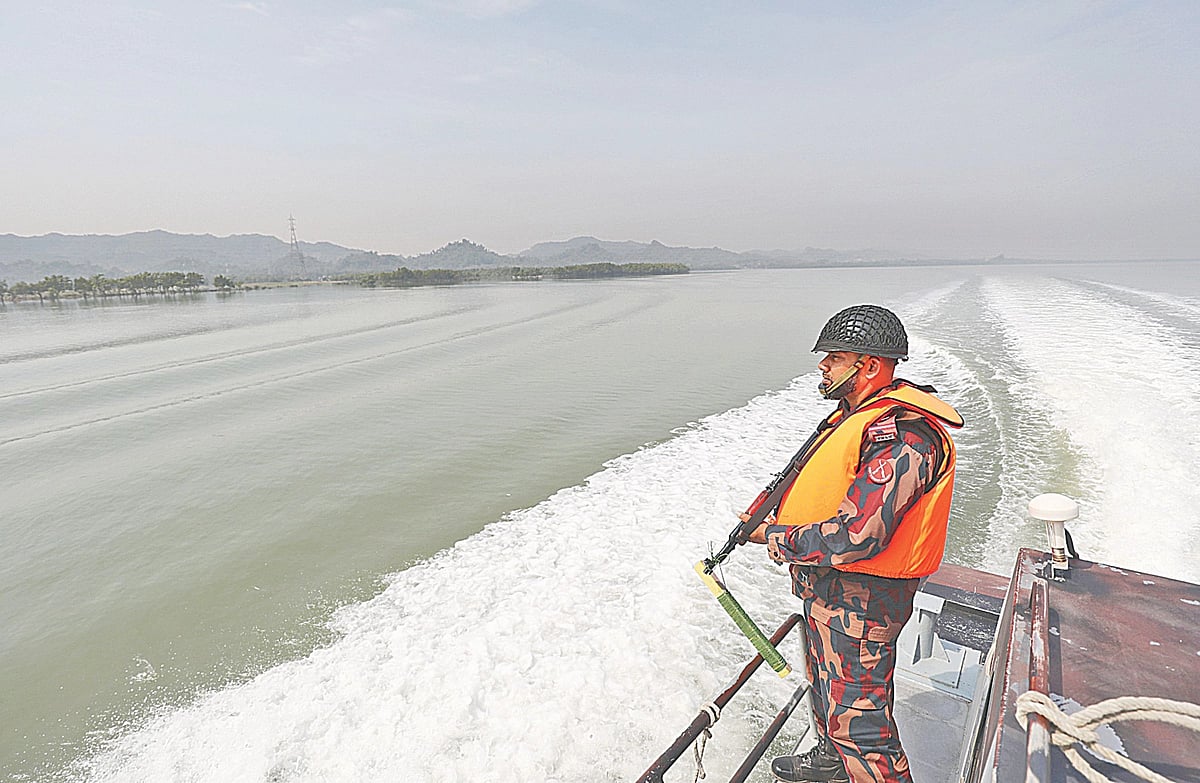
Eight years have passed since more than 700,000 Rohingya fled across the Naf River into Bangladesh, what the UN officials called “a textbook example of ethnic cleansing” has hardened into a protracted geopolitical trap. A credible horizon of repatriation is not in sight.
Two fundamental policy errors condemned over a million people to suffering and are quietly planting seeds of insecurity—seeds that external forces may be watering quietly to spread wings only.
Reality of a policy choice
In August–September 2017, as Myanmar’s Tatmadaw executed genocidal “clearance operations,” Bangladesh kept its border open. The decision was apparently driven by humanitarian instinct. The government made a fatal assumption that the Rohingya exodus would also be an isolated incident like before. It failed to see Myanmar’s persecution as a deliberate, generational project of ethnic cleansing.
The Tatmadaw’s objective was to empty Rakhine permanently. To succeed, it needed a neighbour willing to absorb the fleeing masses. Bangladesh handed the junta exactly what it wanted. Naypyitaw had pre-analysed Dhaka’s politico-military psychology over the past Rohingya crises: lack of political will and military resolve to resist future adventures. Before and during the crisis in 2017, Myanmar’s air force violated Bangladesh’s airspace nineteen times. Each time, the political direction was not to react.
That persistent politico-military insouciance was perhaps read in Naypyitaw as: Bangladesh will neither act nor react and will absorb anything “we” push across the border. Opening the door was a political disaster, not an act of helping Rohingya stay home.
What if Bangladesh had resisted?
Imagine a different response. Bangladesh had closed its border—or, more provocatively, acted to restrain the Tatmadaw from escalating its genocidal act. Suppose, Dhaka had declared that it would not accept any refugees without an immediate binding international guarantee of citizenship and safety. What could have happened?
The Tatmadaw could have faced a dilemma as its objective was to push Rohingya out. If Bangladesh refused to take them, the refugees would have piled up inside Rakhine—starving, dying, and pulling in the focus of the world’s cameras. The Tatmadaw would have been forced to either stop its operations or become even more brutal.
Consider the example of Egypt and Gaza. In 2023–2024, Israel was desperate to push Palestinians through Rafah crossing into Egypt’s Sinai desert. Egypt resisted, fortified its border, threatened to void the peace treaty, and refused to accept mass displacement. That resistance did not lessen Israel’s genocidal crimes, but it shifted global attention. The world saw Palestinians became victims of Israel’s genocide. International outrage intensified. Lawsuits at the ICJ gained urgency. The very impossibility of expulsion became a spotlight on the aggressor.
But what if the Tatmadaw had chosen to escalate to more monstrous crime? In a hypothetical worst case, with refugees unable to flee and the junta determined to “finish the job,” the Tatmadaw could have rounded up Rohingya in a confined area and carried out a Srebrenica-style massacre—systematic, industrial-scale killing of thousands in plain sight. Such concentrated atrocity would have backfired dramatically. The world, already watching trapped civilians, could not have looked away. The UN Security Council would have faced unbearable pressure to act. The very scale of the horror would have isolated the junta putting China and Russia in an awkward position.
Had Bangladesh resisted in 2017, two paths were possible: the junta halts its operations under global pressure, or it escalates to a Srebrenica-like atrocity that ensures its own downfall. Either way, the plan to clear Rakhine would have been exposed and obstructed. Instead, Bangladesh’s open door made the Tatmadaw’s job easy—and the world looked away.
The Second Policy Choice: Relocation to Bhasan Char
To decongest Cox’s Bazar, the government planned to move around 100,000 Rohingya to Bhasan Char—a low-lying, flood-prone island hours from the mainland. It was, apparently a humanitarian measure. In geopolitical calculus, it was a grave miscalculation.
Naypyitaw most likely interpreted the move: Bangladesh was preparing for permanent absorption, not repatriation. The junta could site Bhasan Char as reference that Rohingya belongs in Bangladesh, stalling any meaningful return. Moving refugees away from the border removed physical urgency from Myanmar’s doorstep.
The junta no longer sees a desperate crowd on the border moving far away. Isolation also thins monitoring and increases radicalization risk—the island could become a recruitment hub for non-state armed groups. Moreover, Bhasan Char feeds Myanmar’s lie that Rohingya are Bengali migrants, eroding Bangladesh’s legal standing. Far from accelerating repatriation, Bhasan Char could give Myanmar an excuse to do nothing. China’s “pilot repatriation project” was a theatrical exercise with no result. The vast majority of refugees remain in Bangladesh with no silver lining on the horizon.
Great power rivalry across the Bangladesh-Myanmar border could intensify—China backing the junta, the United States backing the NUG and the People’s Defence Force, and India hedging opportunity
The resulting insecurity
In the ninth year of the crisis, repatriation, or even discussions about it, is missing. China withdrew its mediation. The Arakan Army (AA) controls 90% of Rakhine territory. The junta refuses Rohingya citizenship. In this vacuum, Cox’s Bazar district is becoming a tinderbox—a potential battleground waiting for a spark.
Radicalisation in a vacuum
1.2 million refugees live with “no hope” for the future. ARSA—a creation of the Tatmadaw—has been active in the camps since triggering the “clearance operation” on the night of 25 August 2017. Myanmar’s military nurtures criminal gangs under the ARSA banner to terrorize refugees. ARSA-aligned groups may grow stronger.
External powers gathering proxies
China, India, Russia, and the US compete in Myanmar. They engage all parties. Bangladesh’s hesitation to engage the AA or the National Unity Government (NUG) has left a vacuum. Rival powers may arm disaffected Rohingya youth as low-cost proxies on Bangladeshi soil.
Geopolitical spillover
The AA opposes Rohingya return. Fighting has already spilled into the Naf River, killing and kidnapping Bangladeshi fishermen. Bullets from Myanmar territory kill Bangladeshi citizens. Intensified conflict could lead to persistent border violations, while Bangladesh, trapped in politico-military insouciance, risks remaining an onlooker to its own security erosion.
The chancy road ahead
Armed Rohingya factions are likely to emerge, funded by external actors. Cross-border attacks will provoke retaliation, endangering Bangladeshi territory. Internal security crises will erupt as radicalised refugees clash with local communities. Great power rivalry across the Bangladesh-Myanmar border could intensify—China backing the junta, the United States backing the NUG and the People’s Defence Force, and India hedging opportunity.
All parties may use Rohingya as cheap proxies, while the junta itself weaponises ARSA to divide the refugees. All of this will create an armed cacophony in the region—a wider chaos of competing violence. The land could become a ground for a multi-party conflict. Having taken two missteps, can Bangladesh now afford a third—the blunder of continued inaction? Faced with this gathering storm, what credible option remains other than turning to calculated action?
Breaking the cycle of inaction
To avert this storm, Bangladesh must move from reaction to calculated action. Several urgent shifts are needed: engage all stakeholders—the Arakan Army, the NUG, and the Rohingya diaspora—not just the junta; launch a global conscience campaign to keep Rakhine in the spotlight; leverage China’s BRI investments to pressure the junta; and prepare for the long haul with skill development and host-community mitigation.
But above all, the most decisive lever lies in empowering the Rohingya from within. A unified, credible political leadership—articulating clear demands for citizenship, property restitution, and safe return—would transform the crisis from a bilateral burden into an internationally recognized struggle for rights. Yet political voice alone, without the means to deter predation, remains vulnerable.
Diplomatically, Bangladesh must recognise that a degree of organised self-reliance among the Rohingya—including the capacity to secure their own communities and negotiate from a position of resilience—would compel both the Tatmadaw and the Arakan Army to treat Rohingya interests as a force to be reckoned with, not simply as a population to be displaced, divided, killed or ignored. Such carefully framed empowerment would shift the strategic calculus in Rakhine and give Bangladesh genuine leverage it currently lacks.
Above all, Bangladesh’s political and military leadership must turn from a reactive to a preventive posture: anticipate threats, build credible deterrence by delivery, and command the environment in southeast Bangladesh before new crisis erupts. No more nineteen airspace violations, no more land border violations, no more border outposts overrun, nor more killing members of foot patrol without reciprocal response. No more border openings to refugees.
Without these steps, a grim third blunder could deepen insecurity on Bangladesh’s southeastern frontier. It will become a battleground for regional proxies and a lasting wound on Bangladesh’s security. A point to ponder: a reactive posture invites exploitation; a preventive posture, backed by credible deterrence by delivery, commands respect.
* Mohammad Abdur Razzak (safera690@gmail.com) is a retired Commodore of Bangladesh Navy and a geopolitical analyst.
* The views expressed here are the writer's own.