The morning in Bangladesh is very beautiful. The sun rises slowly, as if the golden colour mixes with the river water. Birds call, and the scent of fresh leaves floats in the air. But amidst this beautiful morning, an invisible darkness hides somewhere—like the dust accumulated inside an old building on the busy streets of the city. That darkness is named corruption.
Corruption doesn't originate in a single day. It is born from human greed, fear, the allure of power, and the long-standing habits of society. The government offices and courts of Bangladesh seem like the old stage of that darkness, where new dramas are performed daily, but the ending of the story never changes.
As soon as the office opens in the morning, a line forms at the door. Someone has come to register a birth certificate, someone else to correct a land document, and another to submit case files. Their eyes hold hope, thinking maybe their work will get done today. However, as soon as they enter the office, they realise that the pace of work is not like the rising sun—rather, it is slow, obscure, and uncertain like fog.
When a person in the second highest constitutional position of the state says something like this, it's not just an allegation—it’s an acknowledgment. It signifies that the moral decay within the administration that people had been feeling for a long time is now being recognised even from the centre of power.
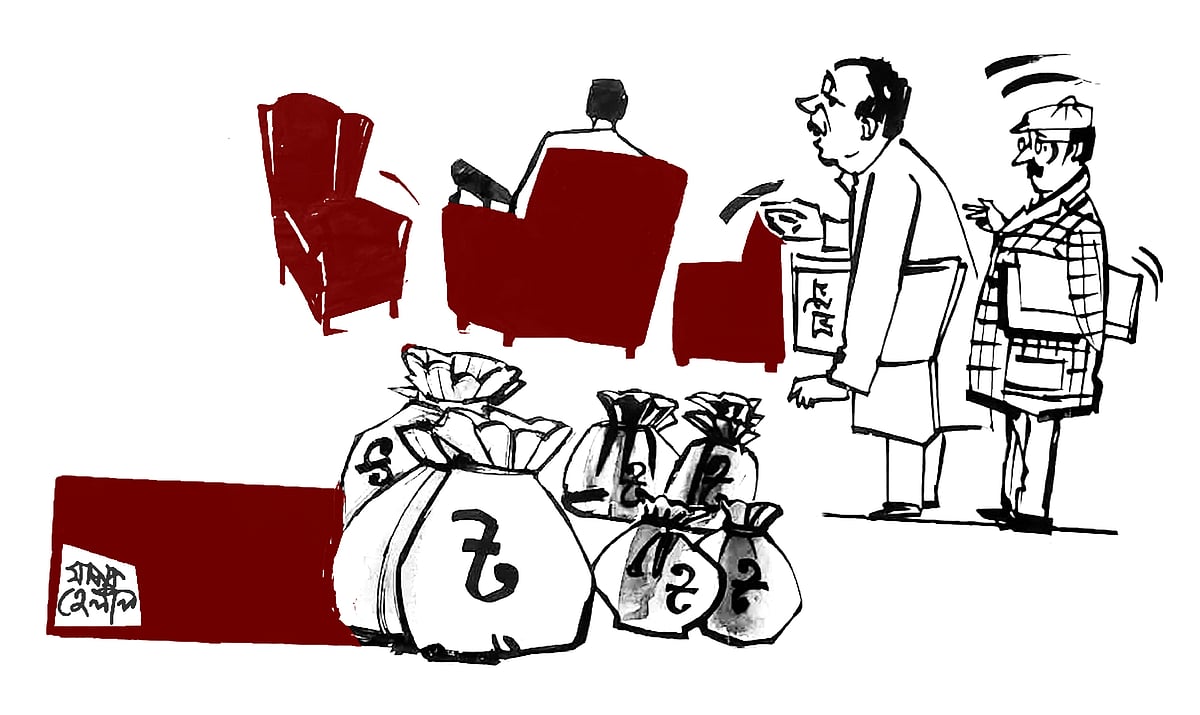
An officer turns over files and then says, 'come back later'. This word ‘later’ seems like an invisible wall, beyond which the speed of work halts. Beside that wall stands another person, known to everyone as a ‘broker. ’ With a smiling face, he says, 'Brother, if you go through me, the work will be done today'. This smile is like the scent of a poisonous flower, seemingly beautiful but hiding darkness within.
In the corridors of the court building, time stands still. People walk slowly, like a sigh. A case file seems older than a person’s life. The judge arrives, the court convenes, the lawyers present arguments—but the pace of the case is like a dry canal rather than a river’s current. Sometimes a date comes, and then another date passes. This long series of dates builds a wall of uncertainty in people’s lives. And in the gaps of that wall lurks the shadow of corruption, which sometimes demands money to move files, sometimes changes a witness, or sometimes mysteriously loses documents. The scales of justice sometimes tilt towards the powerful, leaving only waiting for common people.
Corruption is not an individual, a party, or a building. It is a habit that has become ingrained in society’s blood. The pace of a file depends on how much money was given, the quality of service depends on how much influence was shown, and the speed of a case depends on how influential someone is. Corruption is like an invisible web, spreading over office tables, court benches, pages of files, people’s words, and even in silence.
Not every office is corrupt. Not every officer is bad. Not every judge is unjust. There are people in Bangladesh who love their responsibilities, who can empathise with people’s suffering, and who know how to protect their integrity. When an honest officer moves a file without a bribe, when a judge delivers justice fearlessly, when an employee listens to people attentively, it feels like there is light amidst darkness. This light is the future of Bangladesh.
Why corruption persists is an important question. It stems from long-standing administrative complexities, inefficient management, the shadow of political influence, social inequality, weak enforcement of law, and human helplessness. When people have to go through ten steps to get something done, when a verdict takes years to reach, when people have to go to the office repeatedly for a service—corruption gets an opportunity. Corruption is like a weed that grows where the soil is barren, where rules are weak, where people are weary.
Change doesn’t come in a day. But change comes when the administration is transparent, technology is used, service delivery is simplified, law enforcement is strict, people are aware, and ethics are valued. When digital services increase in offices, when case information is available online in courts, when opportunities for bribes diminish, the darkness of corruption fades bit by bit.
Change also comes from within people—when a person refuses to give a bribe, when an officer refuses to take a bribe, when society does not tolerate injustice. There is corruption in Bangladesh’s offices and courts, that is true. But amidst this truth, there is another truth—Bangladeshi people have not yet lost hope.
In Bangladesh’s politics, sometimes sentences are uttered that are not just words—they become an echo of an era's fatigue, anger, despair, and restlessness. Recently, the Speaker of the National Parliament, Hafiz Uddin Ahmad, has thrown such a sentence into the public, 'Most government officials are thieves'. This sentence is not an ordinary allegation; rather, it reveals the deep-rooted wounds of the state at once. It is a sentence that makes one feel—as if the walls of the administrative buildings of a country have suddenly shaken. The significance of this statement is not one-dimensional. It is like an onion; peeling off one layer reveals another.
When a person in the second highest constitutional position of the state says something like this, it's not just an allegation—it’s an acknowledgment. It signifies that the moral decay within the administration that people had been feeling for a long time is now being recognised even from the centre of power.
Corruption is like the darkness of the night, which, no matter how deep, cannot stop the dawn’s light. Bangladesh is waiting for that dawn, where work in offices will be easy, justice in the courts will be swift, people’s dignity will remain intact, and corruption will be a chapter in history that we will remember, but never wish to return to. How far is that day?
For many years, ordinary people in Bangladesh have been experiencing the same thing when they go to an office—files remain stuck, work doesn't progress, brokers roam around, and getting service without a bribe is difficult. The Speaker’s statement seems to have given a voice to that public sigh. Such a statement can sometimes be a show of courage, and sometimes a political strategy. Which one is true, only time will tell.
Such an allegation from a Speaker hints at deep distrust towards the administration. It’s like an announcement of the failure of the internal machinery of the state. The reaction to this statement can spread in various directions, like waves when a stone is thrown into a pond.
A significant number of government officials may feel hurt by this statement. Because 'most are thieves' is a blanket accusation, which puts honest officials under the same shadow. There may be whispers in the corridors of offices, 'We are being blamed for everything!'
The opposition might use this statement as a weapon. They may claim, "They were champions in corruption before, and now they have become champions again." The government might be forced to explain, "This is not a generalisation, but rather a strong stance against corruption". The public might think, finally, someone has spoken the truth. And some may think—if the Speaker says something like this, how dire must the situation be!
Corruption is like the darkness of the night, which, no matter how deep, cannot stop the dawn’s light. Bangladesh is waiting for that dawn, where work in offices will be easy, justice in the courts will be swift, people’s dignity will remain intact, and corruption will be a chapter in history that we will remember, but never wish to return to. How far is that day?
#Mohiuddin Ahmad is a writer, researcher, and political analyst.
*The opinions expressed here are the writer's own
#This article, originally published in Prothom Alo print and online editions, has been rewritten in English by Rabiul Islam