Analysis
Measles outbreak in Bangladesh: Panic, politics of blame, and reality
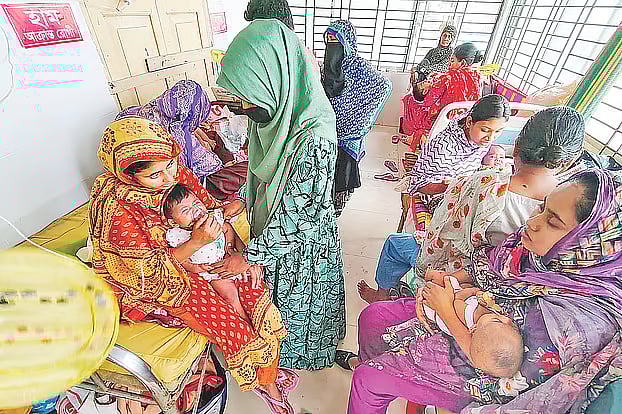
After the COVID-19 pandemic, a sense of fear centering public health has once again emerged. Although this is nothing like a pandemic or epidemic on that scale, we are concerned about the measles outbreak because our children are dying.
So far, more than fifty children have died. Although the outbreak has been more severe in Dhaka and northern regions, this contagious disease has now spread to other districts of the country as well.
The blame game
During the COVID-19 pandemic, we saw how fragile and mismanaged our healthcare system was, along with irregularities and corruption within the state machinery and the Awami League government in the health sector.
In a corruption-prone developing country like ours, the blame naturally falls first and foremost on the government. The current BNP government has not even been in power for two months after coming to office through a democratic election.
At the very beginning of its tenure, this measles outbreak has come as a major test for them. But in facing that test, they seem to have chosen the familiar safe position of avoiding responsibility and continuing the long-standing blame game.
At an event in the capital, in response to journalists’ questions, Health Minister Sardar Sakhawat Hossain said, “The number of measles patients has increased significantly. The measles vaccine was administered eight years ago. No government has provided the vaccine since then.”
This statement by the health minister has sparked strong criticism in civil society. Many parents have shared photos of their children’s vaccination cards to show that the minister’s claim is not accurate. In any outbreak of an infectious disease, ensuring accurate information is extremely important, yet the first obstacle seems to come from the health minister himself. Even now, the exact number of hospital-based deaths and the ages of the children who have died are not fully known.
Major mismanagement, negligence, irregularities, and staff shortages in the health sector have been evident not only during the tenure of the ousted Awami League government but also during the subsequent interim government. In particular, strong allegations have emerged against the interim government regarding vaccinations. Civil society has expressed anger toward the interim government, and leaders aligned with the ousted Awami League have also harshly criticised it.
Statements from health experts have also highlighted the interim government’s failures in the health sector and in vaccine-related management. At the same time, some argue that attempts to reform the corruption and irregularities that existed in the health sector during the ousted Awami League government have instead contributed to this crisis. Individuals who were associated with the interim government have also presented various arguments to shirk their responsibility.
It is becoming clear that a serious public health crisis has now turned into political mud-slinging. This is creating confusion among parents and the general public.
Past measles outbreaks in the country
Since independence, through the dedicated and consistent efforts of various governments as well as non-governmental organisations (NGOs), Bangladesh has earned global recognition for its immunisation programs. Fear-invoking slogans like “there is no escape if you get tuberculosis” are now a thing of the past. The World Health Organization (WHO), UNICEF, and many foreign donors and strategic partners have played a major role in this success.
Despite the success of immunisation programs, measles outbreaks have occurred at different times. In July 2017, an outbreak spread among an ethnic community in the hilly areas of Sitakunda in Chattogram, where nine children died. At that time, questions were raised about gaps in immunisation programs in remote areas. Lessons were not learned from that incident, which led to another outbreak in March 2020 in the Chittagong Hill Tracts. During that time as well, nine children from two ethnic communities died (The Daily Star Bangla, 31 March 2020).
According to the WHO database, from 2017 to 2020, the coverage rate for the first dose of the measles vaccine in the country was 97 percent each year. Despite this, the highest number of infections in the past decade occurred during these years: about 4,000 cases in 2017, nearly 6,000 in 2019, and over 2,000 in each of the other two years.
The full picture of this year’s outbreak is still not available. There is also a significant lack of accurate data. Although reports suggest that last year’s vaccination rate dropped by more than 20 percent compared to previous years, authorities of the Expanded Programme on Immunisation (EPI) under the Directorate General of Health Services claim that this information is not accurate and has not yet been fully updated.
Global measles outbreaks
According to experts, measles outbreaks used to reappear every two to three years in different regions of the world. However, due to improvements in immunisation, that interval has now increased to 5–10 years depending on the region, and the scale of outbreaks has also become smaller. But this time, outbreaks of varying sizes are being seen in different countries around the world.
At present, India is experiencing a major measles outbreak, with more than 12,000 cases reported in recent months. Pakistan has also seen a spread of measles (around 7,500 cases). In Indonesia, the prevalence among children has increased (approximately 8,900 cases). In Africa, large outbreaks have been reported in countries such as Angola, Yemen, Cameroon, and Sudan.
In Africa, between 3 to 6 per cent of infected children are dying. In Yemen and Afghanistan, the death rate among infected children exceeds 5 per cent. Smaller clusters of measles outbreaks have also been reported in Mexico, the United States and Canada, as well as in Romania, the United Kingdom, and Austria.
On March 9, 2026, Harvard Medical School’s publication Harvard Health Publishing released a report titled: “Measles is making a comeback: Can we stop it?”
According to health experts, this current global measles outbreak is largely a result of the impact of the recent COVID-19 pandemic. In a joint reportreleased toward the end of 2024 and early 2025, WHO and UNICEF stated that COVID caused the biggest disruption in the history of immunisation programs.
There is a lack of adequate ICU facilities, delays in emergency treatment, limited capacity and workforce shortages to treat many critically ill patients at once, and insufficient arrangements for rapid transfers even when space is unavailable.
At a press conference in Geneva in early 2024, Dr. Katherine O’Brien, head of immunisation at WHO, said that around 60 million children missed their routine measles vaccinations during the pandemic. This “immunity gap” is now turning into a global epidemic.
There is also growing concern about children contracting measles before reaching the eligible age for vaccination. When speaking with Dr. Mohammad Shahriar Sazzad, Deputy Director of EPI, he stated that infections are now being seen among children under 9 months of age in the country. However, they are not supposed to receive the vaccine at this age, meaning they are becoming infected before they even have the chance to be vaccinated.
According to him, similar situations are being observed in neighboring countries as well as in other parts of the world. Research is ongoing on this issue. Experts are also discussing whether the scheduled timing for measles vaccination can be brought forward.
Although measles is spreading in other countries as well, health experts say that the death rate in Bangladesh is much higher. Alongside gaps and failures in immunisation, this high mortality rate is also linked to the country’s fragile healthcare system. There is a lack of adequate ICU facilities, delays in emergency treatment, limited capacity and workforce shortages to treat many critically ill patients at once, and insufficient arrangements for rapid transfers even when space is unavailable. Even in cases of infectious diseases, patients often have to be kept in overcrowded hospital conditions.
Flaws and failures in the immunisation program
Since 1998, with support from international donor agencies, the country introduced the five-year Health, Population, and Nutrition Sector Program (HNPSP). Before that, immunisation and other public health activities were carried out through more than a hundred separate projects, which were later brought under HNPSP. The fourth phase of HNPSP ended in June 2024.
According to a report published on 20 February 2025, by the daily Ajker Patrika, the fifth phase of HNPSP, worth 1,06,100 crore taka, was supposed to begin in July of that year. However, it was not approved at the time by the then Awami League government, although preparations for documentation had reportedly begun.
In this regard, public health expert and former EPI program manager Dr. Tajul Islam, in a conversation with The Daily Star, stated that although preparations for the fifth phase of HNPSP had started, the interim government canceled it and instead adopted a two-year DPP (Development Project Proposal) program. Under this, 1,451 crore taka was allocated for the first year. However, the funds were not released on time, creating a crisis in vaccine procurement. The last allocation for vaccines was released on December 28, 2024, and none has been released since then.
In such a situation, since June 2024, the salaries of thousands of workers under this program have been suspended. Even the workers who transport vaccines from upazilas to vaccination centers have not been paid for the past nine months.
Discussions with experts reveal that during the tenure of the Sheikh Hasina government, various objections were raised by the Health Sector Reform Commission regarding the HNPSP program. Allegations included widespread corruption, lack of coordination, and waste of resources in the implementation of previous programs. It was also alleged that under the cover of a large budget, certain political syndicates established monopolistic control over procurement and tender processes.
There was also a lack of coordination between the development and revenue budgets. To address these issues, the interim government attempted to move away from dependence on foreign aid and instead initiate the program with its own funding and management. However, due to shortcomings in planning and preparation, among other reasons, these reform efforts failed, leading to the current crisis.
Saeed Ahsan Khalid, Associate Professor of Law at the University of Chittagong and a PhD researcher in health law at the University of Sydney’s Health Law Centre, said: “Through HNPSP and EPI under it, Bangladesh achieved significant success in controlling infectious diseases and ensured the health rights of millions. However, although reforms were necessary in light of allegations of irregularities and corruption, the way and timing in which this structure was dismantled were unplanned and risky. As a result, a large ‘transitional gap’ has emerged, posing a serious threat to public health.”
He said, “In international human rights law, immunisation is recognised as a ‘core obligation’ of the state. Therefore, delays in vaccine supply directly impact the ‘right to life.’ Ensuring preventive healthcare is an international obligation of the state. As such, child deaths from preventable diseases indicate a failure of the state’s due diligence. The goal of reform should be to ensure uninterrupted healthcare services. A child missing a vaccine is not just a loss for a family; it is a symbol of the state’s failure in upholding human rights. What is needed now is to build an accountable and sustainable healthcare system through a combination of law, human rights, and effective implementation.”
Allegations have been raised against the health adviser of the former interim government for failing to reform the immunisation program and for creating the current crisis. In this regard, political analyst Asif Bin Ali said, “From the very beginning, there was widespread criticism surrounding the health adviser. Her absence, inefficiency, weak leadership, and inability to handle crises were repeatedly discussed in the public sphere. It has been alleged that despite the criticism, Professor Muhammad Yunus did not remove the health adviser due to personal closeness, nor did he appoint any qualified alternative.”
Disruptions in the immunisation program were further aggravated by protests from health workers. In 2025 alone, health assistants across the country went on strike in three phases. During these periods, vaccination activities were halted nationwide.
According to statements from participants in a nearly two-week-long protest by health assistants in December of that year, around 120,000 temporary vaccination centers across the country remained closed for several days due to the strike. As a result, with about 15,000 daily immunisation sessions suspended, nearly 150,000 mothers and children were deprived of routine immunisation (BanglaNews24, December 10, 2025). Since the fall of the Awami government, there have been multiple changes in the Director General (DG) of the Directorate General of Health Services, which also had an impact. Additionally, there has been a persistent and severe shortage of personnel carried over from previous administrations.
Overall, it appears that due to the lack of funding arrangements for vaccine procurement, the central warehouse has run out of vaccines for ten diseases, including measles. At the same time, shortages at the field level, lack of manpower, and workers’ protests have deprived children and mothers of timely vaccinations.
Other immunisation programs and Vitamin A capsule campaigns have also faced significant shortfalls, which could have serious negative impacts in the future. The new government now faces a major challenge of how to tackle this crisis.
However, questions have arisen as to why there has been no investigation or legal action against those responsible for the failure of the immunisation program and the large number of child deaths. Why are reforms and discipline not being introduced in the health system? We do not want our children’s lives to be repeatedly put at risk due to negligence and irresponsibility.
* Rafsan Galib is an editorial assistant at Prothom Alo. Email: rafsangalib1990@gmail.com
* The views expressed here are those of the author.