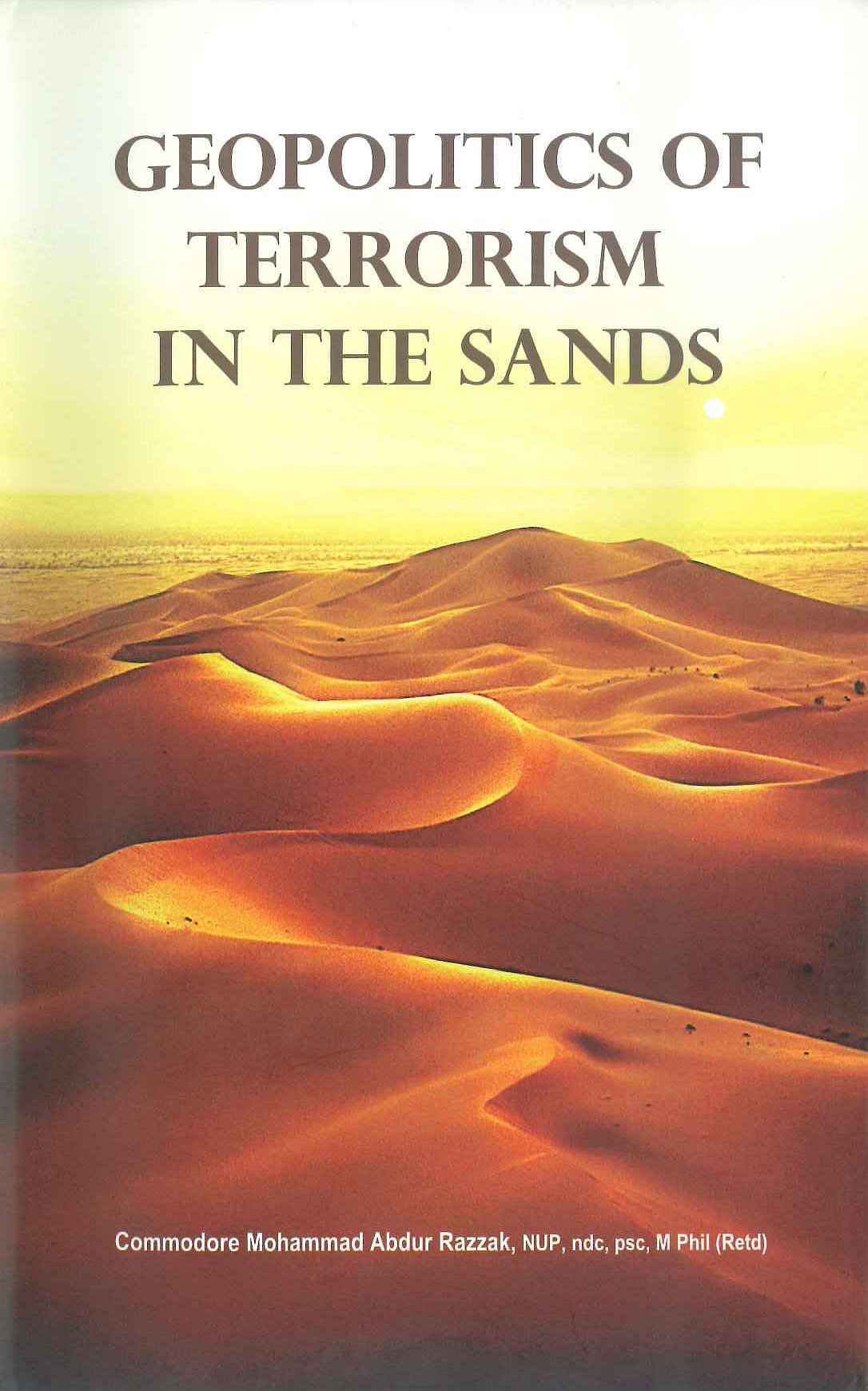
Like the hot sands of the Arabian peninsula, in recent history West Asia (more commonly referred to by the Eurocentric term "Middle East"), has been a heated terrain of war and various conflicts. While the US, Iran and Israel are engaged in a war that is reverberating across the globe, manifested in fuel shortage, economic crises and food insecurity, the unrest in the region is not new.
The Israel occupation of Palestine, the Gulf wars, the unrest in Syria and other conflicts have been more than just a thorn in the flesh for the people there. And it is exactly these predicaments that are the subject of the book ''Geopolitics of Terrorism in the Sands'' by Commodore Mohammad Abdur Razzak (retd).
A retired commodore of the Bangladesh Navy, Mohammad Abdur Razzak is now a regular geo-political commentator, his columns appearing in the leading dailies of the country. This book is of particular interest at a time when the Middle East is rocked with war and conflict, because it looks back into the various events, incidents, intrusions and incursions that have culminated in today's state of affairs.
The book shows how egregious instances of terrorism have instrumentalised the prevailing power struggle in the Middle East. There were the attacks of 9/11 (September 2001), the invasion of Iraq "justified" by the so-called weapons of mass destruction, the spectre of Al Qaeda, Arab Spring, unrest in Syria, the emergence of the "Islamic State" and so on. Though published this year, ''Geopolitics of Terrorism in the Sands'' was drafted in 2017 and the context remains relevant as the domino effect of events succinctly sums up this history of current affairs.
The author jogs our memory to the starting point in Tunisia when a 26-year-old street vendor Mohammed Bouazizi set himself on fire in frustration, a frustration that echoed the people's desperation over living standards, police violence, unemployment and human rights abuses.
The first chapter deals with Middle East before the Arab Spring. It begins with the Arab-Israel War of 1948, sparked by the proclamation of Israel's independence by David Ben Gurion, executive head of the World Zionist Organisation, on 14 May 1948. Since 1948 Arab countries and Israel have been in a state of intermittent war.
The chapter goes on to detail the Suez War of 1956, which concluded in an Egyptian political victory. It details the Six-Day War in 1967 between Israel and Egypt, Syria and Jordan, the Arab-Israel War of 1973, Arab Israel Peace agreements (though till date peace remains as elusive as ever), the Israel-Hezbollah War of 2006, the Israel-Gaza conflict of 2014, the breaking of Arab unity, the Iran-Iraq War, Iraq's invasion of Kuwait, the 2003 US invasion of Iraq and more.
The second chapter deals with the Arab Spring. The author jogs our memory to the starting point in Tunisia when a 26-year-old street vendor Mohammed Bouazizi set himself on fire in frustration, a frustration that echoed the people's desperation over living standards, police violence, unemployment and human rights abuses. The Arab Spring spread like wild fire to Egypt, Libya, Jordan, Algeria, Morocco, Saudi Arabia, Bahrain and beyond.
The narrative of how the Islamic State of Iraq and the Levant (ISIL) was created has been laid out in the third chapter. He writes, "In April 2013 the international media reported Islamic State of Iraq and the Levant''s (ISIL) violent arrival in the midst of the civil war in Syria." Soon after its emergence, ISIL occupied Ramadi in Iraq. Unlike Al Qaeda with its iconic leader Osama Bin Laden, IS' leadership was largely ambiguous and its threats waxed and waned.
The author goes on to narrate how there ISIS faced a decline in its resources and how an international military response to the Syria crisis emerged. There was a global divide here too and he delves adeptly into the nooks and crannies of the complicated geopolitical machinations involved.
It was, or course, not all war-mongering. International peace initiatives were undertaken to attenuate the volatile situation. Among other efforts, there was the UNSC peace plan, the Russian ceasefire plan, then again, the US-Russia ceasefire plan, Geneva peace talks and more. But the hopes for peace remained on a steady decline.
The author deserves kudos for his research and analysis on a subject matter that remains a moving puzzle, erupting and disrupting at regular intervals. Given his expertise and understanding, perhaps we can hope for another book in the offing, analysing the turbulent state of current affairs in West Asia.
''Geopolitics of Terrorism in the Sands'' by Commodore Mohammad Abdur Razzak (retd) has been published by RAOWA Publications and costs Taka 1000. A note to the publisher: A brief summary of the book could have been printed on the inner flap of the cover and a note about the author on the back inner flap. That's always a plus point for a browser in a bookshop!