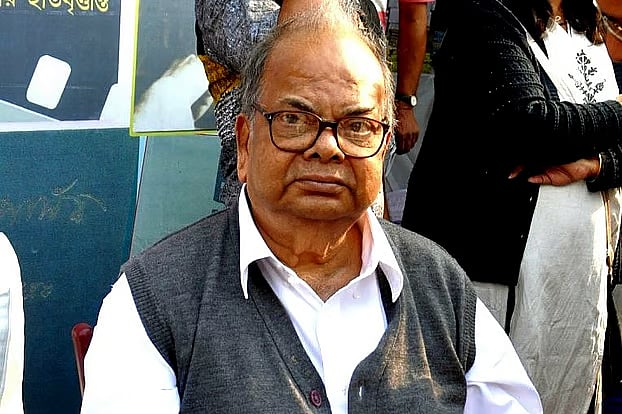
Sankar has passed away.
The beloved writer of Chowringhee fame, Mani Sankar Mukherjee, died yesterday, 20 February 2006, in Kolkata. His passing will be mourned by countless friends, admirers, and generations of devoted readers.
I remember, with particular clarity, his visit to Bangladesh in October 2010. He had come to Dhaka at the invitation of the Independent University, Bangladesh (IUB).
At the time, I was a member of The Reading Circle (TRC). At the initiative of Professor Niaz Zaman and the team, TRC hosted an event in his honour at the Indira Gandhi Cultural Centre in the capital. It was, in every sense, a special occasion.
This was Sankar’s first visit to Bangladesh, and for readers on this side of the border, it felt like the arrival of someone intimately known yet never before seen. As a writer, he commanded great affection in both Bengals. To see him, meet him, and listen to him speak, was certainly a privilege.
The late Professor Syed Manzoorul Islam observed that Sankar’s writing possessed a universal appeal. There was a vitality in his narratives, a sense of lived experience, that made them not only compelling to read but also vividly adaptable to cinema.
He spoke with disarming candour and humour about the beginnings of his literary journey. “I tried my hand at everything, from mathematics to guarding shoes, from painting to Pitman’s shorthand, but nothing quite seemed to be my calling,” he said.
There had been struggle and uncertainty. Yet even in those early years, it became evident that his destiny lay in the persistent magic of words. He began writing at the age of twenty-one, and thus emerged the Sankar we came to know and love.
Like many popular writers, he was at first dismissed by critics, brushed aside as a one-book wonder, a passing fancy. But Sankar paid little heed to such judgments. He wrote, and went on writing, steadily carving out his niche, until he achieved literary success.
His stories, rich with life and movement, found an equally powerful expression on screen. Chowringhee was adapted into a celebrated film starring Uttam Kumar and Supriya Devi. Other works, too, travelled from page to cinema, inspiring films such as Jana Aranya and Seemabaddha.
The late Professor Syed Manzoorul Islam observed that Sankar’s writing possessed a universal appeal. There was a vitality in his narratives, a sense of lived experience, that made them not only compelling to read but also vividly adaptable to cinema.
At the Dhaka event, Sankar spoke with quiet emotion about what sustained him through his journey. He said that one of the strongest sources of inspiration in his life had been his mother, whose unwavering faith in him endured through hardship and disappointment alike.
“Everyone has a lamp within their hearts,” he said. “A good writer lights that lamp.”
Sankar lit many such lamps.
His light travelled far, across generations, across borders, across the two Bengals and beyond. 'Chowringhee' was translated into English and French. 'Jana Aranya' reached English readers as 'The Middleman'. 'Koto Ajanare' became 'The Great Unknown', and 'Gharer Madhye Ghar' was known as 'Thackeray Mansion'.
The lamp that he ignited shines on, as we continue to turn the pages of his novels, watch those wonderful movies and remember the simple and smiling Sankar.