Opinion
Bangladesh’s midwifery needs stronger clinical mentorship
Globally, various social media platforms have quietly evolved into essential digital town halls where anyone can share thoughts and comments. These platforms are also helping healthcare professionals exchange evidence-based insights, celebrate milestones, and debate pressing frontline challenges.
In Bangladesh, dedicated Facebook groups for midwives offer a real-time window into the internal dynamics of midwifery services, bringing into sharp focus a critical duality in the quality of midwifery education.
This duality was captured vividly in a recent Facebook exchange that resonated deeply across the midwifery community. Initiating the dialogue in a Bangla post regarding ward governance, a midwife leader posted a direct question (translated here): "Why are there no clinical preceptors present during the clinical practice of nurse-midwives during their internship? Why is the entire responsibility handed over to an intern during the internship period? Is it a teacher shortage or a lack of planning? Quality matters!!"
A response from one of her colleagues caught widespread attention as it focused on systemic concerns, detailing the direct operational impact on the delivery room. Responding in Bangla to the post, a practicing clinical midwife provided a candid assessment from the delivery floor (translated here): "Nothing is left solely on the interns at my place! Their knowledge gap is so wide that it feels scary even to guide them through the work... Except for a very few, even in their 3rd year, they can't take patient histories or perform basic assessments... I can't match what I see here with the sheer amount of posts I see by interns on Facebook... Then again, I think perhaps because there is such a huge gap in their academic course, it feels like a burden when they go into their internship... There is a shortage of teachers as well as a lack of proper planning—both are missing... Quality matters in education and practice..."
This candid thread of discussion highlights an important opportunity to further align practical skill acquisition with academic instruction within the evolving training ecosystem. Supporting interns with enhanced mentorship and continuous clinical guidance during fast-paced ward rotations presents a vital pathway to strengthen patient safety and accelerate midwives’ confidence.
With structured supervisory support during critical clinical encounters, midwives can play a vital role on healthcare teams to prevent complications—such as postpartum hemorrhage, pre-eclampsia, or fetal distress—while reinforcing the resilience of newly graduated midwives. Providing comprehensive bedside mentoring further empowers midwives to manage normal physiological labor confidently, reinforcing evidence-based practice and optimizing referral pathways across the health system.
From an educational and workforce planning perspective, these Facebook exchanges underscore the immense value of continually pairing rapid workforce expansion with rigorous clinical mentorship. To build upon its remarkable public health momentum, Bangladesh can further synchronise its ambitious recruitment targets with standardised, quality-driven midwifery educational enhancements.
The Government of Bangladesh has shown visionary leadership in addressing maternal and neonatal mortality, evidenced by a recent workshop planned by the Ministry of Health and Family Welfare to coordinate an inter-departmental roadmap aimed at recruiting and deploying 25,000 midwives by the year 2030.
This historic policy ambition builds on remarkable national achievements over the past two decades. Since formalising the professional midwifery cadre in 2010, Bangladesh has achieved an extraordinary drop in its maternal mortality ratio. According to the Bangladesh Maternal Mortality and Health Care Survey (BMMS) and joint reports by WHO, UNICEF, UNFPA, World Bank, and UN-DESA, Bangladesh reduced its Maternal Mortality Ratio (MMR) significantly—from approximately 437 deaths per 100,000 live births in 1990/2000 to 123 per 100,000 in recent survey estimates, representing a drop of around 70–80%. This milestone earned international recognition and established the nation as a global champion in the UN-led Midwifery Accelerator initiative.
To build upon these gains, the government has instituted major structural and legislative reforms. By updating national legislation through the Bangladesh Nursing and Midwifery Council (BNMC) Act and upgrading the administrative authority of the Directorate General of Nursing and Midwifery (DGNM), the state has established robust regulatory mechanisms for quality assurance and professional licensing. Furthermore, the government has introduced standardized national curricula, institutionalised quality assurance frameworks across public and private institutes, and established a nationwide network of over 170 midwifery colleges.
First announced at the International Confederation of Midwives Congress in Lisbon in June 2026, the plan to scale the workforce to 25,000 represents a major shift toward midwife-led care across public health infrastructure, particularly in Upazila Health Complexes and union Health and Family Welfare Centres. Executive bodies like DGNM and BNMC have approached this strategy with commendable speed, backed by international partners including UNFPA Bangladesh.
This broad multi-donor effort is fortified by key development partners, including Swedish SIDA, the UK Government (UK Aid), and Global Affairs Canada, alongside specialized global organisations like the Royal College of Midwives UK and the International Confederation of Midwives (ICM). Ongoing inter-agency coordination will continue to streamline administrative processes, accelerate civil service deployments, and secure long-term budgetary support to ensure seamless implementation in rural communities.
To continually strengthen the bridge between national recruitment targets and clinical preparation, educational leaders and health administrators can implement a synchronised, multi-pronged strategy across all levels of academic and clinical governance.
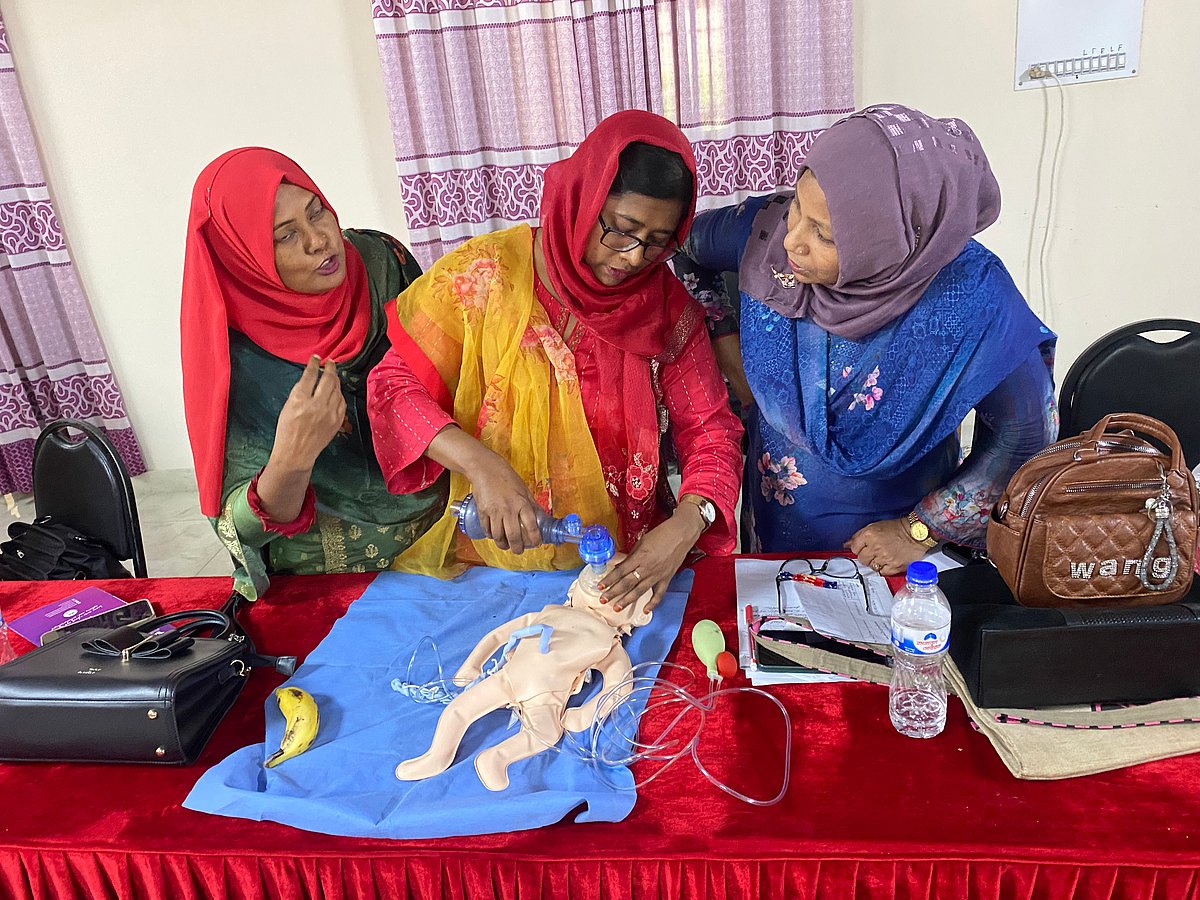
First, academic institutions can expand competency-based learning approaches alongside foundational theoretical instruction. Before students begin clinical rotations, training programs can mandate advanced simulation lab practice to master core emergency obstetric skills on high-fidelity manikins. Utilizing standardized Objective Structured Clinical Examinations serves as an effective benchmark to verify baseline readiness before ward entry.
Second, health system administrators can further elevate clinical governance by formalising and expanding dedicated roles for Clinical Preceptors. Structuring dedicated preceptor positions enables clinical educators to focus specifically on one-on-one supervision, bedside teaching, and formal evaluations during internship rotations.
To optimise clinical volume exposure, public maternity facilities can continue expanding strategic placement partnerships with accredited healthcare institutions, ensuring every midwife trainee completes the recommended number of supervised normal deliveries and obstetric complication cases. Additionally, expanding clear, structured career pathways—spanning clinical specialist roles, preceptorships, academic faculties, and health leadership positions—presents a compelling approach to attract and retain top-tier professional talent.
The constructive insights shared by practicing midwives on social media offer valuable, real-time feedback that can inform continuous quality enhancements.
Midwives should be well-positioned to drive continuous progress by embedding Quality Improvement frameworks, such as the Plan-Do-Study-Act (PDSA) cycle, directly into internal quality assurance and facility management. By institutionalizing these continuous improvement cycles, local leadership can systematically support intern preparation through structured shift handovers, daily case reviews, and collaborative chart audits. Applying continuous quality improvement methods fosters a highly supportive learning environment where new midwives feel encouraged to seek guidance, share insights, and engage proactively with senior colleagues.
International academic and bilateral partnerships continue to provide powerful support to Bangladesh's national educational vision. Since 2016, strategic collaboration with Swedish partner universities, specifically Dalarna University and Gothenburg University, has successfully built institutional capacity by training over 150 midwifery faculty members at the Master's level.
These educators now serve as academic leaders directing institutes across the country, while Gothenburg University continues to work with the Directorate General of Nursing and Midwifery (DGNM) to implement internal quality assurance processes, standardize accreditation, strengthen national quality protocols, and align teaching frameworks and practices with global standards set by the International Confederation of Midwives (ICM).
The expansion of Bangladesh’s midwifery profession represents one of the most promising public health initiatives in modern South Asia. By maintaining strong alignment between policy ambition and frontline clinical practice, Bangladesh is positioned to set a benchmark for the midwifery profession and the maternal healthcare sector as a whole.
The constructive insights shared by practicing midwives on social media offer valuable, real-time feedback that can inform continuous quality enhancements. By continuing to invest in dedicated clinical preceptors, simulation-based evaluations, modernised curricula, and facility-level quality improvements, Bangladesh will ensure every midwife possesses the expertise, confidence, and institutional backing needed to safeguard mothers and newborns for generations to come.
* Noor Islam Pappu works as a lecturer at Dalarna University and serves as the national coordinator for Gothenburg University, Sweden.
* The views expressed here are the author's own.