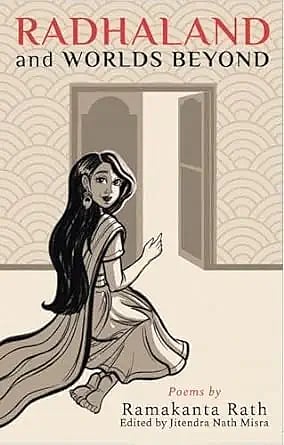
The celebration of Indian heritage, ''Radhaland and Worlds Beyond'' is a bold and eminent collection of Ramakanta Rath’s Odia poems in English, not only as a volume of selected poems, but also as a meditation on the nature of translation. The book is not simply an introduction of Ramakanta Rath to English readers; it is a recreation of the internal space and world of his poetry of metaphysical angst and turmoil, tenderness, sorrow, and unease - the ambiguity of all translation.
Ramakanta Rath (1934-2025) was one of the most celebrated modern voices in Odia literature, famous for merging the lyrical intensity of poetry with philosophical depth and political turmoil. A renowned poet and former Indian Administrative Service officer, Rath has won some of the highest literary and civilian awards in India, such as the Saraswati Samman for his work "Sri Radha" and the Padma Bhushan, in recognition of his immense contribution to Indian literature and his cultural stature that transcends geographical limitations. His poetry, with its Odia sensibility and universal existential appeal, has long been considered the bedrock of Indian modernism after independence.
What makes “Radhaland and Worlds Beyond” especially significant is not only the selection of poems but also the editorial approach that encompasses this selection. Edited by Jitendra Nath Misra, this volume brings together translations carried out by 13 different translators, thereby creating a complex and significantly intense English Rath, while also ensuring a unity of themes through the editorial approach of Misra. The translation process is also shown to be rigorous and thoughtful: the editor is conscious of the need to strike a balance between fidelity and voice, thereby ensuring that the English translations are close to the Odia originals while still being living poems.
One of the book’s greatest strengths is its scope and structure. It draws poems from several of Rath’s landmark works, especially Sri Radha (1984) and Sri Palataka / Mr. Runaway (1997), along with poems from Saptama Rutu, Sachitra Andhara, Sandigdha Mrugaya, and other collections. The poems are arranged into four thematic sections: “Love and Longing,” “Sorrow,” “Consciousness,” and “War and Death.” This organisation is not accidental; it is explicitly an editorial intervention by Jitendra Nath Misra, who argues that Rath’s poems often resist conventional categorisation.
Many poems that at first glance appear to be love poems are placed under “Consciousness” instead because, as suggested by Misra, they are centrally concerned with the theme of personal growth and awareness rather than love.
Most significantly, the book highlights the importance of translation and how it is the conduit through which the greatest literary traditions of India can enter the world stage. With this volume, Rath’s Radha, sorrow, and metaphysical explorations are brought into the English language, ensuring that Odia literature is not limited to geography and language but is where it rightfully belongs - within world literature.
The volume's unique character, however, also comes from a collaborative nature. Numerous translators contribute to the venture: Jitendra Nath Misra and Ratnaprava Misra, Jatindra Kumar Nayak, Sindhubala Choudhury and Chandrahas Choudhury, Amalendu Misra, Bikram Das, Jagannath Dash, Lagna Panda, Lipipuspa Nayak, Sambit Dash, Sangram Jena and others, along with translations attributed to Rath himself.
Such a wide range of translators introduces diversity in interpretation and shows the ways in which a single poetic voice can produce multiple English "echoes." Yet the book is not a mess: the editorial presence strives towards thematic cohesion and stylistic uniformity. Misra’s introduction candidly narrates the difficulties of translation, including Rath’s blunt rejection of early drafts -“this is not my poem!”-which forced the translators to recalibrate their approach toward a more literal fidelity. At the same time, Misra points to the paradox: even a literal translation becomes “an original work.”
The first section, “Love and Longing,” introduces Rath’s most iconic poetic figure: Radha. However, Rath’s Radha is emphatically not the Radha of devotional legend. She is “every woman there is,” testing the boundaries of existence, and at times she even becomes, as Misra suggests, “a male’s experience of love.” Desire in these poems is not romantic idealism but vulnerability, defiance, and existential exposure. In “Sri Radha 5,” longing is addressed to a beloved who is almost formless, a void:
“You have neither a face nor form…
I know, as the night ends
I will return home
To another death.”
Here, love is inseparable from annihilation; intimacy becomes metaphysical dissolution. Similarly, “Sri Radha 15” captures belated love and exhaustion:
“But we met very late…
It is not only the tears which flow from my eyes
But pieces of my existence are bruised and battered, too.”
The language of “pieces” and “fragments” anticipates the collection’s recurring obsession with self-scattering. Rath also reveals the brutal underside of domestic life in “Sri Radha 25,” where conjugal violence is described without sentimentality -“my husband violently pulled at my hair” -yet the poem ends in bitter irony, as the narrator mocks his stupidity for seeking proof of infidelity “on my body, and in daylight.” Even in physical subjugation, her agency persists through contempt and disavowal.
Radhaland will essentially appeal to readers who value deep, reflective, and multilayered literature. It is a book that extends an invitation to think about our times through the mirror of myth and poetry
The second part, “Sorrow,” increases the emotional impact of the volume. The introduction links Rath’s melancholia to the traumatic death of his first child at age four, suggesting that poetry became a means of surviving profound loss. Whether or not every poem is biographical, the atmosphere is saturated with ruin, shattering, and delayed mourning. In “By That River,” lyrical tenderness is haunted by catastrophe:
“Somewhere along the river a song comes to life…
Helping the fragments of my life
Come together into one.”
The beloved’s voice briefly repairs the broken self, yet the river carries “a past smeared with many deaths,” pulling the poem back toward historical devastation. In “A Welcome to the Guest,” sorrow becomes communal and political: a solitary woman’s suffering is reduced into sameness after her death-“Maybe all days were really one day / And there was no weeping on the second day.” The bitter implication is that violence becomes routine, grief is bureaucratised into silence. Likewise, “That Song!” expands mourning into a transnational setting: the speaker hears an old song in youth, then again in “another land” during a memorial meeting for those “snatched away… under piles of rubble.” Memory here is not nostalgia; it is a force that refuses to let the past escape.
The third section, “Consciousness,” justifies the argument that Rath’s love poems are often philosophical meditations. “Sri Radha 1” begins with a landscape description - “The wind has become self-aware”-and quickly shifts to existential reflection on how new love destroys old relations even as the body grows “sick, old, and dying.” “Sri Radha 37” takes this further, presenting love as an experiment in perception:
“When the shape of an object
Ceases to hold meaning…
That fragrance slowly
Transforms into a colour
Merging into all other colours.”
This is not romance but phenomenology: a stripping away of categories until the world dissolves into unity. Rath’s own self-translated poem “Sri Radha 39” offers an anchor point, describing the self as “an intermittent glimmer” deluded into believing it contains the whole universe. His English is compressed, abstract, and philosophically sharp, and it reveals how other translators either echo or expand his tone.
The final section, “War and Death,” places the book’s recurring mortality into explicitly historical settings. “What Should I Wear on the Day of My Death?” is a brilliant satire in which death becomes performance, filtered through costumes and public stereotypes - shorts, dhoti, black-tie attire - until the poem collapses into genuine pathos, recognising that even the “boy chasing dragonflies” dies alongside the adult. The Mr. Runaway poems confront war directly. In “Mr. Runaway 36,” the speaker offers ritual water and rice to dead soldiers, but the offering collapses into guilt:
“All I have is what I never gave you.”
In “Mr. Runaway 37,” the arithmetic of death becomes its denial: “The human count remained exactly as before.” The poem exposes how societies normalise mass death through language, abstraction, and false reassurance.
Ultimately, “Radhaland and Worlds Beyond” matters because it is not merely a sample of a celebrated Odia poet. It is a carefully argued case for Rath as a modern voice whose themes- love, sorrow, consciousness, and war- extend beyond region and nation. The thematic sections are not rigid compartments but overlapping lenses, showing how Radha’s voice moves fluidly between erotic longing, metaphysical inquiry, and political dread. The multiplicity of translators becomes a strength rather than a flaw: it mirrors the book’s own conviction that there is no single closed “Radhaland,” only worlds beyond it- linguistic, emotional, historical- into which Rath’s poems continually open.
Radhaland will essentially appeal to readers who value deep, reflective, and multilayered literature. It is a book that extends an invitation to think about our times through the mirror of myth and poetry. Radhaland is an incredible and original work on modern India that fully deserves attention and respect. The very consideration of human factors against the backdrop of politics and culture makes it not only an entertaining piece of literature but even an enlightening one.
* Aryan Gupta is a policy and research professional. He has research interests in geopolitics, literature, education, cybersecurity, AI and Global South cooperation.