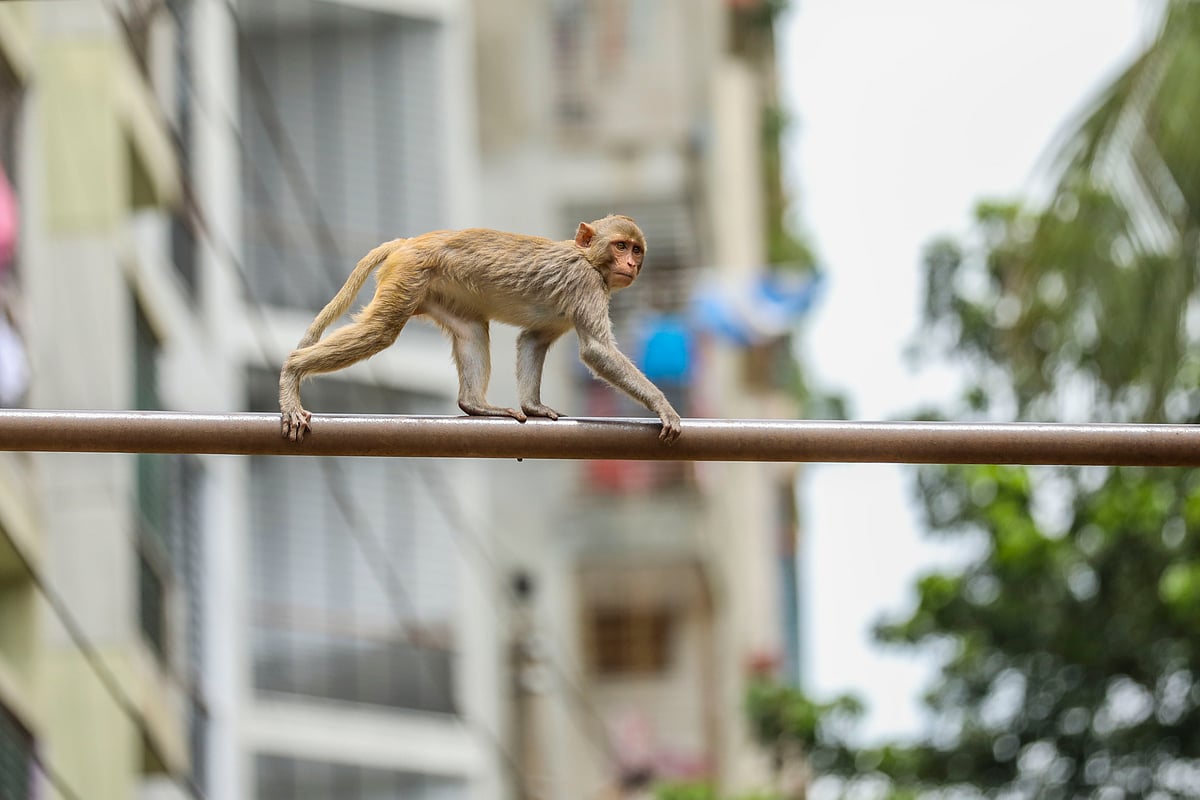
A rhesus macaque walks calmly through a lane in Gendaria, passing close to local residents. Scenes like this have been part of everyday life in the neighbourhood for generations, reflecting the long-standing coexistence of people and monkeys.Two juvenile macaques play beside barbed wire while balancing on a rooftop railing. The next generation is growing up amid the city's human settlements
Advertisement
A macaque travels from one building to another along an overhead power line. The tangled web of electrical cables has become part of its daily route through the city
Advertisement
During the 19th century, rhesus macaques roamed freely through the forests and woodlands of Dhaka. As the city expanded rapidly, however, deforestation and the growth of human settlements drastically reduced their natural habitat. In their struggle to survive, these intelligent animals gradually adapted to life in the urban environmentFour macaques sit on the ledge of a building, scanning their surroundings in search of food and a safe refugeClutching her infant tightly to her chest, a mother macaque makes her way along the boundary wall of a building. Despite the many hazards of urban life, she continues her daily struggle to protect and raise her youngA troop of rhesus macaques sits together on the roof of an old building. Amid human settlements, they have established an alternative habitat of their ownDifferent worlds, yet the same address. From above, a curious rhesus macaque watches a dog searching for food at the entrance to a building. In this urban landscape shaped by people, wildlife continues to adapt and survive alongside human communitiesA rhesus macaque carefully makes its way along a pipe, another example of its daily struggle to adapt to an increasingly urbanised environmentSustained by the food and affection offered by local residents, these rhesus macaques continue to survive in the narrow streets and alleyways of Old Dhaka