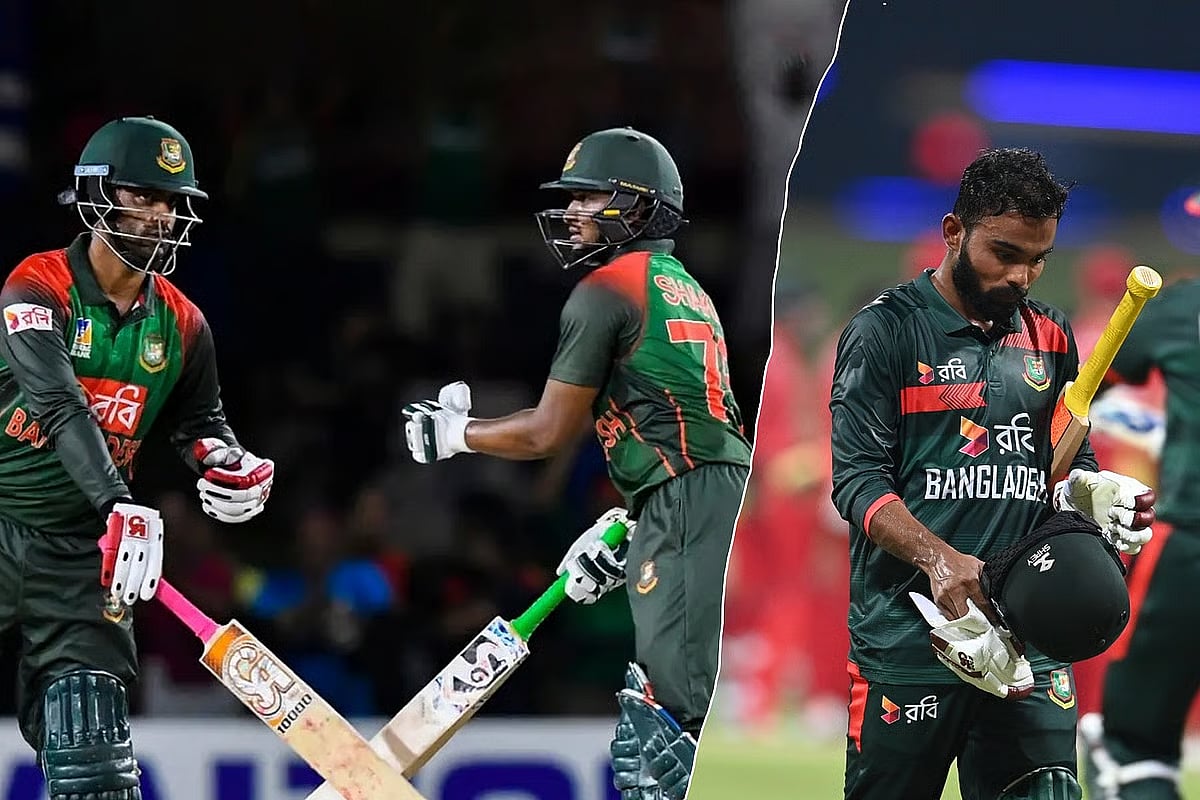
If life were a cricket match, it would probably resemble Test cricket more than any other format. A long journey spanning five days. Sometimes there is sunshine, sometimes clouds. Sometimes the batters dominate; at other times, the bowlers are in control. Good times come, and bad times follow. Sometimes, it feels as though everything is over. Then, just when all seems lost, a new story begins.
In a way, one-day international cricket is life, too. Only a little shorter. A miniature life spanning 50 overs. There is room to make mistakes, and there is a chance to correct them. With patience, a team can recover from a collapse. But there is one condition: it must survive.
Bangladesh’s ODI journey has been an exciting struggle to survive. There was a time when batting through 50 overs was an achievement in itself. The fragility of Bangladesh’s batting often seemed more frightening than the opposition’s bowling.
Then times changed. Shakib Al Hasan, Tamim Iqbal and Mushfiqur Rahim came along. Bangladesh cricket moved beyond its childhood and into adolescence. Batting through 50 overs was no longer a surprise.
But does time always move forward? Recent statistics on Bangladesh’s ODI batting raise that very question. A problem that had largely been overcome seems to be returning: the old habit of seeing innings crumble before the allotted overs are completed.
Of course, there is no rule that a team must bat for all 50 overs to succeed in an ODI. A side can be bowled out after 40 overs and still win. If its bowlers produce a brilliant performance, even a modest total may be enough. And when chasing, winning a match in 30 overs is certainly a success.
But the equation is different for a team batting first. It has the opportunity to use all 50 overs. If it repeatedly fails to make the most of that opportunity, questions inevitably arise about the depth of its batting, its patience and its ability to build an innings.
Bangladesh’s story, therefore, can be told through one statistic: how often it has been bowled out before completing 50 overs when batting first.
The fragile batting of Bangladesh’s early years
Think back to the early days of Bangladesh cricket. Scoring 200 runs in an ODI was a relief. Reaching 250 was practically a cause for celebration. As soon as the opposition bowlers applied a little pressure, the batting line-up would collapse. It was not unusual to see one batter depart, followed by two more in quick succession.
The numbers tell the same story. Between 2000 and 2010, Bangladesh batted first in 82 ODIs. It failed to complete 50 overs in 48 of them. In other words, its innings ended before the allotted overs were completed in 58.5 per cent of those matches.
Put simply, Bangladesh’s batting could not survive the full 50 overs in nearly six out of every 10 matches.
And what about wins?
Bangladesh won only two of those 48 matches—one against Zimbabwe and the other against Kenya. By contrast, it won 18 matches in which it batted through the full 50 overs. The connection between surviving until the end of an innings and winning was already quite evident.
Of course, batting for 50 overs does not guarantee victory. The total scored, the opposition and the nature of the pitch all matter. Even so, the statistics from that period made one thing clear: if Bangladesh wanted to win, it first had to learn how to survive.
Then the times changed
In cricket, as in life, a change of generation can sometimes mark the beginning of a new era. Shakib, Tamim and Mushfiqur became the faces of that transformation in Bangladesh’s batting. The team gained experience alongside them. It learned how to build an innings, when to attack and when to protect its wickets.
It is difficult to compare the Bangladesh team of 2000–2010 with the side that emerged in the following decade.
Between 2010 and 2020, Bangladesh batted first in 83 ODIs. It failed to complete 50 overs in 28 of them, a rate of 33.7 per cent.
The rate had fallen from 58.5 per cent in the previous decade to 33.7 per cent—a drop of 24.8 percentage points. That was a substantial improvement. A team that once failed to bat out 50 overs in nearly six out of every 10 matches had reduced that figure to about three in every 10.
What better statistical evidence could there be of greater stability in the batting?
Bangladesh also won nine matches during that decade despite failing to complete 50 overs. In matches in which it batted through the full 50 overs, it won 27. In other words, Bangladesh had not only learned to spend more time at the crease; it had also begun turning that resilience into victories.
What do the golden years tell us?
When recalling the most memorable periods in Bangladesh’s ODI history, the years following 2015 stand out.
Shakib was then a world-class all-rounder. Tamim was a dependable presence at the top of the order. Mushfiqur was a major pillar of the middle order. Experience and confidence went hand in hand.
Watching Bangladesh during that period inspired at least one belief: losing two early wickets did not mean everything was over. An innings could still be rebuilt.
But do the statistics from those years tell a different story from the decade as a whole?
Between 2015 and 2020, Bangladesh batted first in 40 ODIs. It failed to complete 50 overs in 13 of them, a rate of 32.5 per cent. The figure for the entire decade was 33.7 per cent. The difference was marginal.
In other words, the improvement in Bangladesh’s batting was not confined to a few years after 2015. It remained broadly consistent throughout the 2010–2020 decade.
This was not a case of Bangladesh producing a few years of good batting and temporarily concealing its old weakness. Rather, the team demonstrated a sustained ability to bat through 50 overs over the course of the decade.
So where has that consistency gone?
New symptoms of an old disease
Bangladesh cricket is no longer where it was in its infancy. Expectations of the team in ODIs have changed, too. The aim is no longer merely to put up a fight; winning matches is now the natural expectation. More is demanded of the generation represented by Najmul Hossain and Litton Das.
Yet the statistics suggest that the team may be moving in the opposite direction.
Since 2020, Bangladesh has batted first in 51 ODIs. It failed to complete 50 overs in 18 of them, a rate of 35.3 per cent.
That is not much higher than the previous decade’s 33.7 per cent—just a difference of 1.6 percentage points. On its own, this may not be cause for serious concern. Such fluctuations are normal in cricket. But the picture becomes less reassuring when the calculation starts in 2023.
Since then, Bangladesh has batted first in 34 ODIs. It failed to complete 50 overs in 14 of them, a rate of 41.2 per cent. That means its innings ended prematurely in more than four out of every 10 matches.
Think about that.
A team that spent more than a decade demonstrating its growing ability to bat through 50 overs now appears to be drifting back towards its old weakness.
Of the 14 matches since 2023 in which Bangladesh failed to complete 50 overs, it won four. In matches where it batted through the full 50 overs, it won eight. Once again, the importance of batting through the innings is apparent.
Are two decades of progress slipping away?
Placing the four sets of statistics side by side makes the evolution of Bangladesh’s ODI batting clearer.
They offer four distinct snapshots of the team’s history. The first reflects inexperience. The second tells a story of growing maturity. The third suggests that progress may have stalled. And the fourth points to the return of an old concern.
A note of caution is necessary, however. A rising rate of innings ending before 50 overs does not automatically mean that batting quality has declined by the same proportion. Sometimes wickets fall as a team tries to score quickly. At other times, the match situation forces batters to take risks.
The strength of the opposition and the nature of the pitch can also affect the figures.
Nor would it be right to deliver a definitive verdict on a long-term decline based on statistics covering only a few years. But the questions are legitimate—and they should be asked.
Are Bangladesh’s batters once again losing the patience required to build an innings? Even when they get off to a good start, are they struggling to turn it into a substantial total? Or has a weakness emerged somewhere in the batting order that repeatedly becomes exposed under pressure?
These statistics alone cannot provide definitive answers. But there is little doubt that the questions need to be investigated.
In 50-over cricket, a good start is not enough. A team must negotiate the middle overs and preserve its resources for the finish. Sometimes it must unleash a storm; at other times, it must weather one. Much like life itself.
Bangladesh cricket once learned these lessons rather well. That is why signs of regression are all the more troubling.
The question is no longer whether Bangladesh can bat for 50 overs. It is whether, after all these years, the team is beginning to forget what it learned.
Perhaps that is the greatest tragedy of a 50-over innings, much like life: finding your way, only to lose it again.