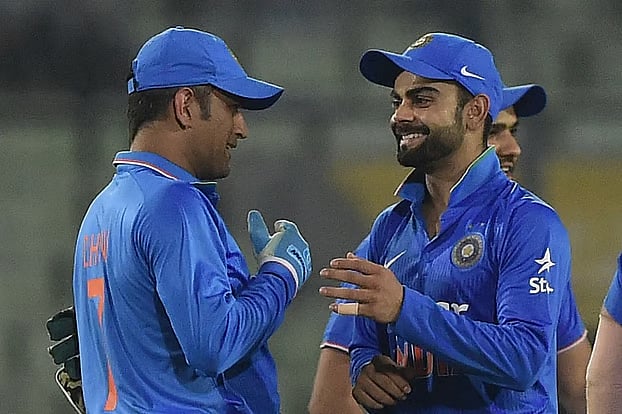
Kohli and Dhoni's secret dinner at a Dhaka hotel, witnessed by ex-Delhi police chief
A small room in a five-star hotel in Dhaka. A night in June 2015. Several Indian cricket team members are sitting close together on the bed and floor. In front of them is dinner, secretly brought in from outside the hotel. The hotel's rules state that outside food is not allowed. Inside the room, the rules are broken with abandon.
One person stands out among this crowd. He is the oldest member of the group, but not a cricketer. At that moment, he is holding a plate of food. But there was a time when he held files, and criminals sat in front of him. Neeraj Kumar. A 1976 batch officer of the Indian Police Service. After a 37-year police career, he retired as the Commissioner of Delhi Police.
Two incidents from Neeraj Kumar's thirteen months as Commissioner have lingered in the minds of Indians. The first is the Nirbhaya case. At that time, waves of protests swept the streets of Delhi. The Chief Minister was demanding his resignation. At India Gate, people were demanding his head. Within 10 days, he managed the storm by filing a charge sheet and completing the trial in record time.
The second was the 2013 IPL spot-fixing incident. Rajasthan Royals’ three cricketers Sreesanth, Ajit Chandila, and Ankeet Chavan were caught then.
In a three-month operation, 36 people were arrested. Phone conversations, television camera footage, everything was evidence. Delhi Police thought the case was a complete “open and shut” case. But two years later, the court acquitted everyone. The argument was that the laws in India on match and spot-fixing have a vast void.
Neeraj Kumar himself wrote, in the life of a police officer, one is recognised by their last big case. Even today, at social events, he is introduced as the “Nirbhaya Commissioner” or “the man who caught the IPL fixing". He has also authored three books: “Dial D for Don,” “Khaki Files,” and “A Cop in Cricket.” Today’s story, the one in the hotel in Dhaka, is in the book “A Cop in Cricket".
The call came in April 2015. On the other side was Anurag Thakur, the then secretary of BCCI. The proposal was to become the head of the Board’s Anti-Corruption Unit (ACU). Neeraj Kumar was then enjoying retirement.
Sleeping late in the morning, spending the whole day with books or movies, playing golf in the afternoon, basking in the sun in winter. For the first time in life, he was not accountable to anyone except his wife. The call was like a ‘jolt’ to him. He wanted to pass, saying he didn’t want to move from Delhi to Mumbai. But Anurag Thakur was persistent. He assured that the job could be done from Delhi. In the end, Neeraj Kumar agreed. He joined on 1 June. Later, he wrote that when he entered BCCI, he “knew nothing” about what was going to happen.
The head of an 85,000-member police force went to work with just two colleagues. Shortly afterward, the office space was taken away, without even the courtesy of being informed. That’s a story for another day.
Why was this man with the Indian team in Dhaka? A large part of the ACU head’s work is to be close to the players. To prevent bookies and fixers from entering the dressing room, confiscate mobile phones, and educate players to report immediately if anyone suspicious approaches. For Neeraj Kumar, the real place for this work was outside the field. The player who trusts him will be the first to speak up if trouble arises.
Within a week of joining BCCI, there was the Bangladesh tour. In his own words, it was an opportunity to learn the work hands-on. Traveling with the team meant gradually becoming part of the family. Staying at the same hotel, having breakfast together, going to the stadium on the same bus. And the hotel food? No one liked it.
During overseas tours, cricketers usually go out in the evening to eat at a nearby restaurant. Neeraj wrote in his book that for the Indian team in Dhaka, there was no ‘place to eat fully'.
The solution came from the stadium. A caterer of North Indian origin provided lunch. His cooking was somewhat palatable. Some enthusiastic members of the team persuaded him to also send dinner to the hotel. The trouble came with the hotel’s rules. Outside food was not allowed.
This operation was tasked to one person. The team’s massage therapist, who everyone called ‘Kaka'. His job was to fix people’s muscles, but he became the chief of secret food supply. The North Indian caterer would prepare dinner, and ‘Kaka’ would sneak it into the hotel. According to Neeraj Kumar, Kaka’s room became the ‘common dining area for the entire team'. When the food arrived, the players would call him too. “Sir, come".
He would also join. In the small room, cramped, many on the floor, everyone eating in such a way ‘as if they hadn’t eaten in weeks. ’ The stars of one of the world's busiest cricket teams sat on the floor with plates in their hands. On one side was Neeraj Kumar, who once made Delhi’s criminal world tremble. In his book, he wrote that the memory of that dinner will ‘always stay’ with him.
Toward the end of the book, he reminisces about that hotel in Dhaka. Many moments of seeing star cricketers up close over three years have collected in his mind. Whether it is the first or not, he mentioned the experience of ‘sharing smuggled food’ in Dhaka. During that tour, he also had a small joke with Virat Kohli. If one loses a bit of weight, Punjabis say ‘you’ve become weak'. So, Virat would greet him with, ‘Sir, you have become very weak!’
Throughout the pages of Neeraj Kumar’s book, there is darkness from the underworld of fixers, bookies, and powerful officials. He hasn’t hidden the wounds of BCCI. Yet, the brightest memory remains the floor of a hotel in Dhaka, and an ‘illegal’ dinner.
He has opened all the files of corruption. Only that night in Kaka’s room is in no file. The only witnesses to that ‘crime’ are the stomach and memory.